Hedge funds reach record leverage as Federal Reserve warns of spillover risk

Hedge-fund leverage has reached its highest level since records began in 2013, raising the prospect that forced position cuts could transmit stress to Bitcoin and other risk assets. The Federal Reserve warns that material losses or tighter funding could trigger spillovers, though current dealer surveys suggest financing conditions remain stable.
- Hedge-fund gross notional leverage hit a record in Q1 2026, the highest in the series starting in 2013.
- Large hedge funds’ gross Treasury exposures reached $4.0 trillion as of September 2025, more than double their 2023 level.
- The Treasury basis trade has expanded to $830 billion, accounting for 35 percent of hedge funds’ long Treasury holdings.
- $4.0T Large hedge funds’ gross Treasury exposures as of September 2025
- $3.0T Hedge funds’ repo cash borrowing as of September 2025, up sharply since 2023
- $830B Treasury basis trade position, double the previous peak in early 2020
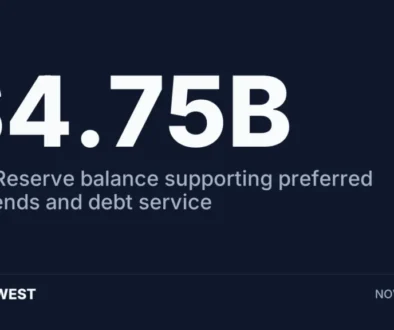
- 8.5% Share of total privately held Treasuries held by large hedge funds
Hedge-fund leverage has reached unprecedented levels, creating potential vulnerability to market stress that could ripple into digital assets. CryptoSlate reported on findings from the Federal Reserve’s November 13 Financial Stability Report, which documented record gross notional leverage across the hedge-fund industry in the first quarter of 2026. The concern for Bitcoin investors is straightforward: if losses or collateral demands force leveraged funds to cut positions across markets simultaneously, the resulting liquidations could spread to cryptocurrencies, which have shown correlation with equities during periods of market stress.
Treasury basis trade has doubled since the previous peak
The growth of hedge-fund leverage has been driven substantially by the resurgence of the Treasury cash-futures basis trade. According to the Federal Reserve’s June 2026 analysis of hedge-fund Treasury exposures, this strategy has expanded to approximately $830 billion as of September 2025, more than double its previous peak in early 2020 and representing 35 percent of hedge funds’ total long Treasury holdings. The basis trade pairs a short Treasury futures position with a repo-financed long Treasury position, creating high leverage because repo borrowing often carries minimal or zero haircuts and futures margins are low.
The Fed’s detailed breakdown shows that highly leveraged arbitrage strategies account for nearly half of the $2.4 trillion in long Treasury positions held by large hedge funds. Beyond the basis trade, swap spread arbitrage has grown to approximately $305 billion, though it experienced rapid unwinding of about $60 billion following tariff announcements in April 2025 before recovering within months. This demonstrates how quickly market conditions can force liquidations in interconnected leverage structures.
Hedge funds have doubled their gross Treasury exposures to $4.0 trillion since the beginning of 2023, with repo borrowing reaching $3.0 trillion to finance these positions.
Record leverage coincides with reduced Treasury basis-trade activity
While hedge-fund gross notional leverage reached its record in Q1 2026, the Federal Reserve’s November stability report describes reduced Treasury basis-trade activity alongside record or near-record leverage in equity, relative-value and macro strategies. This apparent divergence suggests that some funds may be shifting from basis trades into alternative arbitrage structures, such as swap-spread trades that combine Treasury and interest-rate-swap positions. Dallas Federal Reserve researchers argued on October 16, 2026 that modest basis-trade retrenchment could reflect changing relative returns and the appeal of competing strategies, rather than a broad retreat from leverage.
However, the reduction in basis-trade activity does not establish that overall financial stress has eased. The Federal Reserve warns that high leverage can generate spillovers after material losses or worsening funding conditions, and that volatility can constrain dealers’ ability and willingness to intermediate markets. A September 2026 dealer survey, conducted August 11-24 and covering June through August changes, found that client leverage, broad financing terms and market functioning remained basically unchanged on net, though some dealers reported wider equity collateral spreads. Two-thirds of the 15 dealers with at least a decade of hedge-fund business placed leverage above the midpoint of its past-decade range.
Bitcoin faces conditional transmission risk from broader deleveraging
Bitcoin’s exposure to hedge-fund deleveraging remains conditional rather than immediate. Research published by the International Monetary Fund in January 2022 documented stronger Bitcoin-equity co-movement and spillovers during 2020-21 than before the pandemic, with spillovers tending to intensify during market volatility. This historical evidence supports a transmission route for cross-market stress but does not establish today’s correlation or identify whether hedge funds currently hold material Bitcoin positions.
The November Federal Reserve report reflects information available by October 28, 2026, and does not capture recent market positioning.
The key monitoring signals are tighter collateral terms and simultaneous position reductions across markets. If funding conditions deteriorate and hedge funds face margin calls or worse collateral terms, they may be forced to cut positions rapidly, potentially spreading pressure to leveraged positions in Bitcoin and other risk assets. Orderly financing and stable terms would weaken the case for an active financing shock. The document does not identify which funds, if any, currently hold Bitcoin or how Bitcoin derivatives feature in their leverage calculations, leaving open the question of how directly Bitcoin would be affected by hedge-fund distress.
The BlockWest read. Large hedge funds now control 8.5 percent of privately held Treasuries and have concentrated Treasury market activity among the 50 largest funds, which account for 90 percent of gross exposures. This concentration amplifies the risk that stress in a subset of large funds could transmit across the system. Allocators and market participants should monitor both collateral conditions and evidence of active position reduction, not just the leverage level itself.
The next critical data point will be the dealer survey conducted in November 2026 and scheduled for release in December, which will show whether collateral spreads have widened further or whether funding conditions have tightened since August. If that survey reveals deteriorating financing terms or dealers reporting reduced client leverage, the case for near-term spillovers to Bitcoin would strengthen significantly.
BlockWest is a news publication. Nothing here is investment advice. Read our disclaimer and editorial policy.