LND developers patch bug that erased confirmed payments from node records
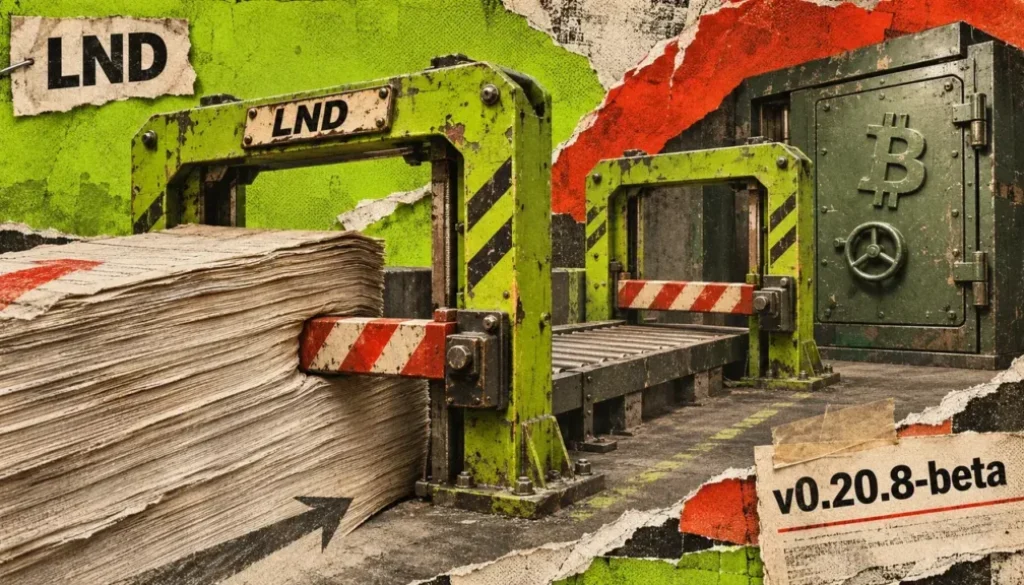
A critical bug in Bitcoin’s Lightning Network implementation could have silently erased confirmed payments from node records after a restart, undermining the channel accounting that secures off-chain transactions. Developers patched the flaw in widely used LND software this week, but the vulnerability highlights how even mature scaling layers require careful oversight to prevent fund loss.
- LND developers released patched versions v0.21.8-beta and v0.20.8-beta on November 11 to address the vulnerability.
- A 16-bit counter tracking acknowledged channel updates could overflow at 65,536 entries, resetting to zero while entries remained on disk.
- Upon restart, nodes could interpret the zero counter as an empty list and omit settled hashed timelock contracts from reconstructed channel state.
- 65,536 Maximum entries before the unsigned integer counter reset to zero
- 201 Stored updates generated in 200 rounds when a peer withheld revocation messages
- Nov. 11 Release date for patched versions addressing the counter overflow issue
- Nov. 5 Date the fix was merged into LND’s main development branch
CryptoSlate reported that Lightning Network developers have resolved a software vulnerability in LND, the most widely deployed implementation of Bitcoin’s payment channel protocol. The flaw involved how the software tracked and stored acknowledged updates between connected nodes, a function critical to ensuring both parties maintain identical records of settled payments. When nodes restart, they must reconstruct their channel state from stored data; this bug could cause that reconstruction to silently drop previously confirmed transactions, corrupting the balances each party believes they are owed. No confirmed exploitation or financial losses have been documented, but the vulnerability demonstrates a potential path to fund loss if exploited deliberately.
How a 16-bit counter overflow could erase settled payments
The root cause lay in how LND stored the count of acknowledged updates from a connected peer. According to LND maintainer Olaoluwa Osuntokun, known as Roasbeef, the software used a 16-bit unsigned integer to track this count, which can represent only values from zero to 65,535. Once the list of acknowledgments reached 65,536 entries, the counter wrapped back to zero, even though the software continued writing each new update to the node’s disk storage.
The danger emerged on restart. When a node restarted and attempted to reconstruct its channel state, it would read the wrapped counter as zero and interpret that as an empty acknowledgment list. The node would then omit the previously settled hashed timelock contracts (HTLCs), the conditional payment primitives that secure Lightning transactions, from its reconstructed commitment state. This gap between what the peer believes is settled and what the restarted node remembers could break the channel’s operational consistency.
A peer could deliberately push the counter toward overflow
The vulnerability became more actionable after developers identified a way for a malicious or malfunctioning peer to accelerate the counter’s growth. In the GitHub pull request discussion, LND collaborator ziggie1984 explained that a connected peer could send repeated transaction fee updates and commitment signatures while deliberately withholding the required revocation message that would normally clear the acknowledgment list. That behavior allowed pending acknowledgments to accumulate without being cleared.
The developer reproduced this condition in a unit test, generating 201 stored updates after just 200 rounds of message exchanges.
Critically, those accumulated entries persisted across reconnections, meaning that repeatedly disconnecting and reconnecting would not naturally prevent the list from eventually reaching the overflow threshold. A peer with patience and control over its connection timing could theoretically push the counter into dangerous territory over days or weeks of channel operation.
Patches now reject oversized logs and recover legacy data
Version 0.21.8-beta and 0.20.8-beta implement a two-part defense. First, the software now rejects any oversized update list before it can advance the channel state or be written to storage, preventing new overflow conditions from forming. Second, the updater code on startup validates existing records more carefully, allowing nodes running older software to recover complete, well-formed update lists saved to disk if the entry count and data pass validation checks. Malformed or incomplete trailing data is rejected.
The fix was merged into LND’s main development branch on November 5 before being released in both November patches.
The Lightning Network’s security depends on both channel participants maintaining bit-identical records of which payments have settled and what each party owes the other. Losing track of an acknowledged update threatens that consistency and could lead to disputes over channel closure, potentially allowing one party to claim a larger balance than the peer believes is correct. However, exploiting this would require sustained coordination with a victim channel peer, making it an unlikely vector for attacks against random nodes or casual users.
The BlockWest read. No matter how mature a scaling layer becomes, bugs in core accounting logic remain systemic risks rather than isolated incidents. This patch highlights why Lightning node operators benefit from staying current with releases and why protocol developers cannot assume that unsigned integer ranges, database formats, or recovery logic will never overflow or corrupt. The lack of observed exploitation suggests good operational security among node runners, not invulnerability to future variants of the same class of error.
Node operators using LND should upgrade to the patched versions to ensure channel restarts do not silently drop settled payments. The larger question is whether Lightning’s dependency on precise local state management will remain manageable as channel counts and lifetime durations grow; developers have not signaled a planned shift toward a different model for recording payment acknowledgments.
BlockWest is a news publication. Nothing here is investment advice. Read our disclaimer and editorial policy.