Britain’s grid operator forecasts 3.9 billion pounds in transmission costs for 2027
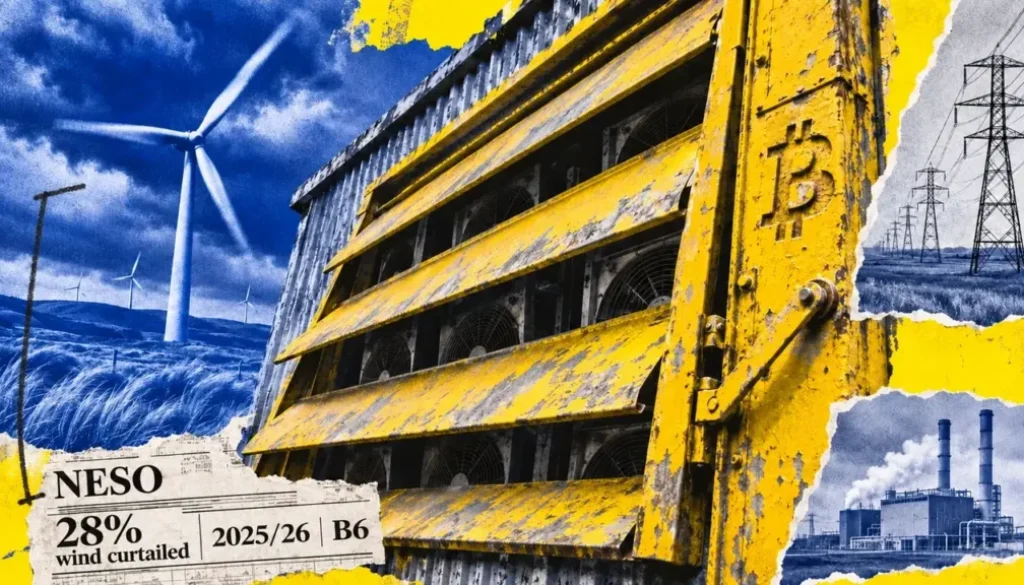
Britain’s grid operator has forecast £4 billion in transmission bottleneck costs for 2027, raising the question of whether Bitcoin miners could help absorb otherwise wasted Scottish wind. The economics depend heavily on where a mine connects and which specific costs it avoids, rather than on a simple windfall of free power.
- NESO forecasts £3.9 billion in thermal constraint costs for 2027, up from £3 billion in 2025/26.
- 28% of wind in Scotland’s northern area above transmission boundary B6 was curtailed in 2025/26, against 13% across Great Britain.
- About 75% of 2025/26 thermal constraint costs went to replacement energy, predominantly from gas units serving southern demand.
- £3.9B Forecast thermal constraint costs for 2027 versus £3 billion in 2025/26
- 28% Wind curtailment in northern Scotland versus 13% curtailment across Great Britain
- 75% Share of constraint costs spent on replacement energy versus grid stabilisation measures
- £500M Amount paid to wind farms to turn down in 2025/26 balancing cycle
CryptoSlate reported that the National Energy System Operator published its forecast on November 12 (Thursday), laying bare the mechanics of grid congestion and whether flexible Bitcoin mining could exploit the gap between Scottish generation and southern demand. The figure concerns thermal constraints, where transmission lines cannot safely carry all available electricity, forcing operators to pay generators to reduce output while sourcing replacement supply elsewhere. The forecast is sensitive to gas prices and network availability, and NESO estimates costs would be 16% lower without network outages, though those same outages also enable upgrades intended to ease future bottlenecks.
Why Scottish wind curtailment alone does not solve the grid problem
A flexible mine located in northern Scotland could theoretically reduce wind turn-down costs by consuming electricity that would otherwise be curtailed on the generation side of transmission boundary B6. However, this action does not by itself address the underlying constraint. While that boundary remains binding and southern demand remains unchanged, replacement supply is still necessary to serve consumers south of the bottleneck.
Reduced wind turn-down does not establish an equivalent reduction in gas generation, consumer bills or emissions.
The 2025/26 outturn illustrates the scale. NESO reported total balancing costs of about £3 billion for 2025/26, including roughly £2 billion for thermal constraints. A little under £500 million was paid to wind farms to turn down, while around 75% of the thermal constraint costs covered replacement energy, predominantly from gas units. For a mining operation to reduce total system costs rather than simply shift them, it would need to operate at the right location and time to eliminate the need for that replacement supply, a requirement that depends on specific grid conditions and dispatch rules.
Proposed mechanism for flexible demand registration in Scotland
NESO’s November thermal constraints report identified additional flexible demand in constrained areas as a mitigation, and the operator’s March 5 proposed Demand for Constraints design focused on Scottish boundaries. The design contemplated registration and dispatch through the Balancing Mechanism, NESO’s system for directing electricity supply and demand in real time, with routes for both new connections and existing assets.
The March design proposed service deliveries from 2028, after the year covered by the forecast, and did not establish a Bitcoin-specific approval or payment entitlement.
For a mine, a usable connection, service qualification and enough operating hours to cover costs would all matter. The Cambridge Centre for Alternative Finance’s mining survey documented that miners can adjust consumption, with respondents reporting curtailment of 888 GWh of electrical load during 2023, representing demand turned down. That capability differs from turning demand up at the right location and time to absorb surplus Scottish wind. The survey covered 49 firms representing 48% of Bitcoin’s network hashrate at collection, with activity concentrated in North America, and did not establish profitable intermittent mining in Britain. Electricity accounted for more than 80% of surveyed miners’ cash-based operating expenses.
What grid relief would actually require
The NESO 2027 forecast identifies the scale of the grid problem but does not price a mining solution. For consumers, the relevant comparison is the expense actually avoided after accounting for the costs the project adds. NESO’s test is overall system cost, not the savings from reduced wind curtailment alone.
No Bitcoin-specific approval, payment entitlement, gas saving or consumer benefit has been established.
The timing and location constraints are material. A flexible mine could reduce wind turn-down costs while replacement supply is still needed beyond the bottleneck, but only if it connects on the generation side of the relevant constraint, operates during hours when wind curtailment occurs, and qualifies for dispatch through the Balancing Mechanism. NESO notes that lower constraint costs do not automatically mean lower total consumer costs, because an action can add costs elsewhere in the electricity system.
The BlockWest read. The grid operator’s forecast quantifies a real cost to consumers, but the case for Bitcoin mining relies on miners finding a way to qualify for demand-flexibility markets that do not yet exist in final form, then operating profitably on electricity that would otherwise be wasted. Existing framework proposals do not carve out Bitcoin-specific privileges or guarantees, leaving any gain subject to the same system-wide cost test applied to other flexible demand.
NESO’s Demand for Constraints service design is expected to begin deliveries in 2028, providing the first opportunity to observe whether Bitcoin miners or other flexible loads actually register and operate under the framework, and whether they achieve measurable reductions in total system cost.
BlockWest is a news publication. Nothing here is investment advice. Read our disclaimer and editorial policy.