NVIDIA expands supply deals with six partners through mid-2029
NVIDIA announced expanded commitments Tuesday, November 17 with six supply chain partners to support long-term manufacturing of its accelerated computing platforms, securing substrate and advanced packaging capacity through mid-2029. The deals align production capability with sustained demand for AI infrastructure as the company begins volume shipments of new Vera processors.
- Kinsus to expand substrate capacity more than 3.5x, with production starting second half 2027
- Amkor agreements announced July and October totaling nearly $3 billion for Arizona and South Korea expansions
- SPIL expanding advanced packaging in Taiwan with multibillion-dollar NVIDIA funding by mid-2029
- NVIDIA Vera Rubin NVL72 and Vera CPUs began volume shipments in third quarter using TSMC 5nm and 3nm
- $3B Total Amkor agreements announced in July and October 2026
- 3.5x Kinsus substrate capacity expansion over current production levels
- 2.5x Aggregate substrate capacity increase over three years from October announcements
- 15x SPIL optical-engine capacity increase by mid-2027 from prior commitments
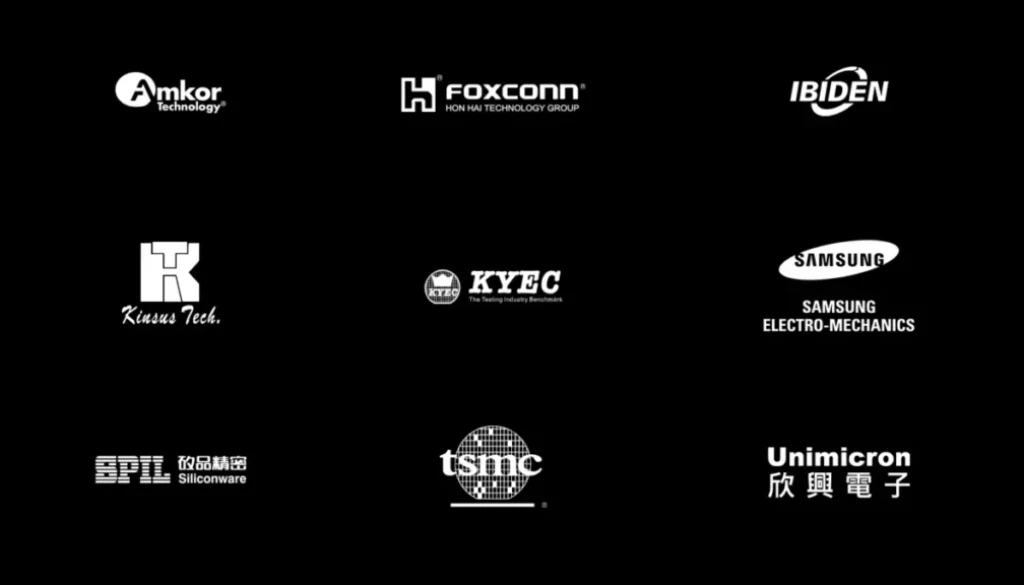
NVIDIA announced expanded commitments with supply chain partners on Tuesday to support manufacturing scale across substrates, advanced packaging and wafer production. The deals span Amkor Technology, Foxconn, Kinsus Interconnect Technology, Samsung Electro-Mechanics, Siliconware Precision Industries (SPIL) and TSMC.
Debora Shoquist, NVIDIA’s executive vice president of operations, said in the release that “our supply chain is a strategic advantage” and that the new partnerships expand capacity “across components, advanced packaging and system production to deliver the accelerated computing platforms our customers need.”
Kinsus and Samsung Electro-Mechanics secure substrate expansion deals
Kinsus plans to expand advanced ABF package substrate manufacturing capacity dedicated to NVIDIA by more than 3.5x over current levels from its Youth campus in Taoyuan, Taiwan. Production is expected to begin in the second half of 2027, with the additional capacity targeted for the third quarter of 2028. The agreement builds on more than a decade of partnership between the two companies.
Samsung Electro-Mechanics amended its existing substrate supply agreement to improve operational capabilities at factories in Sejong and Busan, South Korea, supporting increased production of NVIDIA’s accelerated computing platforms and high-speed networking technologies.
Amkor and SPIL secure packaging and testing expansions with multibillion commitments
NVIDIA is supporting Amkor’s expansion of advanced packaging capacity in Arizona and South Korea through multiyear agreements announced in July and October 2026, totaling nearly $3 billion. The agreements include prepayments to help Amkor scale manufacturing capacity for NVIDIA’s long-term production needs.
NVIDIA and SPIL are expanding advanced packaging operations in Taiwan under a multiyear agreement supported by multibillion-dollar funding from NVIDIA. The expansion will increase contracted advanced packaging capacity dedicated to NVIDIA by mid-2029 and includes new production lines spanning bumping, interposer wafer fabrication, assembly and testing.
NVIDIA is supporting Amkor’s expansion of advanced packaging capacity in Arizona and South Korea through multiyear agreements announced in July and October 2026, totaling nearly $3 billion.
NVIDIA newsroom
Vera processor volume shipments begin with TSMC node leadership
NVIDIA Vera Rubin NVL72 and Vera CPUs began volume shipments in the third quarter, leveraging TSMC’s 5nm, 3nm and CoWoS advanced packaging technologies. The release does not specify production volumes or revenue contribution from the new processors.
Foxconn is deepening collaboration with NVIDIA across next-generation GPU and networking platforms, drawing on its integrated global production network spanning Asia, North America and Europe to support volume ramps of new AI infrastructure.
The commitments build on agreements announced in October that included an aggregate 2.5x increase in substrate capacity over three years, expanded advanced packaging, a doubling of semiconductor testing capacity from 2026 to 2027, and a 15x increase in SPIL’s optical-engine capacity by mid-2027.
Securing supply amid demand uncertainty and geopolitical risk
The deals represent NVIDIA’s attempt to lock in manufacturing capacity ahead of potentially softer demand growth. By securing multiyear agreements with prepayments to partners like Amkor, NVIDIA commits capital now to avoid production bottlenecks later, shifting some demand risk to its suppliers. The geographic diversification across Taiwan, South Korea and the United States also reduces exposure to any single region’s export restrictions or supply disruptions, a priority given U.S. policy scrutiny of semiconductor exports to China.
The release does not disclose whether these commitments trigger minimum purchase obligations for NVIDIA or how they align with current demand signals. It also does not specify whether the expansions aim primarily to support current-generation product lines or are sized for products beyond Vera generation.
The BlockWest read. NVIDIA is prepaying for manufacturing capacity it may not fully absorb if AI infrastructure demand plateaus or shifts to competitors’ architectures. The $3 billion Amkor commitment and multibillion SPIL deal lock in supply but create balance-sheet drag and inventory risk if end-customer orders soften. These agreements prioritize supply security over capital flexibility, a rational trade at current growth rates but a material bet on sustained AI hyperscaler spending through 2029.
NVIDIA’s next quarterly earnings report will show whether these supply commitments are matched by order flow and revenue growth. The release does not name a date for NVIDIA’s next earnings call or guidance revision.
BlockWest is a news publication. Nothing here is investment advice. Read our disclaimer and editorial policy.