Nvidia sweeps MLPerf training with Vera Rubin platform debut
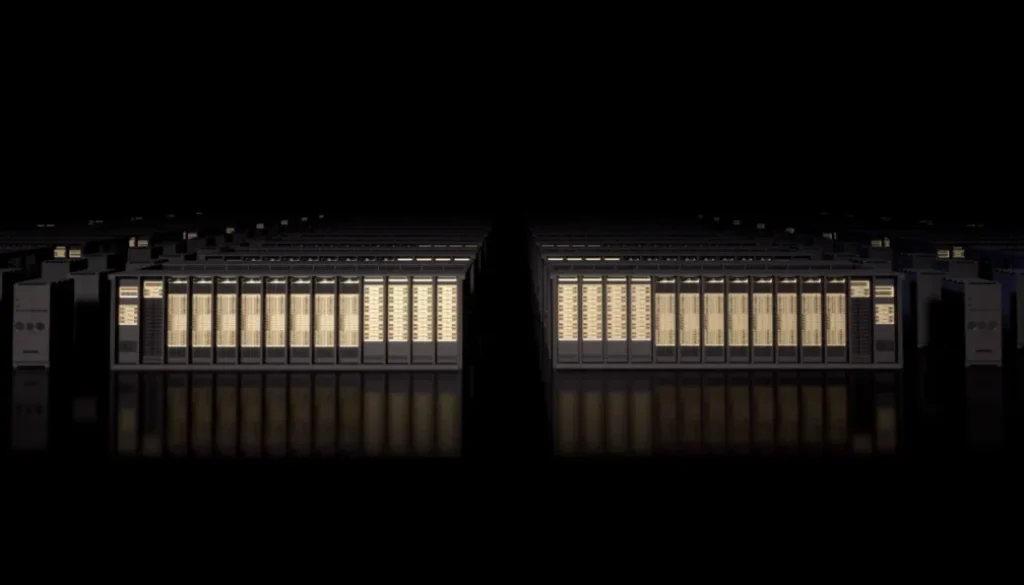
Nvidia said its Vera Rubin platform swept every benchmark in the MLPerf Training v6.1 round and led all categories in its first MLPerf Endpoints submission, according to results the company released Monday, November 16, 2026. The figures mark the first independent-style benchmark debut for Vera Rubin, the GPU platform Nvidia is positioning as the successor to its GB300 NVL72 systems.
- Vera Rubin NVL72 delivered up to 2x more performance per GPU than GB300 NVL72, per the release
- On a provisional Kimi K3 test, Vera Rubin NVL72 showed more than 10x the throughput per watt of GB300 NVL72
- Watch for MLCommons Association verification of the provisional Vera Rubin Endpoints results
- 2x Vera Rubin NVL72 performance per GPU vs. GB300 NVL72
- 97% scaling efficiency from 256 to 1,024 GPUs on DeepSeek-V3
- 10x throughput-per-watt gain on Kimi K3 vs. prior generation
- 20 partner organizations that submitted MLPerf Training results
Nvidia detailed the results in a post on its corporate blog, the release titled “NVIDIA Sweeps MLPerf Training and Endpoints as Vera Rubin Debuts With Leading Performance.” The company said Vera Rubin was “the only one with results on every benchmark this round, spanning large language models, image generation, recommender systems and reinforcement learning post-training,” a reference to the MLPerf Training v6.1 suite retrieved from MLCommons on November 16, 2026.
Scaling numbers tied to DeepSeek-V3 and a 10,240-GPU run
The release ties its scaling claim to a specific test: Vera Rubin NVL72 “scaled from 256 to 1,024 GPUs with about 97% efficiency: quadrupling the GPUs cut time to train from 16 minutes to about four,” on the DeepSeek-V3 benchmark. Nvidia also ran the same benchmark at 10,240 GPUs using GB300 systems, which it called the largest scale in this MLPerf round.
Microsoft Azure matched that scale using 10,240 Nvidia GPUs on GB200 systems, the release said. Nvidia attributed the scaling performance to its NVLink scale-up networking paired with Quantum-X800 InfiniBand and Spectrum-X Ethernet scale-out networking linking systems across a data center.
Agentic inference figures carry a verification caveat
For the MLPerf Endpoints submission, Nvidia published a provisional Kimi K3 result in which Vera Rubin NVL72, using 32 accelerators, posted system throughput of 41,414.2 tokens per second at an operating power of 100.89 kW, versus GB300 NVL72’s 2,210.4 tokens per second at 60 kW using 48 accelerators. The release said Vera Rubin NVL72 systems “deliver more than 10x the throughput per watt of NVIDIA GB300 NVL72 at the same response speed.”
The document itself flags a key distinction: the GB300 figures were “verified by MLCommons Association,” while the Vera Rubin figures are provisional, “pending MLCommons Association verification,” subject to change on peer review. The Kimi K3 results were published November 9, 2026.
Twenty submitters, no pricing or shipping date
Nvidia listed 20 organizations that submitted MLPerf Training results on its platform, including Azure, CoreWeave, Dell Technologies, Google Cloud, HPE, Lambda, Oracle, Supermicro and the University of Florida. The release frames this participation as evidence that Nvidia’s “programmable platform, with open source libraries and frameworks,” lets partners optimize training performance independently.
The release does not disclose pricing, shipping timelines or general availability dates for Vera Rubin hardware, nor does it give power or cost figures for a full-scale deployment beyond the 32- and 48-accelerator Kimi K3 comparison. It also does not specify how the independent SemiAnalysis AgentX and Artificial Analysis AgentPerf benchmarks it cites were configured or verified.
What the sweep means for buyers weighing GPU generations
For cloud providers and enterprise AI buyers, the throughput-per-watt figure matters more than raw speed because power, not chip supply, increasingly caps how many agents a data center can run. A 10x gain in tokens generated per watt, if it holds after MLCommons verification, would let operators serve more agentic workload per megawatt of installed capacity than the current GB300 generation allows.
The 97% scaling efficiency figure on DeepSeek-V3 also speaks to a narrower but consequential question for allocators sizing GPU clusters: whether adding more chips keeps paying off or hits diminishing returns. Nvidia’s own comparison point, the already “highly optimized” GB300 NVL72, sets a higher bar than most generational launches clear, which is why the company frames the 2x per-GPU gain as an early-stage result rather than a final figure.
Vera Rubin NVL72 systems deliver more than 10x the throughput per watt of NVIDIA GB300 NVL72 at the same response speed.
Nvidia, MLPerf Endpoints release
The BlockWest read. The provisional tag on Vera Rubin’s headline agentic-inference numbers is the detail buyers should weigh most. Nvidia is marketing verified-grade comparisons against its own prior chip while its newest numbers still await MLCommons sign-off, a gap that matters for anyone sizing power budgets around the 10x claim before it is confirmed.
MLCommons Association verification of the provisional Vera Rubin MLPerf Endpoints results is the next concrete checkpoint, alongside any follow-on submissions in future MLPerf rounds that would confirm whether the 2x per-GPU and 10x per-watt figures hold.
BlockWest is a news publication. Nothing here is investment advice. Read our disclaimer and editorial policy.