El Salvador’s Bukele administration acquired 1,540 Bitcoin without paying for them, according to the IMF
The IMF’s assessment of El Salvador’s Bitcoin holdings introduces a crucial distinction between government-funded purchases and private donations, creating ambiguity around President Bukele’s “one BTC per day” messaging. This matters to digital asset investors and policymakers tracking how sovereigns actually accumulate crypto reserves versus how they publicly describe those efforts.
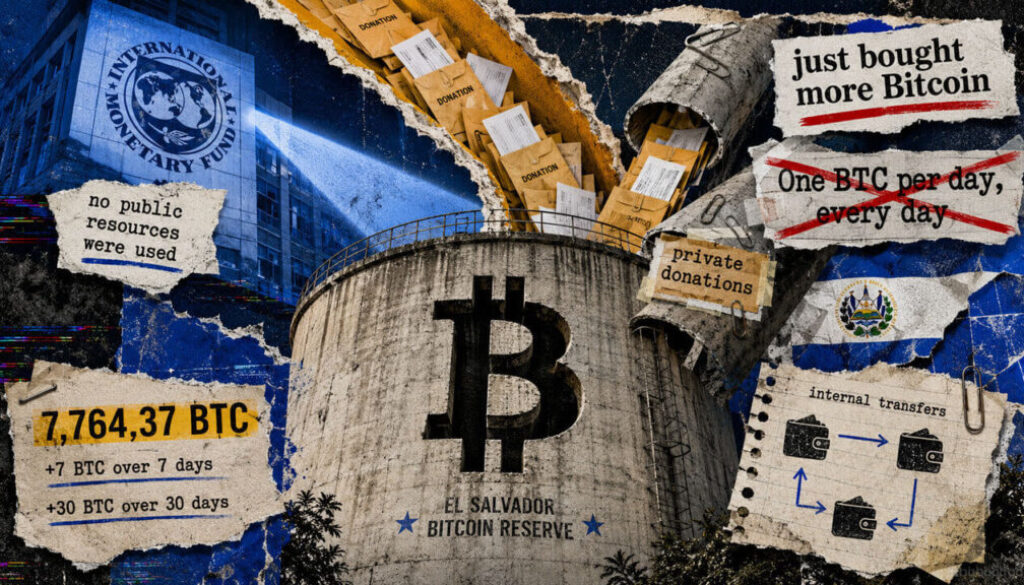
- El Salvador’s Bitcoin reserve grew by approximately 1,540 BTC to reach over 7,764 BTC as of late 2025, up from 6,224 BTC at end of June.
- The IMF stated that Bitcoin accumulated since its previous review reflected private donations with no public resources used, contradicting implied government purchases.
- El Salvador’s National Bitcoin Office claimed on August 28 the country had “just bought more Bitcoin” and repeated its “one BTC per day, every day” messaging despite IMF findings.
- 1,540 BTC Net increase in El Salvador’s reserve over the past year period.
- 7,764 BTC El Salvador’s current Bitcoin holdings as tracked by official reserve monitor.
- Aug. 28 Date when National Bitcoin Office claimed recent Bitcoin purchases occurred.
The International Monetary Fund has determined that the bulk of El Salvador’s Bitcoin reserve expansion over the past year did not come from taxpayer-funded government purchases, but rather from private sector donations. In its latest review of the country’s loan program, the IMF stated that documents provided by El Salvador demonstrated that accumulated Bitcoin since the previous assessment reflected private contributions, with no public funds deployed. The Fund also said it expected no further accumulation beyond those documented donations.
El Salvador’s embrace of Bitcoin as legal tender beginning in 2021 under President Nayib Bukele marked a historic policy divergence from traditional monetary frameworks. The country became the first sovereign nation to adopt Bitcoin as official currency alongside the US dollar, a move that drew both international curiosity and criticism from the IMF and World Bank. This unconventional approach to monetary policy created fresh scrutiny around how the government would manage and account for its digital asset reserves.
IMF clarifies how previous Bitcoin holdings were acquired
The IMF’s finding applies not only to the recent 1,540 BTC increase but also reframes how earlier portions of the reserve were built. In prior reviews, the agency noted that increases in El Salvador’s Strategic Bitcoin Reserve had reflected internal transfers between government-controlled wallets rather than new purchases. Small fluctuations elsewhere were tied to Bitcoin-denominated deposits held through the Chivo e-wallet platform.
The Fund also highlighted that El Salvador’s government had “substantially unwound” its stakes in the Chivo e-wallet, with majority ownership and operational control transferred to a private operator. The government retained only a minority stake and custodial responsibilities for customer assets under this arrangement. This shift reduced the state’s direct exposure to operational and regulatory risks associated with managing retail crypto holdings at scale.
Transparency around sovereign Bitcoin reserves has become increasingly important as more nations consider cryptocurrency strategies. Unlike traditional foreign exchange reserves held in bonds or currencies, Bitcoin holdings exist on a public ledger where independent auditors can verify balances by examining blockchain records. El Salvador has leveraged this transparency advantage by maintaining publicly accessible wallet addresses, though the blockchain does not automatically reveal the source or timing of individual transactions.
Government messaging conflicts with IMF assessment of funding sources
El Salvador’s public statements about Bitcoin accumulation sit in direct tension with the IMF’s findings. On August 28, the country’s National Bitcoin Office declared that the nation had “just bought more Bitcoin” and restated its signature commitment: “One BTC per day, every day.” President Nayib Bukele has maintained an active pro-Bitcoin stance, and the government continues expanding Bitcoin education programs while framing the asset as central to long-term economic strategy.
The language of active purchasing persists in official communications even as IMF documentation suggests recent reserve growth stems from donations rather than government expenditure.
Last year, El Salvador restructured its Bitcoin treasury by dispersing holdings across multiple addresses instead of using a single reused wallet. Officials attributed the change to digital asset security best practices and reducing theoretical exposure to quantum-computing threats. The new structure maintains public address visibility, allowing independent verification of reserve balances, but it does not differentiate between Bitcoin acquired with public funds, private donations, or transfers between government-controlled accounts.
The unresolved question of what “One BTC per day” actually means
El Salvador’s reserve has demonstrably grown by more than 1,500 BTC in the past year while government officials publicly promote daily Bitcoin acquisitions. The IMF’s verification, however, indicates that at least the portion of recent accumulation it examined did not require new public spending.
What remains unclear is whether the government’s repeated “one BTC per day” phrase describes the rate at which government-funded Bitcoin enters the reserve or simply the overall pace at which Bitcoin accumulates through all sources including private donations.
The distinction between reserve growth and purchasing activity reflects broader debates within cryptocurrency policy circles about how to measure and communicate digital asset accumulation. Private donations to a sovereign Bitcoin reserve represent a novel phenomenon without clear historical precedent in international finance. The IMF’s approach of documenting whether public funds were deployed offers one framework for accountability, but does not necessarily clarify the government’s forward-looking acquisition strategy or commitment levels.
The distinction between government-funded purchases and privately donated Bitcoin now sits at the center of disagreement between El Salvador and the IMF. The country’s continued public messaging about active Bitcoin buying, combined with the IMF’s documentation that recent reserve growth did not require public resources, leaves unresolved whether the government will provide granular accounting that separates taxpayer-funded acquisitions from private sector contributions in future IMF reviews. For cryptocurrency markets and emerging economies watching El Salvador’s experiment, clarity on these funding sources carries practical implications for evaluating the sustainability and fiscal responsibility of Bitcoin accumulation strategies.
BlockWest is a news publication. Nothing here is investment advice. Read our disclaimer and editorial policy.