Robinhood Chain encounters major outages and backlash from business sector while hitting peak growth phase
Robinhood Chain’s explosive growth has made network reliability critical just as corporate legal challenges to its Stock Token business intensify. A 14-minute service halt in early September exposed vulnerabilities at a moment when the platform’s revenue trajectory and holder base are expanding faster than comparable layer-2 competitors.
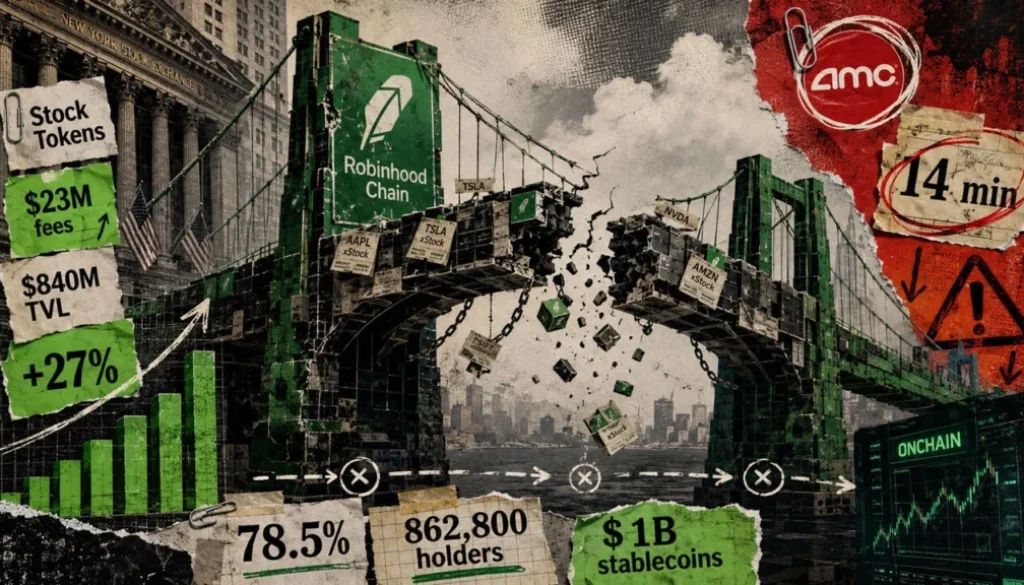
- Robinhood Chain generated approximately $23 million in cumulative fees, with roughly $4 million accrued in a single 24-hour period.
- The network accounted for 78.5% of layer-2 blockchain revenue over the past 30 days, far outpacing Ethereum and other competing layer-2s.
- AMC Entertainment and OpenAI have publicly rejected Stock Token offerings tracking their securities, setting up potential legal confrontation over unregistered financial instruments.
- $840M Total value locked on Robinhood Chain, up 27% over the past week
- 862,800 Robinhood Stock Token holders, narrowly exceeding Binance’s tokenized stock holder count
- $6.4B Decentralized exchange volume for tokenized stocks in 30 days, up 90% from prior period
- $1.7B Annualized revenue run rate extrapolated from current fee generation pace
Robinhood’s layer-2 blockchain network experienced a halt in block production lasting at least 14 minutes on September 4, disrupting transaction flow before operations resumed. The outage arrived roughly two months after the network’s public mainnet launch and occurred without Robinhood disclosing the underlying cause. The incident coincided with mounting corporate opposition to Robinhood’s Stock Token business, which enables the platform to issue debt securities tracking publicly traded companies without their consent or participation.
These tokens provide economic exposure to share prices but convey no legal ownership stake or claim against the referenced companies and operate outside U.S. securities law registration frameworks. The tokenized securities model emerged from regulatory arbitrage opportunities created by decentralized finance infrastructure, where blockchain-based instruments can circulate globally without traditional securities registration. This structure has attracted retail investors seeking fractional access to high-priced equities and institutional participants interested in 24/7 trading cycles outside traditional market hours.
Revenue generation reaches scale just as Outage tests reliability
Robinhood Chain’s financial metrics have accelerated dramatically since launch. According to Entropy Advisors analyst Tom Wan, the network generated approximately $23 million in cumulative fees, including roughly $4 million collected in a single 24-hour window. Token Terminal separately calculated that Robinhood Chain accounted for 78.5% of layer-2 blockchain revenue over the past 30 days, substantially outpacing competing Ethereum-based scaling solutions like Arbitrum and Optimism.
At current revenue velocity, annualized fees would reach roughly $1.7 billion, though this figure extrapolates from a concentrated period of elevated activity rather than representing a formal projection. The network’s total value locked climbed nearly 27% over the past week to approximately $840 million, with decentralized exchange activity accelerating as users migrate capital onto the platform. Beyond transaction fees, Robinhood is developing ancillary revenue streams, with Wan estimating roughly $1.7 million generated from the platform’s share of USDG economics at a 3% annual yield.
Crypto assets under management on Robinhood itself rose by approximately $4 billion, while Bitstamp holdings increased by roughly $600 million, suggesting growing institutional and retail participation across Robinhood’s ecosystem. The concentration of revenue on a single blockchain platform highlights both the opportunity and risk inherent in rapid scale without fully proven infrastructure maturity.
The September outage raised questions about whether Robinhood Chain’s technical architecture can support sustained growth without service interruptions. Layer-2 networks generally operate by bundling transactions and settling them periodically on Ethereum’s base layer, a design intended to reduce congestion and costs compared to mainnet processing. However, these systems introduce their own operational dependencies and failure modes that developers must carefully manage.
AMC and OpenAI publicly oppose tokenized Stock offerings
AMC Entertainment CEO Adam Aron discovered a Stock Token tracking his company’s shares on Robinhood Chain and publicly objected on September 4. In a social media post, Aron stated that the tokens “are not registered under U.S. securities laws” and characterized the practice as “contemptible, outrageous, disgusting, detestable, inexcusable, vile.” He called on Robinhood to cease trading AMC tokens and indicated that AMC’s legal team would explore whether they could compel Robinhood to halt the offering if the platform refused voluntarily.
We know a little something about the US securities laws and will not ‘DESIST.’ Send your lawyers and we’ll educate them.
Dan Gallagher, Robinhood Chief Legal Officer
Robinhood had previously encountered similar resistance from OpenAI, which stated that the instruments did not represent OpenAI equity, that no partnership existed with Robinhood, and that the company did not endorse the offering. These disputes expose unresolved legal questions about tokenized equity instruments and jurisdictional authority over securities that track corporate shares but operate outside traditional registration frameworks.
Securities regulators including the SEC have not yet issued comprehensive guidance addressing tokenized stocks that reference real-world companies without issuer participation or consent. This regulatory vacuum has enabled platforms like Robinhood to operate while companies seek injunctive relief through courts rather than administrative channels. The legal strategy adopted by Robinhood’s leadership suggests the company is prepared to contest corporate claims in litigation, potentially establishing precedent for derivative token instruments.
Stock token adoption accelerates despite corporate resistance
Despite corporate objections, Robinhood has become the largest Stock Token issuer by holder count within roughly two months of network launch. The platform reached approximately 862,800 holders, marginally exceeding Binance’s 827,200 holders in tokenized stocks. The broader tokenized-stock market has expanded more than eightfold over the past six months to roughly 2.6 million holders, indicating sustained investor demand for cryptocurrency-based access to traditional equity exposure independent of company endorsement.
Trading volume in tokenized stocks generated approximately $6.4 billion in decentralized exchange activity over the past 30 days, representing growth exceeding 90% from the prior comparable period. PancakeSwap and Uniswap accounted for roughly $3.1 billion and $2.5 billion of that volume respectively, giving the two exchanges dominant market share. This concentration of trading on established decentralized exchanges suggests that Stock Tokens benefit from existing liquidity infrastructure rather than requiring proprietary trading venues.
Stock Tokens now represent more than $200 million in active real-world assets on Robinhood Chain, while stablecoins on the network have approached $1 billion, indicating that the platform is transitioning from a single-purpose vehicle into broader onchain financial infrastructure. This diversification could reduce Robinhood Chain’s dependency on Stock Token economics if regulatory pressure forces token delisting, though it also requires sustained operational excellence across multiple asset classes.
The September 4 outage highlighted a growing operational risk: as Robinhood positions its chain as infrastructure for financial products with broader distribution than traditional markets offer, the network must maintain reliability standards acceptable to institutional participants and regulators. The combination of rapid revenue growth, corporate legal challenges, and infrastructure vulnerabilities creates a compressed timeline for Robinhood to demonstrate sustained operational maturity while defending its legal positioning against issuer objections.
BlockWest is a news publication. Nothing here is investment advice. Read our disclaimer and editorial policy.