Lambda deploys Nvidia photonics switches across 10000-GPU cluster
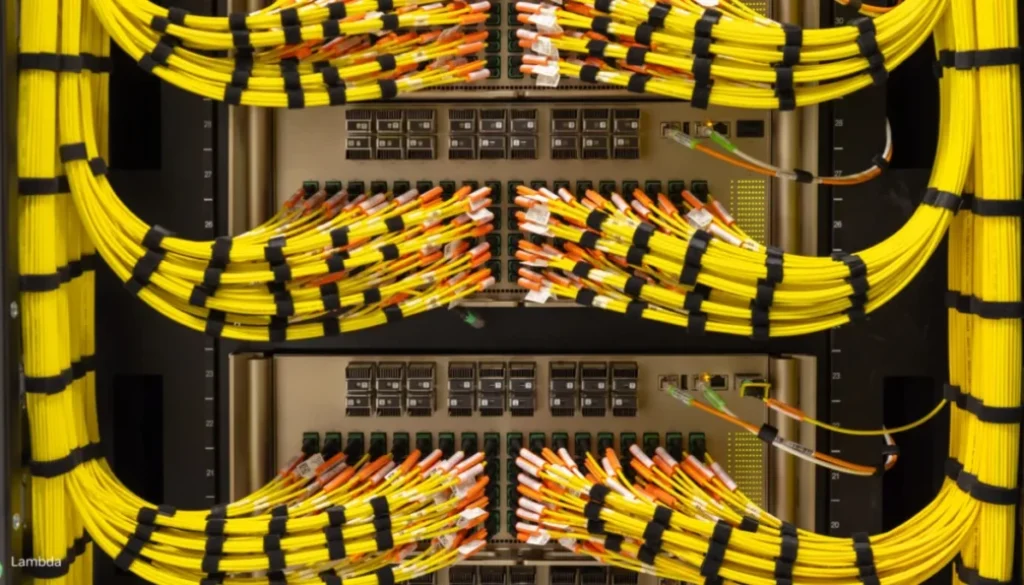
Lambda, a cloud services provider, has deployed NVIDIA Photonics co-packaged optics switches to connect more than 10,000 GPUs across NVIDIA GB300 NVL72 racks, according to an announcement in the NVIDIA newsroom Monday, Nov 16. The move addresses a critical bottleneck in AI factory operations: the networking infrastructure that must keep pace with accelerating compute demands while minimizing power consumption and interruptions.
- Lambda’s switches feature 144 ports running at 800Gb/s with liquid cooling
- Network latency dropped 4% at rack scale, up to 10% at pod scale
- Median optics temperature reached 36°C versus 51°C for conventional pluggable optics
- Each switch has 18 removable external light sources for field replacement
- 5x Better power efficiency versus conventional pluggable optics
- 15x Higher reliability versus conventional pluggable optics
- 4x Fewer lasers reduces failure points in optical system
- 36°C Median optics temperature, down from 51°C baseline
In the NVIDIA newsroom announcement, Lambda reports that NVIDIA Photonics switches “deliver lower power, higher resiliency and longer mean time between interruptions (MTBI) to an AI factory at scale.” The deployment targets a known constraint in large-scale AI training: network failures that can stall thousands of GPUs simultaneously, introducing both latency and unplanned downtime.
The technical approach centers on co-packaging optical components directly onto the switch silicon rather than using pluggable transceivers. This architecture shortens the electrical-to-optical conversion path from inches to millimeters, eliminating retimer chips and reducing both signal loss and power draw.
Operational resilience and field serviceability reshape network maintenance
Lambda’s deployment emphasizes a serviceability advantage absent from conventional pluggable optics. The switches include 18 removable external light sources per unit that technicians can replace in the field without swapping the entire optical module. This design directly addresses the cost and downtime associated with laser failures in production clusters.
The power efficiency gains carry direct implications for AI factory economics. Each watt consumed by networking reduces capacity available for GPU compute, the revenue-generating component in cloud AI services. NVIDIA Photonics achieves up to 5x better power efficiency through co-packaging and by using 4x fewer lasers, reducing both component count and thermal load.
Lambda reports a median optics temperature of 36°C using liquid cooling, compared with 51°C for conventional pluggable optics, translating to lower cooling costs and longer component lifespan in densely packed clusters.
Throughput maintained while latency and reliability improve
Lambda’s testing found that the switches maintain the same throughput as conventional pluggable optics across rack, scalable unit and pod configurations, while reducing network latency by approximately 4% at rack scale and up to approximately 10% at pod scale. The latency reduction reflects the shorter electrical paths and reduced signal retiming requirements of the co-packaged design.
Networking has to keep pace with the demands of increasingly large AI clusters. Bringing co-packaged optics into a deployment of this scale is an important step toward building the infrastructure needed to support the next generation of AI.
Dave Ward, president of cloud services at Lambda
The document does not specify the total cost of the deployment, the number of switches installed, the timeline for rollout, or whether Lambda plans further expansion of the photonics-based infrastructure.
The BlockWest read. Photonics switching moves from edge-case deployments to production use at scale, signaling that the architecture has reached operational maturity for hyperscalers. The serviceability model and power efficiency gains address two distinct pain points in AI cluster operations, reducing both operational expense and unplanned downtime. This validates the thesis that network architecture, not GPU density alone, now constrains AI factory productivity.
Watch for Lambda to disclose total deployment scale, power consumption measurements in production, and mean time between failures data under real-world training workloads. The next comparable disclosure point will come from other hyperscalers adopting similar photonics architectures or from NVIDIA’s earnings calls detailing photonics switch adoption rates.
BlockWest is a news publication. Nothing here is investment advice. Read our disclaimer and editorial policy.