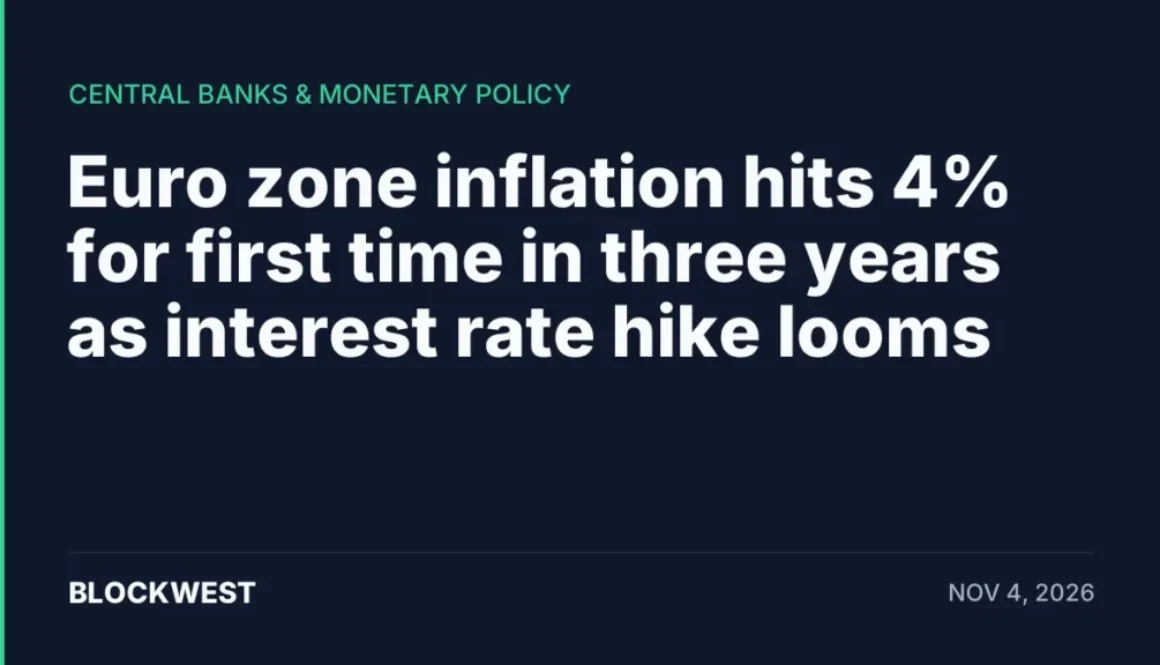
Euro zone inflation rises to 4% in October as energy costs surge
Euro zone inflation hit a three-year high of 4% in October, keeping an ECB rate hike in December more likely than not. The data matters for euro, bund and dollar positioning, and for investors weighing how French bond stress could limit the central bank’s response.
- Euro zone inflation hit 4% in October, up from 3.8% in September and in line with forecasts.
- Energy inflation rose to 20.8% from 18.9% in September, largely driving the October increase.
- The next test is December’s ECB meeting, where pricing shows more than a 72% odds of a hike.
- 4% October euro zone inflation, up from 3.8% in September
- 20.8% Energy inflation in October, compared with 18.9% in September
- 6.1% Lithuania’s rate, highest in the bloc, versus Malta’s 2.3% low
- 72% Priced chance of a December ECB hike, up from 71.8%
Euro zone inflation climbed to 4% in October, a three-year high, according to a flash estimate that CNBC reported on Wednesday (November 4). The reading matched the forecast of economists polled by Reuters and compared with 3.8% in September. It is the first print at or above 4% since September 2023, when the rate stood at 4.3%.
Energy inflation reaches 20.8% as Iran war lifts prices
Officials said the increase was largely due to surging energy costs. Energy inflation rose to 20.8% in October from 18.9% in September, a 1.9-point jump against 0.2 points for the headline rate. Europe, a net energy importer, is exposed to external shocks and has seen prices climb steadily since the Iran war began.
Inflation also varied across the 21 euro zone economies, with all staying above the European Central Bank’s 2% target.
Lithuania recorded the hottest rate at 6.1%, while Malta’s 2.3% was the lowest. That is a gap of 3.8 percentage points, and even Malta sits 0.3 points above target.
ECB held at 2.5% in October, and a December hike is priced above 72%
The ECB kept its key interest rate at 2.5% last month, following a 25 basis point hike in September. Policymakers said underlying inflation and wages were broadly stable despite the three-year high.
Shortly before the release, pricing implied a 71.8% chance of a hike at the ECB’s final meeting of the year in December. After the data, pricing showed more than a 72% chance of higher rates. The shift was marginal because the reading matched economists’ forecasts.
The euro was up 0.6% against the U.S. dollar on Wednesday morning. The greenback also fell against a basket of major currencies as counting continued in the U.S. midterm elections. The yield on the 10-year German bund, broadly seen as the benchmark for euro zone bonds, was marginally higher.
French bond turmoil is the constraint Validus Risk flags ahead of December
Robert Mertens, global capital markets senior analyst at Validus Risk Management, cautioned that “ongoing turmoil in the French bond market is placing constraints on ECB policy” and on the bank’s capacity to get inflation under control. He tied the pace of tightening to the political backdrop in France.
Should we see an easing in French political unrest, the ECB could potentially pursue a more aggressive hiking path.
Robert Mertens, global capital markets senior analyst at Validus Risk Management
Mertens also linked the outlook to the currency. “If the ECB can deploy more aggressive tightening relative to the Federal Reserve, we would see increased Euro support and upside versus the Dollar,” he said.
Mertens is the only analyst quoted in the reporting. The ECB’s own officials, the Federal Reserve and the French government are not represented beyond the policymakers’ assessment that underlying inflation and wages are stable.
The BlockWest read. We read the data as a funding story more than an inflation surprise. With a December hike already priced above 72%, the print changed little, so the euro’s 0.6% gain looks tied to dollar weakness during the U.S. count. For holders of French debt, the ECB’s hiking path and French political stress are linked risks, not separate ones.
The next test is the ECB’s final meeting of the year in December, where pricing shows a hike is more likely than not. Whether French political unrest eases before then is the open question Mertens ties to a faster tightening path. Counting in the U.S. midterms was still under way on Wednesday, leaving the dollar side of his euro call unresolved.