Sakana AI’s Sawara model ties sovereign AI to Japan’s industrial base

Tokyo-based Sakana AI is building its own foundation model, Sawara, and co-founder and CEO David Ha says the project is about more than Japan’s national security. His long-term aim is to give Japan’s industrial and manufacturing companies AI they can audit, customize and run on their own premises.
- Sakana began work on Sawara in November and plans a smaller model in early 2027, followed by a larger one.
- The company holds a Ministry of Defense research contract signed in July and has built disinformation-detection systems with the Ministry of Internal Affairs and Communications.
- Ha said there are no near-term plans for an IPO, after Nikkei and Bloomberg reported a listing could come as early as next year.
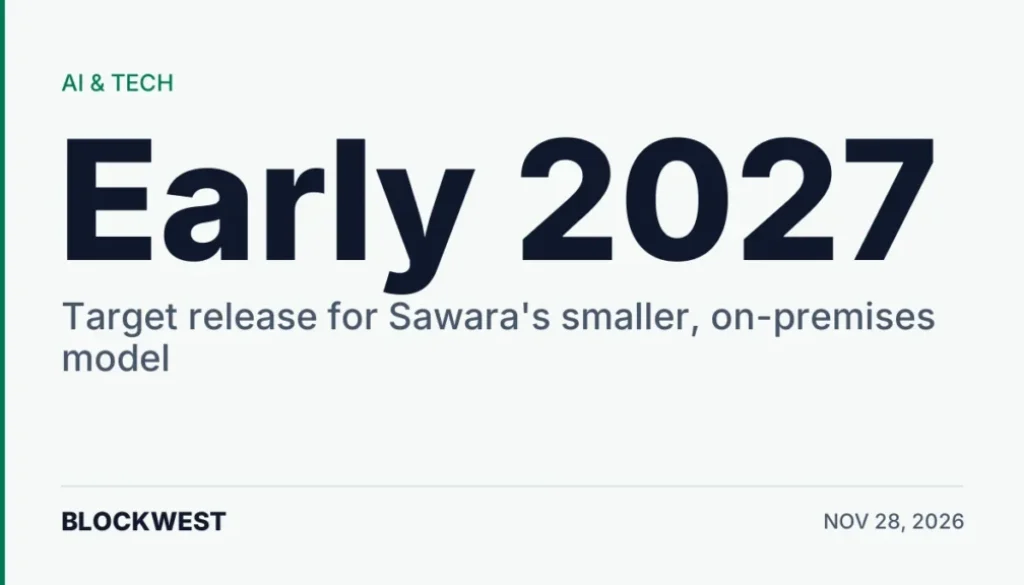
- Early 2027 Target release for Sawara’s smaller, on-premises model
- July 2026 Ministry of Defense research contract signed
- 3 Product layers: Fugu orchestration, Namazu Japanese-tuned models, Sawara pre-training
From orchestration to full stack
Ha laid out the plan in an interview with TechCrunch. Sakana announced Sawara in October. Until now it has built on top of other companies’ models.
Its Fugu system, launched about five months ago, combines large language models, including OpenAI’s, to assemble AI agents for specific tasks. Namazu fine-tunes open-weight models from Meta and DeepSeek for Japanese language, culture and business use, including translation, political questions and agent tasks.
Ha argues open-weight models cannot be used as-is inside Japanese enterprises, because they tend to reflect their creators’ biases and may refuse or distort questions about Japan. Pre-training its own model is, in his words, the missing piece for Sakana to become a full-stack company.
Government work shaped the design
Sakana’s public-sector work has centered on two areas: detecting and analyzing disinformation, and multimodal systems that pull together data from different government sources. Under the July contract, it is studying how AI could analyze and integrate information from multiple sources for the Ministry of Defense.
Those buyers typically require auditable training data, customizable models and on-premises deployment, and Ha said those requirements shaped Sawara. The smaller model is aimed squarely at on-premises use, which he says Japan needs. Ha expects Japan to keep using U.S. systems, naming Palantir, Snowflake and Datadog as companies he respects, while building domestic alternatives for defense.
The industrial bet
Security is the near-term need. The long-term vision is Japanese manufacturing. Sakana is tying its growth to the global expansion of Japanese manufacturers, positioning itself less as a model vendor and more as a partner helping local companies use AI to compete abroad. Enterprise customers can use Fugu, Namazu or overseas models alongside Sawara.
On a listing, Ha called the reported timing and valuation speculative and said he does not know when it would happen, though he expects Sakana to eventually go public in Japan.
The BlockWest read. Sovereign AI is moving from policy slogan to procurement requirement. Buyers that need auditable data and on-premises models cannot rely only on U.S. frontier labs, and that opens room for national champions like Sakana. The test is whether an industrial customer base can fund pre-training at a competitive scale, which is the question any eventual IPO would have to answer.
What to watch: the early 2027 release of the smaller Sawara model, the first named enterprise or manufacturing customers, and any IPO filing in Japan.
BlockWest is a news publication. Nothing here is investment advice. Read our disclaimer and editorial policy.