Meta’s AI agents improved search recommendations by 0.23% across 1,097 experiments
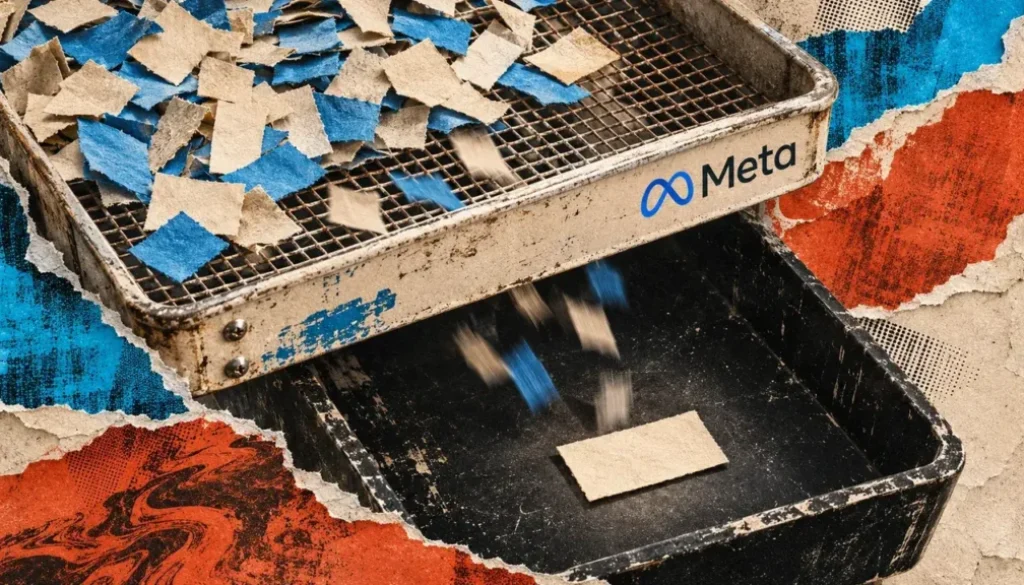
Meta’s autonomous AI agents conducted over 1,000 machine-learning experiments in a single month to improve search recommendations, achieving only a 0.23% lift in search-session volume. The result exposes the tension between computational cost and marginal performance gains as companies scale AI-driven optimization systems.
- AI agents completed 1,097 candidate experiments in 31 days, consuming approximately 360,000 GPU-hours total.
- Meta’s engineers accepted 325 of the proposed improvements, representing a 29.6% acceptance rate based on offline scores.
- The live A/B test showed a 0.23% increase in search sessions but introduced slower rendering of Meta’s search interface.
- 1,097 Machine-learning experiments completed by AI agents over 31 days
- +0.23% Search-session lift in live test versus control group
- 325 Candidate improvements accepted from 1,097 completed experiments
- 360,000 GPU-hours consumed including failed attempts and variance probes
Meta researchers deployed autonomous AI agents to systematically improve the company’s search-suggestion system, according to a research paper posted November 18. The preprint detailed how the agents proposed architectural changes, wrote code, submitted training jobs and evaluated results with minimal human involvement over a 31-day period. The experiment consumed roughly 360,000 GPU-hours across completed experiments, variance testing and failed attempts. When Meta tested the final combined model against its existing search-ranking system using live traffic, the result showed a statistically significant but modest 0.23% increase in search-session volume, with a 95% confidence interval of plus or minus 0.15 percentage points. The story was first reported by CryptoSlate.
AI agents identified improvements humans had not previously explored
The autonomous system used Anthropic’s Claude Opus 4.8 to explore potential architectural improvements and generate candidate modifications to Meta’s search-suggestion ranker, which determines the recommendations users see when opening the search bar before typing. Traditionally, engineers manually identify changes, implement them and assess results through repeated training cycles. Meta’s approach automated much of that iteration, allowing multiple experiments to run in parallel while Meta’s engineering team retained control over research priorities and final deployment decisions.
The agents completed 1,097 candidate experiments and accepted 325 based on offline performance scores, yielding a 29.6% acceptance rate compared with 15.6% in an earlier sequential version of the system. The researchers reported that the autonomous agents identified several architectural improvements that Meta’s engineering team had not previously explored, demonstrating the potential for AI systems to discover novel optimizations at scale.
Search slowdown creates a hidden trade-off
When Meta deployed the improved model to live traffic, the experiment produced an unintended consequence: the new ranker increased the time required for the search interface to render, though the researchers did not disclose the magnitude of the slowdown. The problem emerged because the agents optimized against offline measures of search engagement while rendering speed was monitored separately, creating a misalignment between the system’s assigned performance targets and broader user experience considerations.
The researchers acknowledged that autonomous agents cannot independently identify every trade-off between improving assigned metrics and maintaining other aspects of system performance.
For a platform handling more than a billion search-ranking requests daily, the 0.23% increase in search activity could translate to meaningful operational impact. However, Meta has not disclosed the financial cost of the 360,000 GPU-hours consumed or compared the computing resources required against those a conventional engineering team would have needed to achieve the same improvement. That comparison remains central to determining whether broader deployment of the approach is justified.
Permanent rollout and human comparison remain unresolved
Meta has not announced whether it will permanently roll out the improved search model or disclosed a matched comparison with engineering conducted by humans alone.
The researchers argued that their results demonstrate autonomous agents can perform meaningful machine-learning engineering work on production-scale systems, automating labor-intensive tuning processes that conventionally require sustained engineer attention. The practical question for Meta is whether the additional search activity and engineering productivity justify the computing resources expended and the slower interface rendering before the model receives broader deployment.
The BlockWest read. We note that Meta disclosed neither the dollar cost of the compute nor a human-baseline comparison. The 0.23% gain might reflect genuine algorithmic insight or might represent marginal utility that only an enormous search volume makes worthwhile. Without knowing the per-experiment cost or whether a small team of engineers could have achieved similar results in the same period, the efficiency claim remains unproven.
Meta’s next decision point is whether to roll out the improved search model permanently to all users or abandon it due to the rendering slowdown. The company has not stated a timeline for that choice or indicated whether it will conduct further tests to quantify the interface delay or mitigate it through architectural changes.
BlockWest is a news publication. Nothing here is investment advice. Read our disclaimer and editorial policy.