Metaplanet Executive Pay Plan Swells from 46 Million to 319 Million Shares as Bitcoin Surges
Metaplanet’s aggressive Bitcoin acquisition strategy has inadvertently created a massive executive compensation windfall that threatens the company’s key per-share metrics and has ignited shareholder demands for reversal. The dispute highlights how equity issuance formulas designed before a strategic pivot can produce unintended consequences that pit management interests against broader shareholder value.
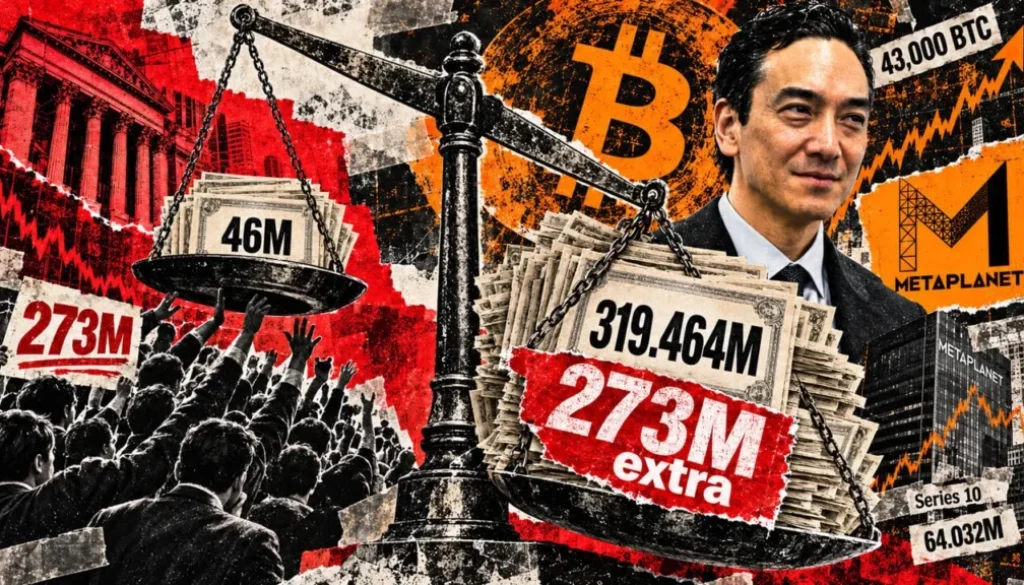
- Metaplanet’s Series 10 executive options pool expanded from 46 million to 319.464 million shares due to an adjustment mechanism tied to capital raises for Bitcoin purchases.
- CEO Simon Gerovich exercised 92,000 rights on August 28, 2026, receiving 64.032 million newly issued shares at a ¥10 exercise price while the market valued them at roughly ¥15.6 billion.
- Shareholders are demanding cancellation of approximately 273 million potential shares added above the original pool size, arguing the mechanism amplified dilution during the company’s Bitcoin fundraising.
- 43,000 BTC Metaplanet’s total Bitcoin treasury holdings as of June 30, 2026
- 1.28B shares Issued shares outstanding by end of June 2026, up from 153.9 million
- 2,635 satoshis Bitcoin per fully diluted share including current compensation pool dilution
- 3,166 satoshis Bitcoin per share if 273 million excess options were cancelled
Metaplanet’s pivot to a Bitcoin treasury strategy under CEO Simon Gerovich beginning in April 2024 has created an unintended governance crisis that now threatens to overshadow the company’s digital asset accumulation. The Tokyo-listed firm’s repeated equity issuances to fund Bitcoin purchases activated an automatic expansion clause within its Series 10 stock acquisition rights, a compensation plan that shareholders had originally approved in early 2023 for 46 million shares. As the company’s issued share count exploded from roughly 153.9 million to 1.28 billion by late June 2026, the adjustment mechanism designed to maintain the executive pool at approximately 20% of fully diluted shares ballooned the compensation award to 319.464 million potential shares.
The expansion mechanism reflects a common corporate governance pattern in which antidilution provisions intended to protect employee compensation from ordinary capital activities can produce outsized effects during periods of rapid equity issuance. When a company’s share count multiplies due to strategic fundraising, a formula that preserves a fixed percentage of fully diluted shares can dramatically increase the absolute number of options outstanding, even when the original intent was to maintain reasonable incentive levels. Metaplanet’s case exemplifies this dynamic: the company eliminated the adjustment mechanism on August 18, 2026, acknowledging in internal notices that the formula “amplifies the dilution borne by existing shareholders” and risked creating misaligned incentives between capital-raising decisions and management compensation interests.
Gerovich’s immediate exercise triggers Shareholder backlash
The governance dispute intensified sharply when CEO Gerovich exercised a portion of his compensation just days after the August mechanism shutdown. On August 28, 2026, Gerovich converted 92,000 Series 10 rights into 64.032 million newly issued shares at the historical exercise price of ¥10 per share, a transaction that cost him approximately ¥640.3 million in total. The timing of his exercise created substantial paper gains, as those same shares carried a market value of roughly ¥15.6 billion at Metaplanet’s then-current share price of ¥244, producing an unrealized spread of nearly ¥15 billion.
The transaction increased Gerovich’s direct shareholdings from 15.56 million to nearly 79.6 million shares.
Shares issued through the plan became subject to a five-year lockup beginning August 2026, restricting sales or transfers until August 2031, though the economic dilution to existing shareholders occurred immediately upon issuance. The restriction on share sales does not affect voting rights or dividend entitlements, allowing Gerovich to benefit from share appreciation and shareholder distributions during the lockup period. As of June 30, Gerovich held 276,000 of the 459,000 outstanding Series 10 rights, leaving him with approximately 184,000 rights remaining after his August exercise, with additional portions scheduled to vest through 2028. Other executives and employees hold the remainder of the rights pool.
The 273 million share question and bitcoin-per-share metrics
Shareholders have coalesced around a central demand: the outright cancellation of roughly 273 million potential shares that were generated above the original 46 million authorization during the expansion period. The dilution dispute carries particular weight because Metaplanet’s investment thesis depends heavily on Bitcoin per fully diluted share, a key metric for investors evaluating the company’s treasury performance and comparing it to competitors pursuing similar digital asset strategies. As of June 30, 2026, Metaplanet’s 43,000 BTC divided by 1.63 billion fully diluted shares produced a ratio of approximately 2,635 satoshis per share, a denominator inflated by the contested Series 10 awards.
Removing the contested 273 million shares from the calculation would raise Bitcoin per share to roughly 3,166 satoshis, approximately 20% higher than current figures. This potential improvement demonstrates why the dispute resonates with long-term shareholders focused on per-share value accumulation. Shareholder Ragnar has led the public push for cancellation, noting that Metaplanet itself acknowledged the mechanism’s harmful effects. He has argued on X that the only viable resolution is a full rollback of the excess shares paired with a replacement incentive program retroactively applied to eliminate compensation benefits accumulated under the abandoned formula. Ragnar has also highlighted that the company’s international offering generated another 96.25 million potential shares through the same adjustment clause, extending the scope of shareholder concerns beyond domestic capital raises.
The replacement compensation Metaplanet proposes carries no performance conditions tied to Bitcoin-per-share growth or other shareholder value metrics.
Metaplanet’s limited response and unresolved Governance tensions
Metaplanet has announced a partial approach to managing the controversy without addressing the central shareholder demand. The company has frozen the Series 10 expansion mechanism as of August 18, capping future dilution from capital raises, yet management has not committed to rolling back or cancelling the 273 million shares already created. The frozen mechanism approach appeals to management because it acknowledges shareholder concerns while preserving executive compensation already awarded or vested.
Instead, Metaplanet has proposed redirecting up to 90,000 remaining Series 10 rights representing 62.64 million potential shares into a new long-term incentive vehicle that could incorporate performance and service conditions without exceeding the existing compensation ceiling. CEO Gerovich has acknowledged shortcomings in the company’s governance communication and stated that Metaplanet continues reviewing its compensation structure and disclosure practices. Beyond the options dispute, investors have pressed for greater transparency regarding MMXX Ventures, a recurring Metaplanet shareholder and former lender that continues to maintain economic relationships with the company.
Gerovich has disclosed that he is a “significant but non-majority shareholder” of MMXX’s parent company and does not participate in the entity’s investment decisions, yet investors continue seeking fuller details about ownership structures and Gerovich’s broader economic exposure to MMXX transactions involving Metaplanet. Such conflicts of interest concerns are particularly acute when company leadership has the power to authorize capital raises that benefit related parties or when related-party transactions involve substantial sums.
Metaplanet has not stated whether it will formally cancel the contested 273 million potential shares or hold them at their expanded level, leaving the company’s most contentious governance issue unresolved heading into what investors expect to be further shareholder engagement on compensation reform and MMXX’s role in Metaplanet’s capital structure.
BlockWest is a news publication. Nothing here is investment advice. Read our disclaimer and editorial policy.