Bitcoin records more extreme price swings than 2018 despite lower overall volatility
Bitcoin’s annualized volatility has fallen to 46% from 84% in 2018, yet the cryptocurrency is experiencing extreme price swings more frequently than it did during that bear market. This divergence creates a hidden risk for investors relying on standard volatility models to size their positions.
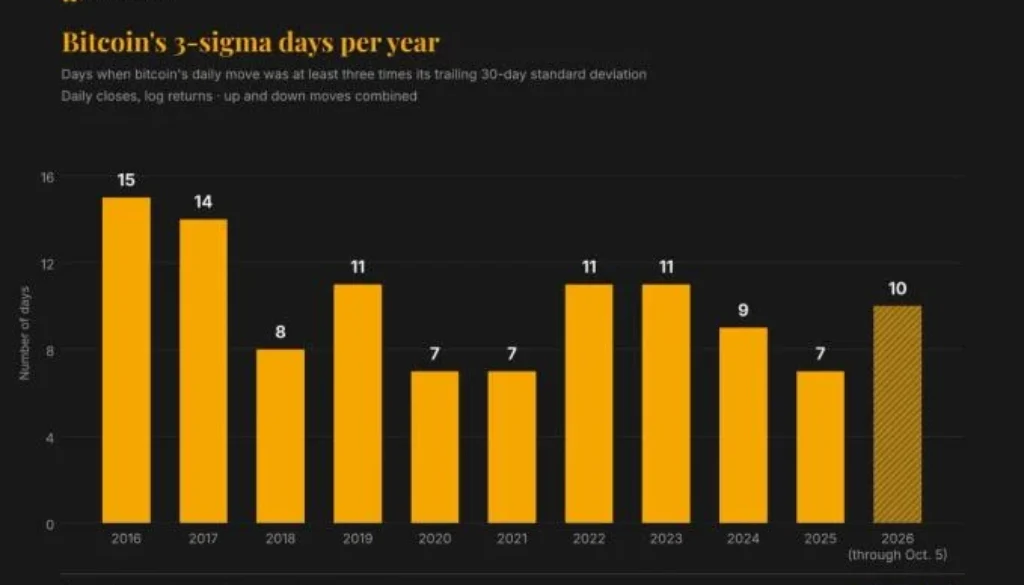
- Bitcoin recorded 10 three-sigma trading days in 2026, exceeding the eight observed throughout all of 2018.
- Annualized volatility has dropped to 46% this year from 84% in 2018, while extreme moves averaged 7% versus 10%.
- Standard value-at-risk models may underestimate tail risk and prompt excessive bitcoin allocations based on deceptively calm recent price action.
- 10 Three-sigma trading days recorded in 2026 versus eight in 2018
- 46% Bitcoin’s 2026 annualized volatility compared to 84% in 2018
- 26 Three-sigma days for bitcoin since 2024 versus eight for Nvidia
- $6.7B Options trades facilitated on bitcoin’s latest 3-sigma day, September 21
CoinDesk reported that bitcoin has logged an unusually high frequency of extreme price moves relative to its baseline volatility in 2026, a pattern that defies the conventional expectation that a calmer market produces fewer outsized swings. The largest cryptocurrency has recorded 10 days this year when its price moved at least three standard deviations from its 30-day realized volatility, surpassing the eight such days during the entire 2018 bear market when bitcoin shed 73% of its value. A three-sigma day represents a move so large that it should occur roughly once every 370 trading days under normal market conditions, making the current frequency noteworthy even as overall price turbulence has declined.
Volatility falls while extreme moves persist
Bitcoin’s annualized volatility stands at roughly 46% in 2026, a sharp drop from the 84% registered in 2018, yet the magnitude of individual three-sigma moves has only slightly compressed to an average of 7% from 10% eight years ago. This contrast illuminates a structural reality about bitcoin’s trading patterns: the cryptocurrency experiences prolonged quiet stretches punctuated by sudden repricing events, a dynamic that has not fundamentally changed despite the market’s maturation.
The persistence of extreme moves is particularly striking when measured against other volatile assets. Since 2024, bitcoin’s volatility has tracked closely with Nvidia at roughly 47%, yet bitcoin has logged 26 three-sigma days in that period compared with Nvidia’s eight, while the S&P 500 recorded 16 and gold 12. This suggests that bitcoin’s tail risk profile remains elevated relative to assets with similar baseline volatility measures.
Risk models may mask concentration danger
Investors using volatility-based risk models face a potentially deceptive signal. Many value-at-risk, or VaR, frameworks rely heavily on recent price fluctuations to estimate potential portfolio losses on adverse days. Bitcoin’s declining 30-, 90-, and 180-day volatility measures could therefore encourage portfolio managers to increase their exposure at precisely the moment when the asset remains prone to sudden shocks.
Standard VaR measures do not properly assess the full tail risk, and this is one of the main reasons industry has been moving towards Expected Shortfall and similar measures, that do take tail risk into account.
Luuk Strijers, CEO of crypto options exchange Deribit
VaR also estimates a loss threshold but provides no insight into how severe losses could become beyond that point, a gap known as tail risk. Expected shortfall methodology addresses this by examining the severity of losses on the worst trading days, not merely their frequency. Nicolas Quatravaux, head of EMEA at Paradigm, a leading institutional liquidity network in crypto derivatives, observed that a quieter bitcoin profile encourages broader portfolio allocations without corresponding increases in hedging, amplifying the impact when sudden jumps occur.
Leverage and macro shocks drive outsized days
Market participants attribute the recurring three-sigma moves to a combination of macroeconomic shocks and highly leveraged derivatives positioning. In 2026 specifically, Quatravaux noted that the year began with capital rotating from crypto into technology stocks, followed by a series of decentralized finance hacks that pushed traders toward selling volatility through structured products. When geopolitical events, Federal Reserve announcements, and other macro headlines arrived, traders caught short volatility through option-selling strategies faced forced covering that amplified price swings.
Alexander S. Blume, co-founder and CEO of Two Prime, an SEC-registered investment advisor, identified call overwriting as a particularly crowded derivative trade. In this strategy, investors sell call options on bitcoin they already own to generate steady income, surrendering some upside potential. When bitcoin rallies sharply, as it has over the past month, sellers of these calls face a squeeze as they rush to cover, which can amplify upward moves into outsized jumps.
The market’s resilience has improved markedly, however. On September 21 (Monday), the day of bitcoin’s latest three-sigma jump, Paradigm facilitated a record 6.7 billion dollars in options trades without reports of major counterparty losses.
Quatravaux attributed this stability to greater sophistication among market participants, improved risk management practices, and higher institutional participation that now absorbs shocks that once created contagion. Yet he expects extreme swings to persist indefinitely, noting that a decade of data shows three-sigma moves have not disappeared as the market matured because macroeconomic shocks remain unavoidable.
The BlockWest read. The gap between volatility and tail risk severity presents an opportunity for allocators to recalibrate hedging rather than simply scale positions. As institutional participation stabilizes sudden moves, the real risk now lies with concentrated derivative positions that can amplify shocks when macro headlines hit. Portfolio construction should price in the likelihood of three-sigma moves, not treat declining volatility as permission to extend leverage.
The critical question for institutional bitcoin allocators is whether risk models accounting for tail risk will become standard practice before the next wave of macro volatility tests positioning again. Deribit and similar platforms now offer bitcoin options tailored to hedge these outsized moves, but adoption remains uneven across the institutional ecosystem. Watch whether large asset managers integrate Expected Shortfall methodologies into their bitcoin allocation frameworks in response to this year’s data, or whether complacency from lower baseline volatility wins out.
BlockWest is a news publication. Nothing here is investment advice. Read our disclaimer and editorial policy.