Berkshire Hathaway gains 19.1% in fourth quarter while selling Bank of America shares
Berkshire Hathaway shares are rallying sharply in the fourth quarter as investors seek shelter from AI stock volatility, but the conglomerate is simultaneously trimming its largest equity position and tapping debt markets at higher rates. For allocators weighing safety against opportunity, this divergence between stock momentum and portfolio reshuffling signals deliberate repositioning rather than passive strength.
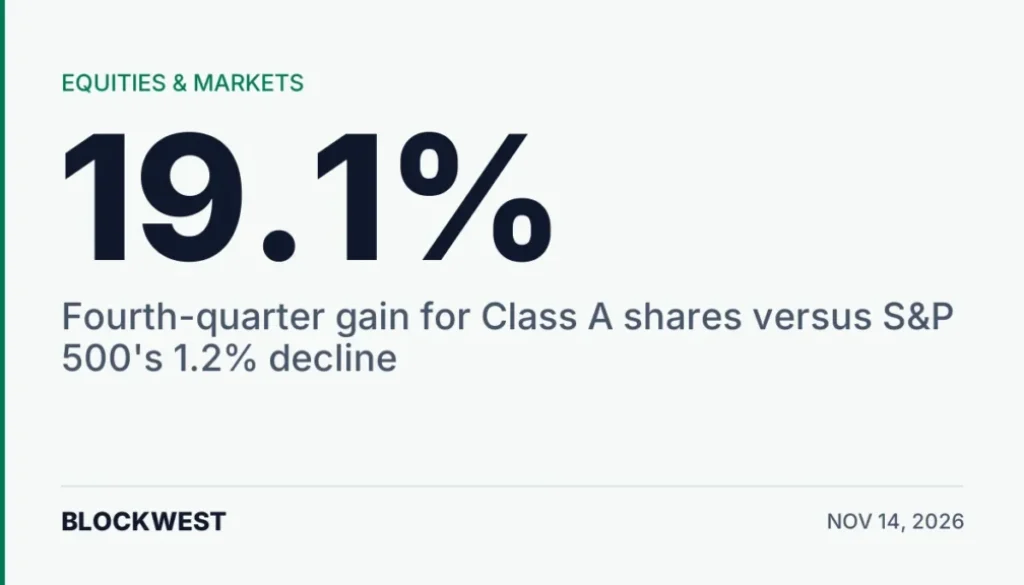
- Class A shares closed at record highs 11 times since October 1, gaining 19.1% in the fourth quarter against the S&P 500’s 1.2% decline.
- Berkshire has sold an estimated 30 to 40 million Bank of America shares in Q3, continuing nine consecutive quarters of reducing its largest equity position.
- The company is issuing more than 182 billion yen in bonds maturing between 2029 and 2056 at higher relative rates than its April offering, signaling tighter market conditions.
- 19.1% Fourth-quarter gain for Class A shares versus S&P 500’s 1.2% decline
- 53.2% Reduction in Bank of America share count since June 2024, despite 28.3% stock price gains
- $377.4B Cash holdings as of September 30, up 3.3% from the prior quarter
- $1.1B Size of latest yen bond offering at higher rates than April’s 272 billion yen sale
According to CNBC reporting, Berkshire Hathaway’s Class A and B shares are capturing investor demand for defensive positioning as concerns about artificial intelligence spending and equity valuations intensify. Both share classes have gained 19.1% since the fourth quarter began on October 1, with Class A reaching record closes on four consecutive trading days this week alone. The S&P 500 declined 1.2% over the same span, leaving Berkshire’s B shares 7.5 percentage points ahead of the benchmark year-to-date. The stock has recovered from losses that followed the announcement of new Chief Executive Greg Abel’s succession plan, climbing nearly 10 percent since last year’s shareholders meeting in May.
Bank of America position shrinks for ninth consecutive quarter
Berkshire’s Bank of America stake, valued at $24.7 billion and ranking as its fifth-largest equity holding, has contracted substantially under what appears to be a methodical reduction strategy. As of June 30, 2024, before sales accelerated, Berkshire owned just over 1 billion Bank of America shares worth $41.1 billion. Since then the share count has declined 53.2 percent, even as Bank of America’s stock price gained 28.3 percent over the period. Had Berkshire made no reductions, the position would now be worth $52.7 billion.
The company’s third-quarter 10-Q filing indicates further selling in that period. A $372 million reduction in the cost basis for equities in the banks, insurance and finance category, combined with $2.2 billion in pretax gains from equity sales, suggests Berkshire sold an estimated 30 to 40 million Bank of America shares in the quarter, roughly in line with the 30.2 million shares sold in Q2. New CEO Abel stated in his February shareholder letter that American Express is one of four stocks Berkshire would hold for “decades,” shielding that large position from immediate sales pressure, making Bank of America the likely source of the quarter’s reported gains.
Berkshire taps yen debt market at widened spreads
In a term sheet filed on Friday, Berkshire announced the sale of more than 182 billion yen, or approximately $1.1 billion, in bonds maturing between 2029 and 2056 with annual interest rates between 2.6 percent and 4.6 percent. The rates, compared to market benchmarks, represent a widening from Berkshire’s previous yen offering in April, when it sold 272 billion yen at more favorable terms. Fund managers noted that market sentiment has become more sensitive, forcing issuers to make their offerings more attractive to buyers, according to reporting by Bloomberg.
Berkshire uses proceeds from yen-denominated debt to hedge its ongoing investments in Japanese equities against currency fluctuations. The company’s cash position, excluding rail cash and subtracting T-bills payable, stood at $352.3 billion as of September 30, down 1.9 percent from June 30, while total cash including those items reached $377.4 billion, up 3.3 percent quarter-over-quarter. In Q3, Berkshire repurchased $9.6 billion of its own shares, its standard capital deployment method alongside debt issuance and selective equity adjustments.
The BlockWest read. The fourth-quarter rally reflects investor capitulation toward safety, not fundamental optimism about Berkshire’s portfolio. Management is systematically reducing its largest single equity bet, raising capital at higher cost, and rebuilding dry powder rather than deploying it. This posture suggests Berkshire sees valuation risk ahead and is preparing for opportunity at lower prices, even as the stock itself benefits from near-term flight-to-quality flows.
Berkshire is due to disclose its complete quarterly equity portfolio snapshot on Wednesday, November 18, when it files its Q3 13F with the SEC. That filing will confirm whether Q3 selling continued across other major positions and provide the first official accounting of whether purchases of Alphabet shares materialized alongside the Bank of America reductions.
BlockWest is a news publication. Nothing here is investment advice. Read our disclaimer and editorial policy.