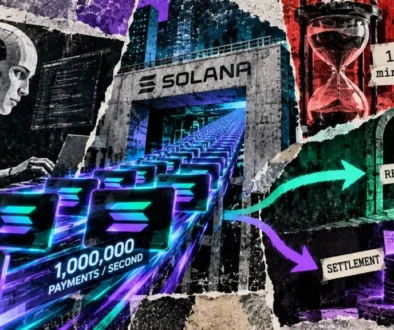
Solana cuts transaction finality to 150 milliseconds with Alpenglow upgrade

Solana’s Alpenglow upgrade cuts transaction finality to 150 milliseconds, potentially unlocking faster settlement for on-chain securities trading. Wall Street’s netting mechanisms already reduce payment obligations by 98%, raising the question of whether blockchain speed alone justifies the shift without matching institutional infrastructure.
- Solana activated Alpenglow on mainnet on October 21 at slot 459,653,000, targeting 150 milliseconds to finality.
- The National Securities Clearing Corporation reduces equity payment obligations by an average of 98% through multilateral netting.
- Faster consensus finality yields theoretical turnover gains only if institutions adopt offsetting and netting on-chain alongside atomic settlement.
- 150 ms Alpenglow finality target, down from 12.8 seconds under TowerBFT at older slot times
- 98% Average reduction in payment value obligations through NSCC multilateral netting
- $608 trillion Equity transactions processed by DTCC in 2025, reflecting institutional settlement scale
- 42.7x Theoretical turnover multiplier from 6.4-second baseline to 150 milliseconds when consensus time is the full cycle
Solana activated its Alpenglow consensus upgrade on mainnet Wednesday (October 21), replacing TowerBFT with a design that aims to reduce transaction finality from seconds to about 150 milliseconds. According to CryptoSlate, the upgrade collapses the confirmed and finalized states into one, meaning a transaction becomes irreversible within the target window. The first phase, called Votor, allows validators to exchange votes directly and aggregate them into certificates, achieving finalization in one or two voting rounds. The second phase, Rotor, handles block propagation and remains unscheduled. Transaction execution, the Solana Virtual Machine, and fee mechanics remain unchanged.
Alpenglow cuts finality to 150 milliseconds but leaves institutional adoption uncertain
The speed gain is real but its practical value depends on where settlement delays actually occur. Solana’s documentation states that production applications read mostly at the confirmed level, and that every confirmed block has historically finalized. The material gain concentrates in workflows that wait for full finality before releasing assets or recognizing settlement. Under TowerBFT at Solana’s older 400-millisecond slot time, documented finality was 12.8 seconds. After Solana cut slots to 200 milliseconds on October 9, applying TowerBFT’s 32-slot finalization rule yields a nominal 6.4-second baseline. Alpenglow’s 150-millisecond target against that 6.4-second baseline creates a theoretical turnover multiplier of 42.7 times when consensus time is the full cycle.
Those multipliers collapse under realistic conditions. A model assuming two seconds of other processing, beyond consensus, yields a 3.9-times multiplier; five seconds drops it to 2.2 times; 60 seconds falls to 1.1 times. Custody checks, funding transfers, compliance reviews and signatures are the typical sources of non-consensus delay, meaning the practical value of faster consensus depends on what currently holds capital back in institutional workflows.
Wall Street’s netting already cuts payment obligations by 98 percent
The National Securities Clearing Corporation, which acts as central counterparty for eligible equities trades, offsets purchases and sales among participants so only residual payments must settle. The Depository Trust and Clearing Corporation reports that multilateral netting cuts the value of equities payment obligations by an average of 98 percent. The DTCC processed $608 trillion of equity transactions in 2025, a figure covering payment obligations separate from margin, regulatory capital and peak intraday funding. NSCC settles on T+1, the gap between trade date and settlement date, which differs from the time a system takes to process a payment.
Solana’s own tokenization initiatives show modest current scale: September 2025 data reported $18 billion in stablecoin supply, roughly $4 billion of tokenized-stock trading against $684 million of tokenized-equity supply, and $78 billion of decentralized exchange volume. The upgrade also removes validator votes from blocks, requiring transaction-count comparisons across October 21 to exclude votes on both sides.
Institutional adoption hinges on matching netting and offset on-chain
The Bank for International Settlements warned in its 2023 blueprint that atomic settlement can raise liquidity demands unless liquidity-saving mechanisms accompany it. Real-time gross settlement has the same effect, raising funding needs relative to deferred net settlement. If on-chain markets add enforceable offsetting before the residual transfer, the combination becomes the point: with a hypothetical $10 billion of gross obligations and 90 percent netting, $1 billion remains to settle, and two seconds of other processing yields a 6.9-times turnover ceiling against the older baseline.
The offset ratio depends entirely on design assumptions around two-way order flow, institutional credit, custody, and usable cash-equivalent settlement assets. A December 2025 BIS working paper on auction-based payment mechanisms simulated the approach on data from Peru, South Africa, the Southern African regional system and Switzerland, finding liquidity savings of 2.6 percent to 12.2 percent, with the auction succeeding on average 79 percent of the time. If institutions prefund each trade and settle it separately with obligations unoffset, Solana’s finality yields only about 1.1 times the recent baseline once realistic other processing is counted, and gross liquidity needs stay the same.
On July 15, the DTCC announced that tokenized DTC-held securities had moved through live production transactions with more than 30 firms, covering Treasury and equity delivery-versus-payment, securities lending, collateral pledging and central-counterparty margin workflows, using Besu and Canton. Its Tokenization Hub operates as a voluntary service under a December 2025 SEC no-action authorization.
The BlockWest read. Faster consensus is only part of the equation. Solana’s 150-millisecond finality unlocks turnover gains only if institutions simultaneously redesign settlement workflows to batch offsetting before residual transfers. Without that infrastructure shift, the speed improvement shrinks to single-digit multiples. The real test is whether custody, compliance and netting logic migrate on-chain before trades execute, not whether the blockchain can finalize transactions faster.
Observed mainnet finality, end-to-end settlement times, residual obligations against gross flows, peak prefunded liquidity and legal finality will reveal which path Solana follows. Watch whether Solana’s Rotor phase, handling block propagation, ships on schedule and whether DTCC tokenization participants adopt offsetting mechanisms within their live production workflows by mid-2026.
BlockWest is a news publication. Nothing here is investment advice. Read our disclaimer and editorial policy.