Aave proposes tokenized SpaceX collateral as $194 billion share unlock tests protocol limits
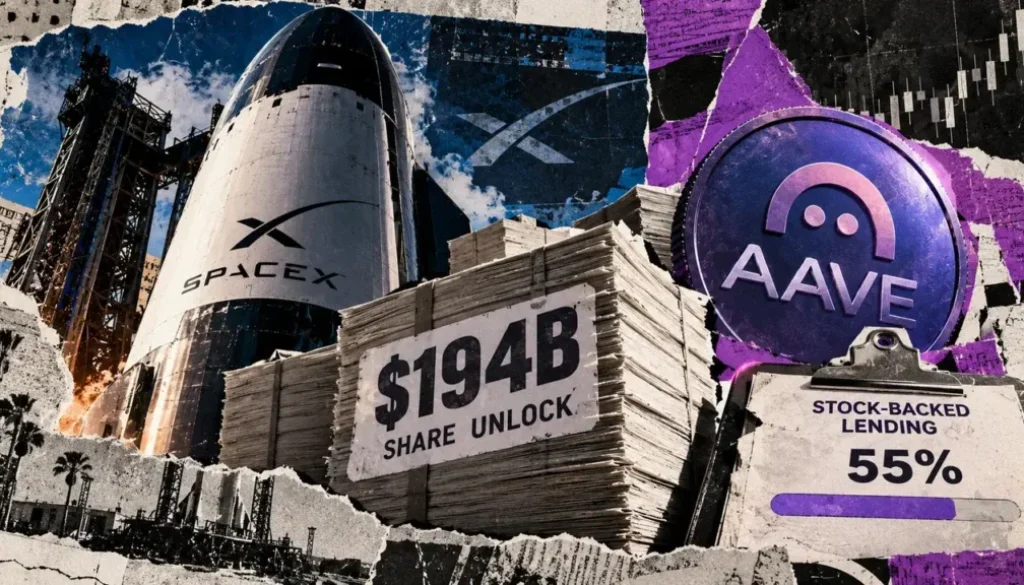
SpaceX’s massive share unlock on Thursday (October 22) arrives just as Aave Labs pushes to accept tokenized SpaceX shares as collateral, exposing a critical tension between decentralized lending’s speed and the operational limits of on-chain liquidity during volatile equity events. The $194 billion in newly tradable shares dwarfs Aave’s tiny capacity to backstop borrowing against them, raising questions about whether decentralized protocols can safely handle tokenized stocks without traditional market infrastructure.
- About 1.3 billion SpaceX shares worth $194.3 billion became eligible for sale on October 22, following Elon Musk’s company’s earnings report on October 20.
- Aave’s risk adviser LlamaRisk recommends a 55% collateral factor for tokenized SpaceX shares, well below the 65% applied to Tesla and Meta, citing 81.4% annualized volatility.
- The proposed 37,000-token cap on SPCXc borrowing would support roughly $3 million of lending, or about 0.0028% of the unlock’s total value, leaving exposure vastly undersized relative to the equity event.
- $194.3B Value of SpaceX shares unlocked on October 22 at closing price of $147.89
- 81.4% SpaceX realized annualized volatility since IPO, versus 52% for Tesla
- 55% Collateral factor recommended by LlamaRisk for tokenized SpaceX shares on Aave
- $3M Maximum borrowing capacity if 37,000-token cap fills completely
A week before SpaceX’s earnings release, Aave Labs proposed accepting tokenized SpaceX shares (SPCXc) as collateral on its V4 Equities Hub on Base. The timing exposed a structural mismatch: Aave’s risk model, prepared by LlamaRisk, had originally modeled a larger share unlock for November 5 to November 9. When SpaceX confirmed on October 16 that it would report earnings on October 20, the unlock date moved forward by roughly two weeks to October 22. The stock closed that day at $147.89, down 5.5% from October 13 and about 14% from $171.92 on October 6, setting the stage for a volatile collateral event. The story was first reported by CryptoSlate.
LlamaRisk proposes conservative terms for volatile equity collateral
LlamaRisk’s assessment, published October 15, recommended a 55% collateral factor for SPCXc, substantially below the 65% maximum Aave applies to its most conservative equities, Tesla and Meta. The lower haircut reflects SpaceX’s extreme volatility: since its IPO, the stock has realized 81.4% annualized volatility, compared to roughly 52% for Tesla. The 30-day realized volatility stands at 51.8%, though LlamaRisk noted the full figure includes initial price discovery and relied on tail estimates from other stocks to model the company’s true risk.
The risk adviser also proposed a 6.5% maximum liquidation bonus, a 1,000 basis point collateral risk premium, USDC as the only borrowable asset, and a hard cap of 37,000 SPCXc tokens. The math translates to real constraints: a borrower depositing $1,000 of SPCXc and borrowing $400 of USDC would start at a 40% loan-to-value ratio and hit the 55% liquidation threshold on a 27.3% fall in share price. At the 55% maximum borrowing level, the position reaches its liquidation threshold immediately.
On-chain depth cannot absorb a large-scale liquidation
The unlock’s size dwarfs Aave’s capacity to manage it. As of October 13, only 13,214 SPCXc tokens existed on-chain, worth about $2 million. The Aerodrome SPCXc/USDC pool on Base held $1.04 million total, with roughly $370,000 of depth for a 2% price move, and more than 99% of all SPCXc trading ran through that single pool. At the proposed 37,000-token cap, Aave’s maximum borrowing capacity reaches roughly $3 million, or about 0.0028% of the $194.3 billion unlock’s value.
Pricing adds another layer of risk. Chainlink provides pricing 24 hours a day, five days a week, while Nasdaq trades in set sessions. A liquidation triggered after market close would face a pricing gap and liquidity entirely dependent on a thin decentralized exchange, redemption from the token issuer, or perpetual futures hedges. LlamaRisk counted average daily volume at about 91 million SpaceX shares over the past 30 sessions. If just 1% of the 1.31 billion newly unlocked shares traded, that would represent 13.1 million shares worth $1.94 billion, or 14% of average daily volume. At 5%, the figure climbs to 72% of daily volume, and at 10% it doubles to 144%.
Stress scenarios reveal liquidation execution risks
SpaceX’s prior unlock events produced mixed price reactions: the stock rose 6.1% on its August 6 unlock day and fell around 4% around the August 20 and September 9 events.
If the October 22 unlock brings orderly trading with a small tranche sold and the stock holding near $147.89 or higher, the 55% collateral factor faces little stress. If the stock falls 30% to about $103.52, the $400 loan against $1,000 of collateral becomes immediately liquidatable under the proposed factor. A fall near LlamaRisk’s modeled 41% tail estimate, to about $87.25 during a market closure, would test liquidation execution at once. The $370,000 of DEX depth, issuer redemption access, and perpetual hedges would all carry the load together, with no assurance that any single channel would absorb a cascade of forced sales.
The mismatch between traditional equity markets and on-chain infrastructure cuts deeper than price volatility. Tokenized lending can speed collateral transfers and unlock capital efficiency, but SpaceX’s unlock demonstrates that a volatile underlying stock, equity-market closures, and thin on-chain exit liquidity define the practical bounds of the model. As of October 20, the Aave governance proposal remained pending and any SPCXc-backed borrowing remained prospective.
The BlockWest read. Aave’s exposure here is economically trivial relative to SpaceX’s market cap, but the operational test is real. A smooth October 22 unlock that leaves the stock near current levels validates the collateral model and strengthens the case for tokenizing volatile equities. Any severe drawdown exposes whether decentralized protocols can actually liquidate positions when traditional markets are closed, or whether they remain dependent on issuer redemptions and off-chain hedging to function.
Watch whether SpaceX trades orderly on October 22. A 27.3% fall in share price to about $103.52 would trigger liquidation at the 55% collateral factor. A drop near LlamaRisk’s modeled 41% tail estimate or a spike in on-chain liquidation activity would signal whether Aave’s risk model holds under stress or whether the protocol needs to slash the collateral factor further before governance votes to greenlight the listing.
BlockWest is a news publication. Nothing here is investment advice. Read our disclaimer and editorial policy.