Solana’s AI system that purports to handle one million transactions each second may neglect to pay merchants after they deliver products
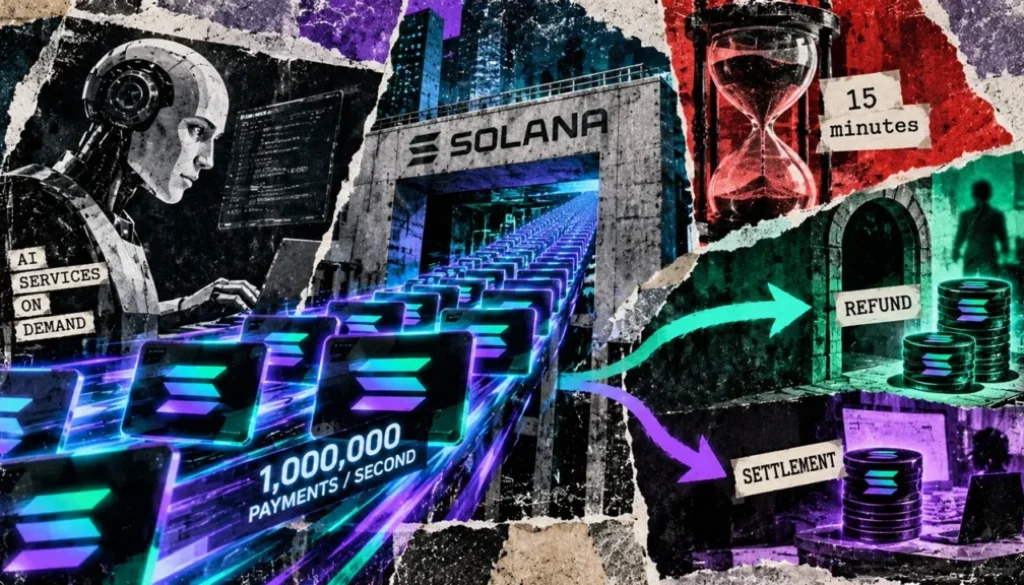
Solana Foundation’s new payment channel system promises to handle over one million transactions per second for AI micropayments, but merchants risk going unpaid if they miss narrow settlement deadlines when operators fail. The architecture exposes a structural tension between scaling speed and payment security that differs markedly from traditional payment processors.
- Solana’s payment channel system processes over one million payments per second, designed for AI service micropayments and low-value transactions.
- Merchants have only a 15-minute grace period to submit final settlement claims on-chain before payment channels close permanently.
- If operators go offline during the grace period, merchants cannot rely on third parties to handle settlement and may forfeit unpaid service balances.
- 1.09M Verified vouchers per second in benchmark, measured over 10-minute run
- 900 sec Grace period for merchants to settle claims before channel closes
- 128-core AVX-512 host used in throughput benchmark test
- Sept 3 Date of specification draft establishing merchant settlement terms
The Solana Foundation announced a payment channel system in early September designed to handle the high-frequency, low-value transactions required by proliferating artificial intelligence applications. The system batches micropayments off-chain before final blockchain settlement, allowing thousands of independent small transactions to share the cost of on-chain operations. Rather than recording every transaction individually on the blockchain, customers prepay into a channel with a spending limit, and merchants deliver services against that prepaid balance.
An operator manages the payment process, advancing cryptocurrency to cover transaction fees and account maintenance. This three-party model reflects growing industry demand for infrastructure capable of handling millions of daily token flows across independent transactions without incurring prohibitive blockchain costs. The rise of AI services that perform small, frequent tasks has made traditional payment models economically impractical, since blockchain transaction fees often exceed the value of individual transactions.
Solana’s Payment channel borrows from Bitcoin and Ethereum infrastructure
Payment channels themselves are not new to cryptocurrency. Bitcoin and Ethereum have employed similar mechanisms for years, most notably through the Lightning Network, which enables off-chain payments while using the blockchain as a settlement and dispute resolution layer. However, Solana’s implementation is tailored specifically to the throughput and latency characteristics required for AI service micropayments.
The published benchmark reported approximately 1.09 million verified vouchers per second on a 128-core AVX-512 host during a sustained 10-minute run. This measurement reflects the payment gateway returning a response without actually processing upstream services or independently settled mainnet transfers, not completed AI transactions. The architecture prioritizes throughput by reducing the computational work required per payment, deferring complex settlement logic until channels close.
Merchants face critical timing risk when operators fail
The system creates a fundamental departure from traditional payment processing by placing settlement responsibility directly on merchants rather than payment processors. When a customer requests to close a payment channel, the system enters a grace period, with the September 3 specification draft recommending 900 seconds, or 15 minutes, configured per channel. During this window, the merchant must submit its final settlement claim on-chain through a payee-authorized process.
If the operator goes offline or becomes unresponsive during the grace period, the merchant cannot rely on a third party to submit the settlement on its behalf, even if that party has sufficient funds to cover transaction fees. A warning in the Foundation-linked benchmark template notes that restarting the default in-memory store can forfeit vouchers that were accepted but not yet settled on the blockchain. Once the grace period expires and the channel is sealed, any unpaid service balance becomes uncollectible from that channel, with the customer’s refund calculated against the recorded on-chain total rather than what the operator claims should have been billed.
This design contrasts sharply with credit card networks and payment services like PayPal, where payment processors assume responsibility for settlement and maintain consumer protection mechanisms. Merchants using traditional systems do not face the risk of losing payment rights if a processor becomes unavailable at a critical moment. The compressed settlement window reflects the system’s focus on speed over redundancy and consumer protections.
Recovery mechanisms cannot fully protect unpaid merchants
When an operator goes silent, customers can request a forced close of the channel and initiate a recovery window. After the grace period expires, anyone can submit the sealing instruction and recovery transactions. However, the program documentation warns of blocking factors: an issuer-frozen escrow can prevent transfers, and distribution can redirect unusable beneficiary accounts’ shares to the treasury instead of the intended recipient.
These recovery mechanisms exist to protect customers and preserve funds when operators fail. For merchants, however, they do not necessarily compensate those who provided services but failed to submit their claims within the grace period window. Practical recovery involves arranging and landing the necessary transactions plus the configured timer. A surviving voucher only helps merchants if it can be submitted through the authorized settlement path before the grace period closes.
The architecture creates incentives for operators to balance cost minimization against reliability, with lean infrastructure potentially increasing outage likelihood that harms both merchants and customers. Operators operating at the edge of profitability may lack redundant systems or geographic failover capabilities.
Solana Foundation reported that Alibaba Cloud API endpoints were live at launch with mainnet deployment available, but published material does not establish uniform grace period configurations or signing modes across all live channels. This means a customer’s and merchant’s exposure depends on their particular channel terms, and the system’s real-world reliability when handling operator failures or network congestion remains untested at scale in commercial conditions.
BlockWest is a news publication. Nothing here is investment advice. Read our disclaimer and editorial policy.