Verona CEO says agent payments are still mostly a promise

Verona CEO says agent payments are still mostly a promise
Anthony Anzalone, whose network just launched a stablecoin for AI agent payments, says agents are probably transacting on almost nothing today and does not expect consumer purchases by agents next year.
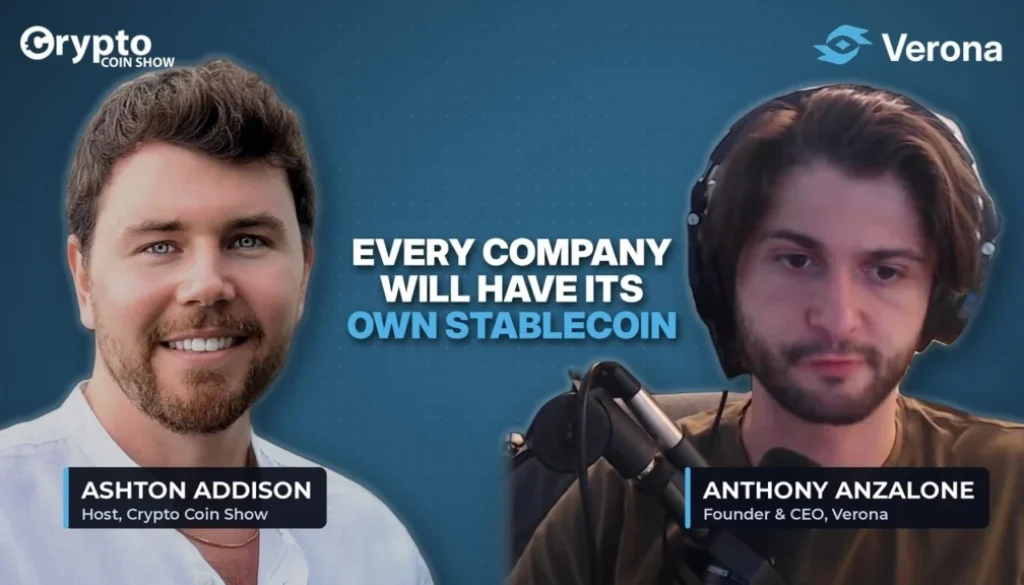
The executive behind a new stablecoin for AI agents is the first to say the agents have little to spend it on yet. Anthony Anzalone, founder and CEO of Verona, the network formerly known as XION, told Crypto Coin Show on Tuesday, October 20 that the agent economy is early and that his company is building for where it is going, not where it is.
Anzalone spoke with Ashton Addison for Crypto Coin Show in his fourth appearance. His company sells verification of internet data and launched verUSD, a dollar stablecoin aimed at agent payments. He therefore has a commercial interest in agents paying, which makes his caution more notable than a bullish pitch would have been. Addison opened by citing more than $100 million in launch commitments. Anzalone’s own split was about $60 million in committed revenue that the payments are going toward and another $40 million in institutional capital. Both are his figures from the interview, not an audited measure of verUSD in circulation. Watch the full conversation on YouTube.
The gapAgents have the rails but not yet the purchases
Addison raised reports that agent stablecoin payments have run well below earlier forecasts. Anzalone did not dispute them. He said the pattern is familiar from every technology cycle, where promise outruns delivery, and that there is often just not a need for the product yet. Verona has the plumbing in place: the x402 standard has been live for some time and the MCP server teased in June is done. What is missing is demand.
What are agents transacting on right now? Probably absolutely nothing.
Anthony Anzalone, Founder and CEO, Verona
He grounded the view in how people use AI today. Most people, he said, treat it as a glorified search engine. He expects the frontier to become the consumer experience about every six months, and offered his own test case: an agent that read his email and logged flight miles he had never claimed, a task he said would not have worked a year ago. Booking flights through an agent is close, he said, and it is the kind of everyday task that would eventually need a payment rail. On the question of agents buying consumer goods, he was direct that he does not expect it next year.
The strategyA startup building for where the puck is going
If agents are not paying yet, why build the coin now? Anzalone’s answer is about timing and survival.
We’re a startup at the end of the day. We can’t be building for right now. We have to be building for where the puck is going.
Anthony Anzalone, Founder and CEO, Verona
The stablecoin also solves a practical problem. Verona spent years settling payments in USDC for projects on its network and, he said, could not give those projects yield or the customization they wanted. Owning the coin changes that. The GENIUS Act, in his reading, opened the door for any company to issue one, and he thinks every large brand will want its own. In the near term, he said, verUSD is a payout rail for the brands already on the network, with Starbucks missions as one example, and an invisible layer rather than something users hold. He told Addison he does not want people holding it.
The company’s frame is also narrower than the headline AI story. Anzalone called Verona an anti-AI AI play: what it sells is verification of internet data, which he said became a real problem only once the internet filled with machine-generated content. That is the business the stablecoin is meant to support, with agents as the future customer.
The incumbentsUSDC and USDT keep the last mile, in his view
Addison asked whether verUSD can compete with USDC and USDT given their exchange listings. Anzalone said it does not need to. The main use is payouts and instant transactions rather than trading, and if a merchant such as a large online retailer accepts only USDC or USDT, he does not expect verUSD to beat them at that checkout. He expects the two to settle into a last-mile role, a brief swap at the moment of purchase, which he argued is cheaper than paying a card-style fee of about three percent.
The proofReserves are the open diligence item
On reserves, Anzalone said Verona will provide proof of reserves and is in talks with a partner, comparing it to an audit. He expects zero-knowledge proofs to let a company prove balances without exposing them, and public dashboards for new stablecoins. He also said he expects fraud among the wave of companies launching their own coins. He named no partner and no date.
The BlockWest read. We take the candor as the useful part. A stablecoin issuer telling allocators that agent volume is close to zero today is giving a better baseline than any launch headline. The diligence questions are the ones he left open: how much of the $60 million in committed revenue becomes verUSD in circulation, and who audits the reserves. Until those have answers, treat the $100 million as commitments, not flows.
What to watchA named reserve partner and the first real agent volume
Three items would test his account: the reserve partner and first attestation or dashboard, the share of committed revenue that reaches verUSD, and the first measurable agent payment flow. Anzalone also pointed to a post-quantum upgrade planned around the time the episode releases. For related reading, see our AI in finance and digital assets coverage and more from the BlockWest interviews page.
| Item | Figure |
|---|---|
| Committed revenue behind verUSD payments | $60M |
| Further institutional capital | $40M |
| Card-style fee versus a last-second swap | 3% |
| Reserve partner | Not named |
Verona, formerly XION, is a network that verifies real-world data at the source while keeping it private, so AI agents can act on information they could not otherwise see. It launched verUSD, a dollar stablecoin for agent payments, in late September 2026.
BlockWest is a news publication. Nothing here is investment advice. Read our disclaimer and editorial policy.