Chainalysis finds $176 billion in Chinese peer-to-peer crypto activity despite ban
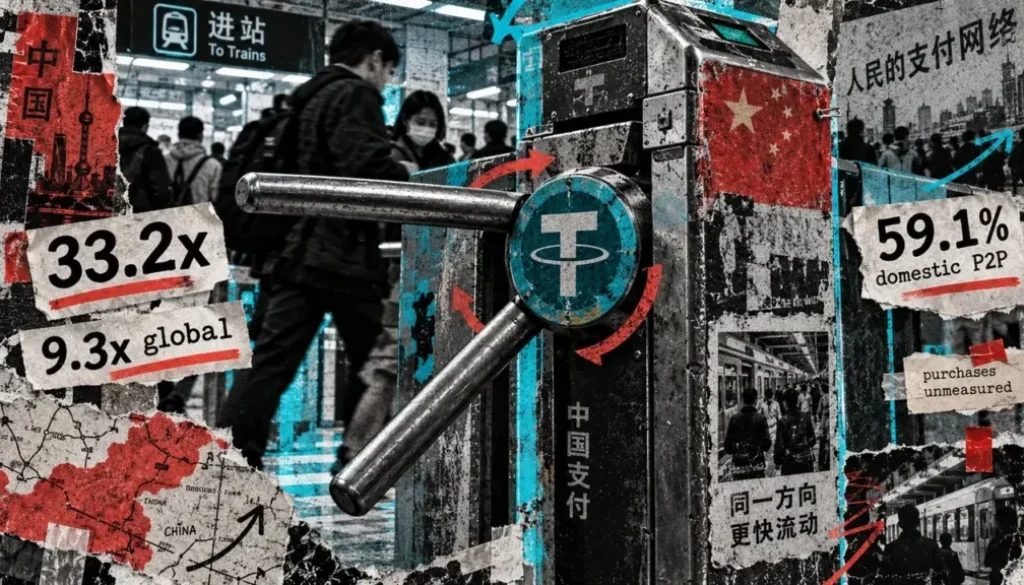
Chainalysis data show China’s crypto ban has pushed activity underground rather than eliminated it, with peer-to-peer stablecoin transfers now dominating a $176 billion annual market. The shift suggests dollar-pegged tokens are functioning as informal payment rails inside China despite years of regulatory crackdowns on exchanges and trading.
- China generated at least $176 billion in crypto activity over the 12 months through June 2026, Chainalysis found.
- Peer-to-peer transfers accounted for 59.1% of that volume, a share 3.5 times higher than the prior period.
- Self-custodied stablecoin turnover in China hit 33.2 times annually, more than triple the global benchmark of 9.3 times.
- $176B total crypto activity in China over 12 months through June 2026
- 59.1% share of Chinese crypto activity done peer-to-peer, up 3.5x
- 33.2x annual stablecoin wallet turnover in China versus 9.3x global average
- 996% jump in sub-$100 stablecoin transfers at start of 2025 shift
China’s longstanding restrictions on crypto trading have not stopped a sizable underground market from operating, and new blockchain data suggest the activity is migrating further from the regulated system rather than toward it. According to reporting by CryptoSlate, blockchain analytics firm Chainalysis estimated China generated at least $176 billion in crypto activity during the 12 months through June 2026. Of that total, 59.1% occurred through domestic peer-to-peer transfers rather than exchanges or other centralized platforms, a share 3.5 times higher than in the prior measurement period.
That divergence sets China apart from most major crypto markets, where regulated exchanges remain the dominant entry and exit point for users. The pattern points to a structural shift in how Chinese users are accessing digital assets under continued state pressure.
Stablecoin transfers under $100 surged 996% starting March 2025
Chainalysis traced the acceleration to domestic stablecoin payment activity that began picking up around March 2025 and continued expanding for 13 consecutive month-over-month periods. New monthly activity rose from roughly $240 million in March 2025 to nearly $5 billion about a year later, a twentyfold increase over that stretch. The growth was not confined to large institutional transfers.
Stablecoin volumes below $100 jumped 996% around the start of the shift, according to the Chainalysis report. Transfers between $100 and $1,000 rose 1,057%, while activity in the $1,000 to $10,000 range climbed 1,321%. The size distribution suggests individuals and smaller businesses, not just large players, are driving the wallet-to-wallet migration.
Chainalysis noted the timing coincides with China’s March 2025 expansion of its social-credit system into finance and internet infrastructure. The firm said people with restricted access to conventional financial services could be turning to crypto, while others may use stablecoins to settle transactions outside monitored banking or e-commerce channels.
Chainalysis was careful to frame this as a working hypothesis rather than a proven causal link.
Blockchain data can show when and how assets move but cannot establish why an individual chose one payment method over another.
Chainalysis, blockchain analytics firm
China’s stablecoin turnover of 33.2x triples the global average
Beyond transaction counts, the way tokens circulate through China-attributed wallets points to stablecoins functioning less like stored value and more like working cash. Chainalysis calculated annual turnover of self-custodied stablecoin holdings in China at 33.2 times, more than triple the global benchmark of 9.3 times. No other major regional market came close: Japan recorded 9.9 times turnover, Hong Kong 6.1, South Korea 5.1 and Taiwan 3.5.
China-attributed wallets held an average of about $3.1 billion in stablecoins during the period but moved $104.1 billion across 18.1 million transactions, a turnover ratio showing the same tokens being recirculated repeatedly rather than sitting idle. Chainalysis said that pattern is consistent with stablecoins developing into a domestic payment rail rather than a speculative holding.
The structure separates China from its neighbors, where regulated exchanges still anchor most crypto activity. In China, restrictions on centralized platforms appear to have redirected volume into direct wallet transfers instead of suppressing it.
Offshore platforms, not exchanges, may capture China’s next growth wave
The data point to a persistent gap between Beijing’s regulatory intent and on-the-ground payment behavior. Restrictions on exchanges limit formal, traceable market access, but self-custodied dollar-linked tokens can still move through decentralized networks and private transfers that fall outside licensed intermediaries.
For stablecoin issuers and crypto service providers, China represents sizable latent demand that remains hard to serve directly given its regulatory posture. CryptoSlate’s reporting suggests growth is more likely to continue through offshore platforms, OTC networks and self-custody than through conventional consumer-facing crypto businesses.
The open question is whether this acceleration holds as Chinese authorities widen oversight of digital payments and financial activity more broadly. If smaller stablecoin transfers keep rising alongside high wallet turnover, regulators face an expanding pool of dollar-linked value moving outside the exchange infrastructure that earlier crypto bans were built to contain.
The BlockWest read. The figures point less to Chinese retail users evading capital controls for speculation and more to stablecoins becoming informal settlement infrastructure where banking access is constrained or monitored. For issuers like Tether and Circle, this is unmonitorable demand they cannot bank, license, or report on, demand that exists regardless of whether Beijing ever permits onshore access. That gap between underlying usage and formal market size is the real balance-sheet story here.
Chainalysis has framed the social-credit connection as a hypothesis, not a finding, leaving open whether China’s regulators will treat the 33.2 times turnover figure as a policy failure requiring a new crackdown or as a signal that enforcement against centralized exchanges has simply displaced volume it cannot see.
BlockWest is a news publication. Nothing here is investment advice. Read our disclaimer and editorial policy.