Evernorth lists on Nasdaq with 473 million XRP despite accounting rule limiting price transparency

Evernorth’s Nasdaq debut brings nearly half a billion XRP into public markets, but an accounting quirk tied to Ripple’s ongoing relationship may obscure the company’s true financial performance. Investors evaluating the treasury company’s core promise—growing XRP per share through active management—will need to parse reported earnings from unrealized price movements.
- Evernorth completed its merger with Armada Acquisition Corp. II on October 9 and will trade under ticker XRPN on Monday (October 12).
- The company holds approximately 473 million XRP and raised roughly $300 million in gross cash proceeds before transaction expenses from backers including Ripple, SBI Group, Pantera Capital, Kraken, and GSR.
- A related-party accounting rule will force Evernorth to use historical cost accounting for XRP rather than fair-value treatment, creating potential divergence between reported book value and actual treasury market value.
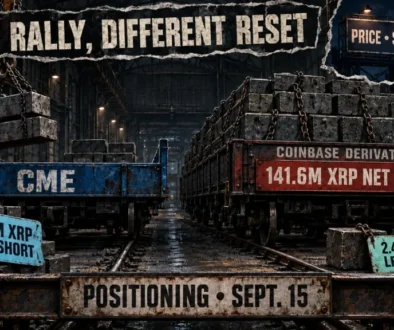
- 473M XRP tokens held by Evernorth upon Nasdaq listing debut
- $300M Gross cash proceeds raised before transaction expenses
- $1.43 Average XRP price used for share calculations at merger close
- $6.9M Potential impairment from XRP’s July-October low observed on Coinbase
Evernorth Holdings Inc. completed its merger with Armada Acquisition Corp. II on October 9, 2026, according to regulatory filings with the Securities and Exchange Commission, bringing one of the largest corporate XRP treasuries to public markets. The company will begin trading on Nasdaq under the ticker XRPN on Monday (October 12), offering stock-market investors direct exposure to crypto assets through a regulated treasury vehicle. CryptoSlate reported that Evernorth holds approximately 473 million XRP and secured roughly $300 million in gross cash proceeds before transaction expenses, backed by investors including Ripple, SBI Group, Pantera Capital, Kraken, and GSR.
Evernorth plans active deployment across XRP ecosystem rather than passive accumulation
Evernorth Chief Executive Officer Asheesh Birla outlined a strategy distinct from traditional crypto treasury companies that accumulate digital assets and rely on price appreciation alone. In an October 9 shareholder letter, Birla described a vision of financial markets transitioning toward blockchain-based infrastructure capable of operating continuously rather than within traditional banking and exchange hours. He argued that tokenization could reshape how securities, credit and other financial assets are traded, settled and used as collateral, with programmable conditions governing interest payments, lending arrangements and transfers potentially reducing delays associated with traditional intermediaries.
Birla identified market liquidity as a critical requirement for these applications to become commercially viable. Evernorth intends to deploy capital on the XRP Ledger to support liquidity and work with developers building financial infrastructure for institutional users. The company plans to pursue institutional and decentralized finance yield opportunities, ecosystem participation, and capital markets activities intended to put its assets to productive use. For shareholders, the stated goal combines cryptocurrency exposure with potential returns from actively managing holdings, aiming to increase XRP per share beyond what market price appreciation alone would deliver.
Related-party accounting rule will exclude unrealized XRP gains from reported earnings
Evernorth’s financial reporting faces an unusual constraint stemming from its relationship with Ripple, which remains a related party following the merger. According to SEC disclosures, Evernorth determined it must continue to account for its XRP holdings at historical cost, reduced by accumulated impairment losses, rather than adopting fair-value treatment available to many other corporate cryptocurrency holders. The Financial Accounting Standards Board introduced fair-value accounting rules for qualifying crypto assets in 2023, requiring them to be valued at prevailing market prices with unrealized gains and losses reflected in reported earnings. However, the standard explicitly excludes certain digital assets created or issued by a reporting company or its related parties.
This distinction creates an asymmetry in how Evernorth’s performance will be measured. When XRP prices decline sufficiently, the company must recognize impairment losses that reduce the carrying value of its holdings. However, subsequent price recoveries cannot reverse those write-downs under the cost-minus-impairment model. For example, if a $100 million XRP position is written down to $70 million, a later recovery to $150 million would not automatically restore its accounting value or produce an $80 million unrealized gain in reported earnings. The merger disclosure itself illustrates the potential consequences: management identified XRP’s lowest observable Coinbase price between July 1 and the October 9 closing as $0.99, a level that would have produced an additional $6.9 million impairment after June 30, though the filing did not confirm whether that amount was ultimately recognized.
Evernorth’s reported earnings may diverge sharply from actual treasury market value
The accounting treatment does not prevent Evernorth from profiting economically from higher XRP prices or recognizing income generated by its investment strategies. However, it could make the company’s reported earnings and book value difficult to compare with crypto treasury businesses eligible for fair-value accounting. That distinction becomes particularly relevant to Evernorth’s core investor promise of growing XRP per share, because changes in token holdings, market valuation, and reported accounting income may tell conflicting stories about performance.
Investors will need to distinguish returns from active treasury management from changes in XRP’s market value when evaluating the company’s ability to finance expansion.
Evernorth’s first post-merger financial statements will test that distinction, showing how much its treasury activities contribute to reported results even as its accounting treatment continues to exclude unrealized XRP price recoveries.
The BlockWest read. Evernorth’s real value to shareholders likely exceeds what its balance sheet will report. The company’s ability to generate yield, support ecosystem liquidity, and accumulate additional tokens could drive substantial economic returns—yet impairment rules will prevent those gains from flowing fully into earnings. Allocators should expect transparent, supplemental reporting on actual treasury performance if this structure is to command institutional capital.
Evernorth begins trading Monday (October 12) under ticker XRPN on Nasdaq. The company’s first quarterly earnings report will reveal whether management quantifies the gap between fair-market XRP value and its historical-cost carrying amount, and whether active treasury strategies generate sufficient income and token accumulation to validate the per-share growth thesis despite the accounting constraints.
BlockWest is a news publication. Nothing here is investment advice. Read our disclaimer and editorial policy.