Cosmos network resumes operations following disruption; however, Ledger wallet holders remain unable to view or transfer ATOM tokens
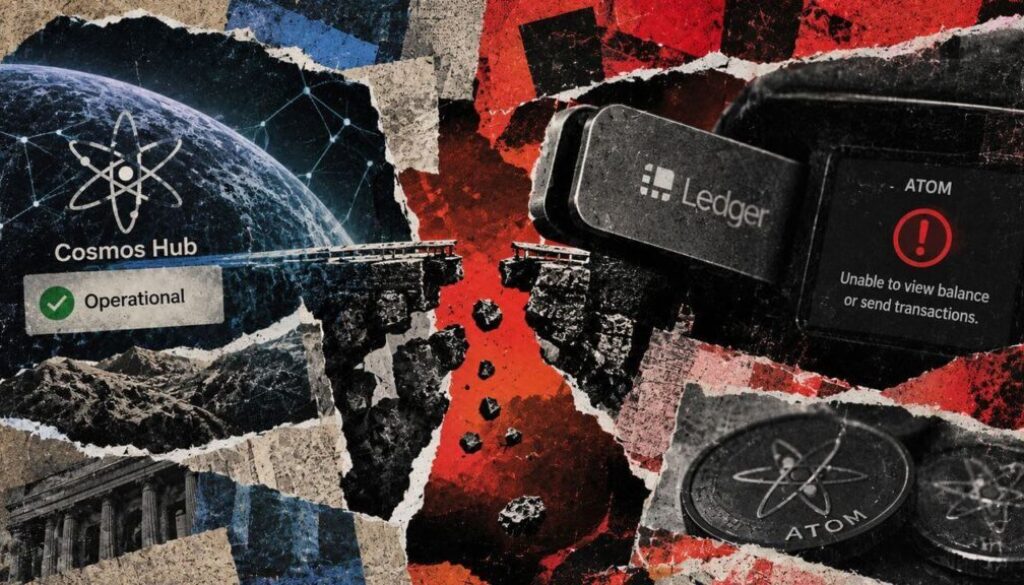
Cosmos Hub has resumed normal operations, but Ledger wallet users remain unable to view or transfer their ATOM holdings through the platform’s standard interface. This separation between network recovery and wallet access highlights how infrastructure failures can persist independently across different service layers.
- Ledger Wallet’s Cosmos service path remained unavailable more than four days after the outage began on September 8.
- Cosmos Hub recovered by September 12, with nodes catching up past block 32.9 million, while Ledger’s incident stayed unresolved.
- Ledger directs affected users to third-party wallet interfaces like Keplr and Cosmostation that connect to hardware wallets as a workaround.
- Sept. 8 Incident opened at 19:41 CEST when Cosmos Mainnet stalled
- Sept. 12 Cosmos Hub recovered and QuickNode marked its incident resolved
- 32.9M Block height Cosmos Hub reached by September 12 assessment
- 4+ days Duration of Ledger Wallet ATOM access outage as of latest update
Network recovery and service provider failures diverge
Cosmos Hub resumed block production before Ledger Wallet regained the ability to display account balances or process ATOM transactions. QuickNode, an infrastructure provider supporting Cosmos nodes, reported that the network stalled at block 32,878,318 at 18:12 UTC on September 8. Its nodes had caught up to the chain tip by 14:26 UTC on September 9, and QuickNode marked its incident resolved at 00:24 UTC on September 12.
The rapid recovery of the blockchain itself contrasts sharply with the extended outage affecting Ledger users. This pattern illustrates a fundamental distinction in distributed systems: the underlying network can restore functionality while dependent services remain impaired. Ledger’s inability to serve ATOM transactions persisted even as the chain itself demonstrated stability and continued to process blocks normally.
Ledger’s service path remains offline despite network recovery
The distinction between network restoration and wallet access failure reflects two separate technical layers. Cosmos Hub itself recovered and continued processing new blocks, advancing beyond block 32.9 million by September 12. However, Ledger Wallet’s service infrastructure for retrieving account data and broadcasting transactions to the chain did not recover alongside the network.
Ledger’s status page continued to flag Cosmos as a major outage on September 13, with its most recent update posted at 16:12 CEST on September 10 stating only that “restoration work was continuing” and that affected features “remained unavailable.” The company has disclosed neither the root cause nor an estimated time for restoration.
This situation raises questions about the operational resilience of cryptocurrency wallet services. While blockchain networks are designed to function through distributed consensus, wallet providers typically operate centralized or semi-centralized infrastructure that can become a single point of failure for end users. Even when the underlying blockchain operates flawlessly, users cannot access their funds if the wallet service they use fails to function.
Hardware Wallet users can access ATOM through third-party interfaces
Ledger has directed users unable to access ATOM through its platform to alternative wallet interfaces that support hardware wallet connections. The company lists Cosmostation and Keplr as compatible options. Users can connect their Ledger device to Keplr by opening the Cosmos app on the device and selecting Keplr’s hardware-wallet connection option, allowing transactions to remain signed by the hardware device while bypassing Ledger’s unavailable service path.
This workaround preserves the security distinction between using a hardware wallet and importing a recovery phrase into software. Ledger’s security guidance explicitly warns users never to enter their device recovery phrase into a computer or smartphone and never to share it, including with Ledger itself. Hardware wallets like Ledger devices keep private keys isolated from internet-connected computers, reducing exposure to malware and theft.
For users unfamiliar with alternative wallet interfaces, the process may seem technical or intimidating. However, the Cosmos ecosystem’s design allows multiple wallet providers to access the same blockchain, creating a form of redundancy at the application layer. This design choice proved valuable during Ledger’s extended outage, as users retained access to their assets through alternative channels rather than facing total loss of access.
The incident underscores the broader principle that cryptocurrency ownership and blockchain access exist independently of any single service provider. While Ledger Wallet offers convenience and a trusted interface for many users, the underlying ATOM tokens on the Cosmos blockchain remain accessible through other means.
Users who do not need to transact urgently should continue monitoring Ledger’s status page before attempting any workaround, as the incident remains open and could change without notice.
BlockWest is a news publication. Nothing here is investment advice. Read our disclaimer and editorial policy.