Bitcoin and ether rebuild order book depth above pre-crash levels, but altcoins face persistent liquidity drain
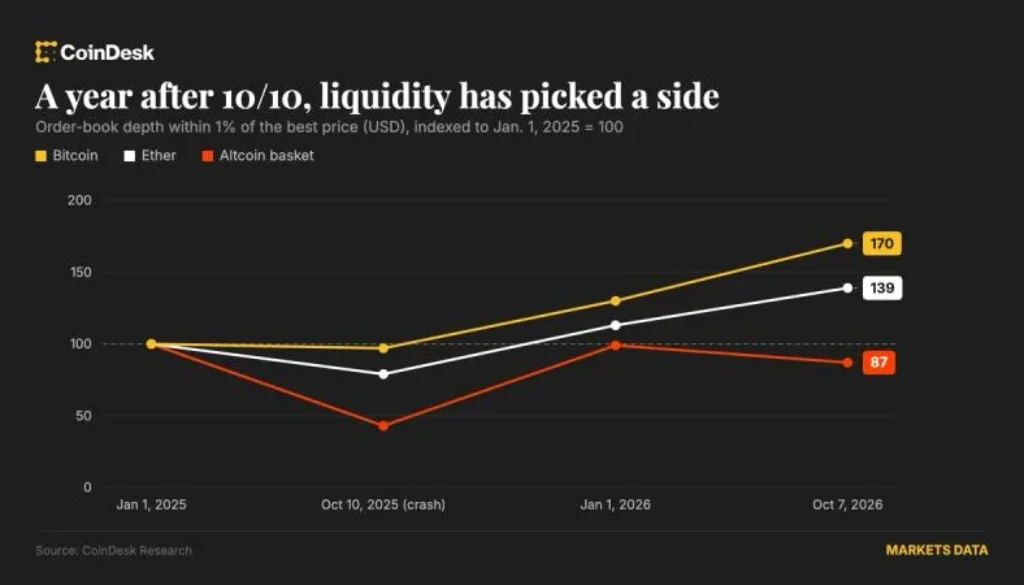
Bitcoin and ether have rebuilt order book depth to exceed pre-crash levels, signaling sustained institutional market-maker commitment, but altcoins show persistent capital flight that suggests a lasting bifurcation in crypto liquidity. This divergence matters to allocators weighing exposure across asset tiers and to traders assessing execution risk on smaller tokens.
- Bitcoin order book depth within 1% of price reached $11.7 million on October 7, up 75% from crash day a year earlier.
- Ether depth within 0.5% of price more than doubled since October 10, 2025, to approximately $4.2 million.
- Altcoin dollar depth fell roughly one-third since early 2025, masked by token price declines that created illusion of token-unit recovery.
- $19B Leveraged positions liquidated in single day on October 10, 2025
- 75% Increase in bitcoin order book depth year-over-year, in dollar terms
- $279B Average weekly spot trading volume, down from $801 billion during crash week
- $2M Altcoin depth at 5% from price, down one-third since January 2025
One year after the largest liquidation event in crypto history, the resilience of market infrastructure has split sharply along asset class lines. CoinDesk reported that bitcoin and ether order books now hold more resting liquidity than they did on October 10, 2025, when President Donald Trump’s announcement of 100% tariffs on Chinese imports triggered a flash crash that erased more than $19 billion in leveraged positions in a single day. Bitcoin had edged back to $122,600 that Friday morning after hitting a record high above $126,000 days earlier, before plunging below $105,000 in thin evening trade. Yet the broader market has not recovered uniformly, with smaller tokens and spot trading volume still trailing pre-crash levels by a wide margin.
Bitcoin and ether order books deepen despite lower token prices
Bitcoin’s order book is deeper now than on any of the four dates measured by CoinDesk Research: January 1, 2025, October 10, 2025, January 1, 2026, and October 7, 2026. On October 7 this year, approximately $11.7 million sat within 1% of the price, representing roughly 75% more depth than on crash day a year earlier, when about $9 million rested at that level, and up from about $6.9 million at the start of 2025. The gain holds in dollar terms despite bitcoin trading at roughly one-third below its pre-crash price, indicating that market makers have deployed more capital rather than simply benefiting from lower token valuations.
Ether’s recovery has been even more pronounced near the price. Depth within 0.5% of the price has more than doubled since crash day to approximately $4.2 million, while depth at 1% has risen by about three-quarters to roughly $5.3 million, exceeding both January 2025 and January 2026 readings. CoinDesk Researcher Saksham Diwan noted that “the majors’ deepening is real capital, not a price effect.” The rebuilt order books faced an early stress test this week as markets sold off, with bitcoin’s 1% depth declining about 12% between October 7 and October 8, though ether’s tightest band tightened only slightly while orders further from the price actually increased.
Altcoin liquidity continues to erode despite falling token prices
The liquidity story for altcoins moves in the opposite direction. In a CoinDesk Research basket of altcoins, dollar depth was greatest on January 1, 2025, and has declined on every measurement date since then. Depth at 5% from the price has fallen roughly one-third since the start of 2025 to around $2 million, while depth at 1% has dropped by about one-sixth. When measured in token units rather than dollars, altcoin depth appears healthier, having peaked on January 1, 2026, and eased only modestly since, but this apparent recovery masks a steady erosion in actual capital commitment as token prices have fallen.
Spot trading volume has not rebounded alongside the major coins. Weekly spot volume on centralized exchanges averaged around $279 billion over the four weeks to September 27, according to CoinDesk Research, nearly two-thirds below the $801 billion traded during the crash week itself. Activity bottomed in August at around $135 billion and has since roughly doubled, but remains well below the levels witnessed around October 10, 2025.
Market makers have rotated capital to bitcoin and ether for the foreseeable future
The divergence between major assets and altcoins appears structural rather than cyclical. Joshua de Vos, Research Lead at CoinDesk, said in a statement that “a year ago, we wrote that liquidity was thin and fragmented, and that it was unclear where capital would rotate once the dust settled. We now have an answer: bitcoin and ether. Market makers have returned to majors, with liquidity above pre-crash levels, whilst altcoin liquidity continues to trend down as a whole.”
De Vos added: “Beyond a select few alts, I expect this divergence to persist into next year as majors continue to dominate institutional interest and volumes.”
The BlockWest read. Market-maker capital concentration in bitcoin and ether reflects institutional risk appetite tilting decisively toward assets with the deepest, most reliable execution. For altcoin investors and traders, this is not a temporary liquidity crunch but a permanent reordering of the capital stack, with only the largest alternative tokens likely to retain meaningful market-maker interest going forward.
Watch whether altcoin liquidity stabilizes or continues its downward trend through the end of 2026, particularly during periods of market stress, which will signal whether the divergence between major and smaller assets becomes the new normal for institutional allocators.
BlockWest is a news publication. Nothing here is investment advice. Read our disclaimer and editorial policy.