US authorities seize $61 million in Tether stablecoins tied to Iranian oil sales
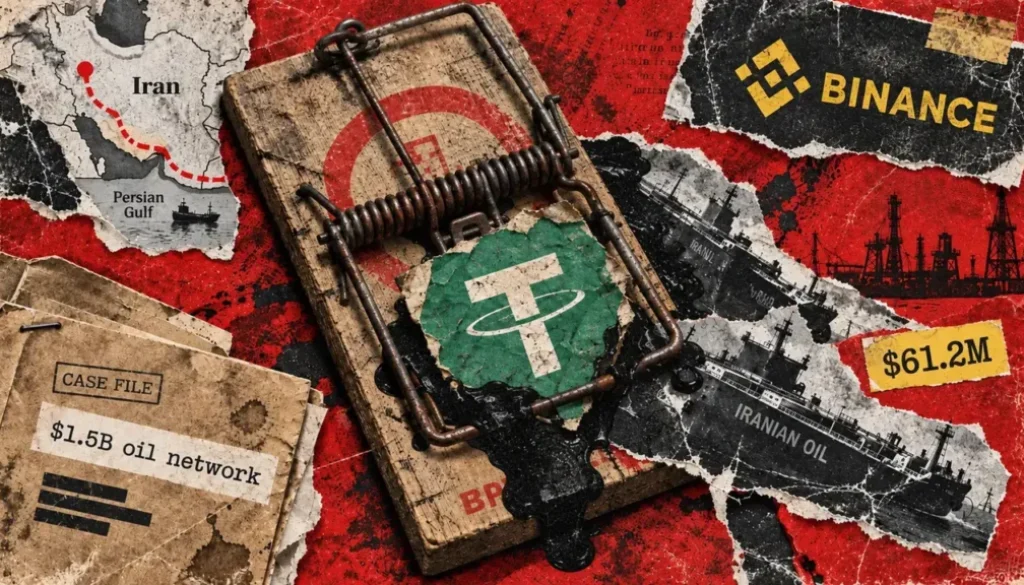
US authorities are targeting $61 million in frozen Tether stablecoins allegedly tied to Iranian military oil sales, establishing a new enforcement model where stablecoin issuers become execution partners in asset seizure. The case reveals how large cryptocurrency exchanges and token issuers now function as chokepoints in sanctions enforcement, even when the exchanges themselves face no allegations.
- US prosecutors filed a civil forfeiture complaint seeking $61.2 million in USDT across 10 Tron addresses on September 14.
- Tether had already frozen seven addresses in June 2025 and three additional addresses in July before the seizure warrant.
- Prosecutors traced a $1.5 billion network of alleged Iranian oil-sale proceeds flowing through Binance via two Hong Kong-incorporated intermediaries.
- $61.2M USDT targeted for forfeiture across 10 Tron addresses, smaller than total network traced
- $1.5B Total proceeds from alleged Iranian oil sales through wider cryptocurrency network
- 7 Interconnected addresses forming alleged “Entity A” receiving and distributing illicit proceeds
- June 2025 When Tether first froze addresses later targeted in the forfeiture action
The US Attorney’s Office for the Southern District of New York filed the civil forfeiture complaint targeting stablecoins it alleges originated from Iranian crude and petroleum sales intended to benefit Iran’s government and military, including the Islamic Revolutionary Guard Corps. The $61 million represents a fraction of a significantly larger financial network prosecutors say they have mapped, illustrating how targeted enforcement against specific assets can operate at scale within broader illicit flows. The story was first reported by CryptoSlate.
Tether’s role as Enforcement intermediary in Stablecoin seizures
The forfeiture mechanism unveiled in the complaint establishes a novel pathway for US authorities to take custody of cryptocurrency assets without direct access to private keys. Rather than seizing the original wallets, prosecutors seek to have Tether burn the 61.2 million frozen USDT and issue replacement tokens of equivalent value for transfer to an FBI-controlled hardware wallet. This approach treats Tether’s position as stablecoin issuer as functionally equivalent to a financial institution holding customer funds.
The mechanism reflects an intensifying enforcement partnership between US agencies and Tether, which has positioned itself as cooperative with law enforcement. Days before the Iran filing, Tether disclosed that the Justice Department credited it with assistance in a separate action involving more than $52 million linked to Xinbi Guarantee, an alleged money-laundering marketplace. Tether says it has worked with more than 340 law-enforcement agencies across 67 countries and helped freeze more than $5 billion tied to suspected illicit activity.
Binance’s $1.5 billion Oil Network traced through hong kong intermediaries
The broader investigation maps a network prosecutors describe as “Entity A,” consisting of at least seven interconnected addresses that received and distributed more than $1.5 billion in proceeds from alleged illicit Iranian oil sales. The addresses allegedly sent cryptocurrency to Iran-based exchange Nobitex and to Middle Eastern money transmitters prosecutors believe functioned as Islamic Revolutionary Guard Corps fronts.
Two Hong Kong-incorporated companies, Blessed Trust Limited and Hexa Whale Trading Limited, allegedly facilitated conversion of oil-sale proceeds from fiat currency into cryptocurrency and moved the funds through trading accounts at Binance. Blessed Trust presented itself as a wealth-management or digital-asset custody business, while Hexa Whale described itself as a commodities broker. The network also utilized conventional US banking channels, with one unnamed company allegedly sending approximately $37.15 million to Hexa Whale through US correspondent accounts in March and April 2024, followed by another $443.49 million to Blessed Trust between November 2024 and March 2025.
Binance denies knowledge while maintaining Sanctions compliance framework
Binance faces no allegations of wrongdoing in the filing, a distinction Chief Executive Richard Teng emphasized immediately after the complaint became public.
This case was not filed against Binance and does not allege any wrongdoing by Binance.
Richard Teng, Chief Executive, Binance
Teng stated the exchange has “zero tolerance” for sanctions violations or illicit activity and had cooperated with law enforcement since the matter was first raised months ago. Binance investigates, restricts or freezes accounts where sanctions or illicit-finance risks emerge, offboards users when appropriate, and reports them to authorities, he added. His response draws a clear distinction between alleged bad actors using Binance accounts and the exchange knowingly facilitating their activity, positioning account restrictions and user offboarding as the exchange’s enforcement contribution.
The BlockWest read. The case shows stablecoin issuers now function as execution agents within the sanctions enforcement chain. While Binance restricts accounts at the transaction layer, Tether controls the token layer itself, allowing authorities to seize assets without requiring access to private keys. This dual-layer enforcement architecture reduces the technical barriers to asset recovery but deepens institutional dependencies on centralized stablecoin operators.
The outcome depends on Tether’s willingness to execute the token burn and reissuance to FBI custody, a procedure the complaint describes but which Tether has not yet confirmed it will perform. The court must also approve the seizure warrant, and questions remain whether USDT held on Tron will be subject to the same enforcement mechanisms as Ethereum-based USDT.
BlockWest is a news publication. Nothing here is investment advice. Read our disclaimer and editorial policy.