Senate blocks CLARITY Act over ethics disputes on officials’ crypto holdings
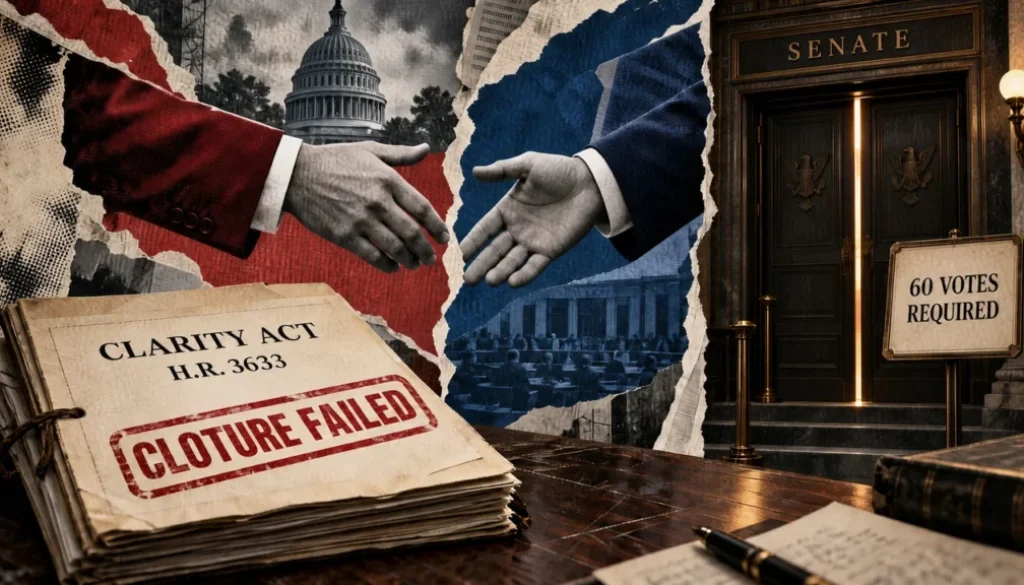
The Senate’s rejection of the CLARITY Act represents a significant setback for crypto market regulation in the US, with bipartisan negotiations fracturing over ethics guardrails for public officials’ crypto holdings. The defeat underscores how policy disputes unrelated to market structure can derail broad legislative efforts in crypto, raising questions about the path forward for digital asset regulation.
- The CLARITY Act failed to secure 60 votes needed for cloture, falling short on the motion to proceed with H.R. 3633.
- Seven Democratic senators who helped craft the bill voted against advancing it, including Gillibrand, Warner, Booker, Warnock, Gallego, Alsobrooks and Cortez Masto.
- A final negotiating session in Sen. Thom Tillis’s Capitol office broke down over ethics restrictions on crypto interests held by senior government officials.
- 60 Votes required to invoke cloture; CLARITY Act fell short
- 126 Substantive changes Republicans incorporated into 635-page final text
- $300M Crypto industry spending on midterm elections, per Bernie Sanders
- $1.4B Total collected by Trump and family from crypto ventures
The CLARITY Act stalled in the Senate on Tuesday (September 16) after final bipartisan negotiations collapsed and key Democratic authors of the legislation withdrew their support. The measure, H.R. 3633, failed to reach the 60-vote threshold required to invoke cloture on the motion to proceed, preventing the most comprehensive US crypto market-structure proposal from advancing to a full floor debate. CryptoSlate reported that the outcome was particularly damaging because the Democratic defectors had spent months shaping the bill before turning against it in its final stages.
Seven key Democrats reversed course over Ethics guardrails
Sens. Kirsten Gillibrand, Mark Warner, Cory Booker, Raphael Warnock, Ruben Gallego, Angela Alsobrooks and Catherine Cortez Masto all voted against the motion to proceed, breaking ranks with Republicans who had built the legislation around bipartisan compromise. Their defections followed a failed last-minute attempt to resolve disagreements over ethics rules governing crypto interests held by public officials and Trump administration members. Senate staff had gathered in Sen. Thom Tillis’s Capitol hideaway office to discuss possible final changes to these restrictions, but staff working for Senate Banking Committee Chairman Tim Scott ended the talks without reaching agreement.
That left Republicans heading into the vote without the Democratic coalition they had spent months assembling.
Republicans offered 126 changes; Ethics concerns persisted
Republicans released a major rewrite over the weekend that incorporated 126 substantive changes Democrats had sought, and President Donald Trump agreed to tougher restrictions on crypto-related financial interests held by senior officials. The 635-page final text represented significant movement from the GOP position, yet the concessions still failed to retain the support of Democrats most closely involved in drafting the legislation. The ethics package emerged as the decisive fault line in the final hours before the vote.
Sen. Elissa Slotkin said she opposed the bill because its restrictions on crypto interests held by Trump, his family and administration officials remained too weak. “The ethics provisions in this bill are simply too thin,” she stated, arguing that Congress should impose rules strong enough to prevent any future administration, whether Democratic or Republican, from using public office to benefit from crypto ventures. Slotkin also raised national-security concerns, questioning whether the Commodity Futures Trading Commission and other agencies tasked with enforcement had sufficient staffing and oversight capacity, and pointing to gaps in rules addressing money laundering and financing channels linked to terrorist groups, North Korea and Iran.
Slotkin indicated her opposition was directed at the current bill’s ethics language rather than market-structure legislation itself, saying the measure contained bipartisan provisions that could form the basis for future negotiations.
Bernie sanders highlights industry spending and trump’s financial stakes
Sen. Bernie Sanders took a broader approach, tying opposition to the legislation to the crypto industry’s political spending and Trump’s financial interests in the sector. Sanders said crypto billionaires had spent nearly $300 million on the midterm elections while Trump and his family had collected more than $1.4 billion from crypto-related ventures. He accused the industry of seeking favorable treatment from Congress and urged senators to reject the legislation.
Republicans face difficult path to revive the bill
The failed vote leaves Republicans with limited options for moving forward. Reviving the CLARITY Act would likely require reopening provisions they had already presented as their final compromise, particularly the ethics rules that failed to retain the support of the Democrats most closely involved in drafting the bill. Sponsors must now decide whether another round of negotiations is possible or whether the legislative moment for comprehensive crypto market-structure reform has passed.
The BlockWest read. The ethics fight was ultimately a proxy battle over Trump’s personal and family exposure to the crypto sector. Rather than debating whether market structure reforms serve investors or traders, Democrats centered their objection on whether safeguards could prevent the sitting president from leveraging his office to advance his own crypto positions. This suggests that any future attempt at crypto legislation will need to address conflict-of-interest questions head-on, not as an afterthought.
Republican leaders must decide whether to attempt reopening negotiations on ethics provisions or pursue a narrower market-structure bill without them. Any decision to revive talks would require conceding ground they have already marked as final, and Slotkin’s stated openness to future negotiations provides no certainty that another round would succeed or retain the Democratic support the measure needs.
BlockWest is a news publication. Nothing here is investment advice. Read our disclaimer and editorial policy.