CME’s weekend crypto trading exposes liquidity gap until Fed upgrades settlement system
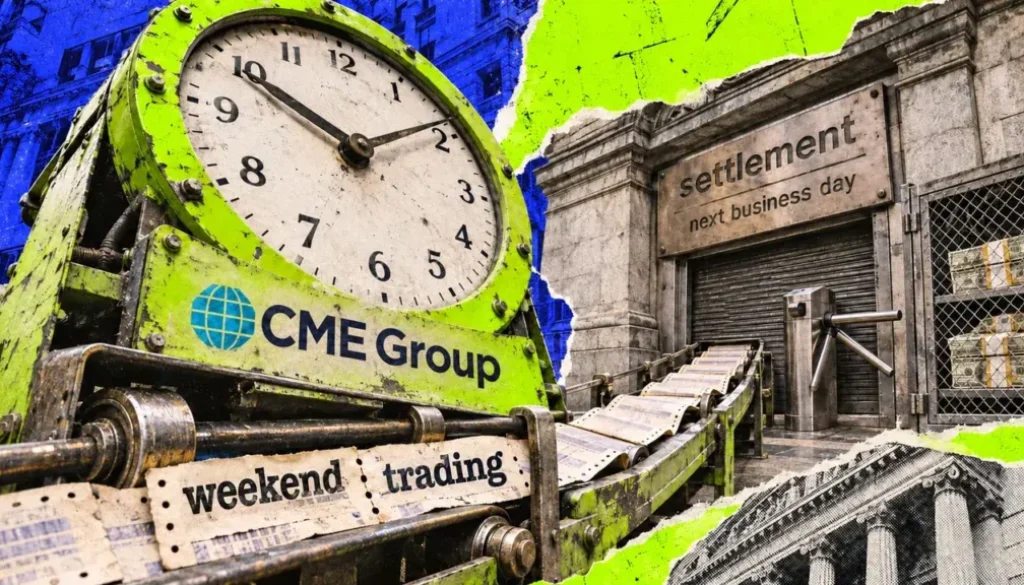
Wall Street’s push for round-the-clock trading in crypto and tokenized assets depends on who holds cash when settlement systems are closed. A June disruption at securities clearinghouses exposed risks that extend beyond trading hours, forcing institutions to decide how much weekend business they can take on without exhausting their liquidity.
- CME opened cryptocurrency futures and options to weekend trading in May 2026, but processes clearing and settlement on business days only.
- A June settlement delay at DTCC subsidiaries left cash trapped in a central counterparty’s Federal Reserve account, reducing bank reserves available for other payments.
- Federal Reserve plans to expand Fedwire Funds and the National Settlement Service to Sundays and weekdays no earlier than 2028, with daily hours of 22 and 21.5 hours respectively.
- $2 Average dollars payable per $100 in equity obligations after multilateral netting by NSCC
- $3.73B Median largest single-participant payment obligation at CME, Q3 2022 through Q3 2025
- $24.31B Median payment under severe but plausible stress conditions at CME
- 2028 No earlier than this year for Fed expansion of Sunday and holiday payment system hours
According to reporting by CryptoSlate, Wall Street’s expansion into continuous trading has created a structural gap between when traders can act and when the financial infrastructure processes their transactions. CME opened its crypto derivatives markets on weekends in May 2026, but the exchange continues to assign all weekend trades to the next business day for clearing and settlement. The arrangement lets investors manage exposure outside traditional hours while deferring the operational burden of moving money. Yet that deferral exposes the system to risks that a June incident at the Depository Trust and Clearing Corporation illustrated with force.
How a settlement delay trapped liquidity at the Federal Reserve
On June 29, a market participant submitted erroneous trades to DTCC’s subsidiaries, the Depository Trust Company and the National Securities Clearing Corporation, creating an unusually large payment obligation. Both entities invoked market-disruption rules and requested extensions from the Federal Reserve while attempting to reverse the trades, but ran out of time at the 8:30 p.m. deadline that day. The balances carried into June 30, and settlement for both days processed the following day, but not before the delay disrupted the flow of cash through the banking system.
The Chicago Federal Reserve’s November account of the disruption explained the mechanism. When cash accumulated in the central counterparty’s account at the Fed and could not immediately return to the banks that were owed the money, bank reserves declined by the same amount, even though the cash remained within the Federal Reserve system. Chicago Fed official Cindy Hull identified two reasons short-term interest rates did not spike: market participants trusted the payments would eventually settle, and the banking system held enough reserves to absorb the temporary reduction.
The incident exposed a vulnerability in the current architecture. Companies that both clear trades and maintain their own Federal Reserve accounts can hold cash that other banks cannot access, creating a bottleneck. When settlement delays, that cash sits in an account outside the banking system’s working reserves, potentially reducing the liquidity available for other payments.
Netting requirements and collateral management under weekend trading
The National Securities Clearing Corporation uses a process called multilateral netting to compress payment obligations. By offsetting what companies owe on purchases against what they are owed on sales, NSCC reduces equity payment obligations by an average of 98%, leaving roughly $2 payable per $100 in original obligations. That dramatic compression shows why clearing systems can function even when individual payments are large, but it also reveals the dependency on timely access to available funds.
When CME and other platforms extended trading to weekends, clearinghouses had to decide how much new risk participants could take on. According to a May 2025 Nodal filing, clearing members supporting weekend trading on selected Coinbase derivatives faced two options: either limit weekend positions to half the customer’s excess margin, or allow customers to use all excess margin minus any unrealized losses on positions they still held. Gains on those positions would only count toward buying power after margin recalculation on the following business day. Members participating in weekend contracts also pay a surcharge into the guaranty fund, a mechanism designed to prevent customers from building positions on money they were still waiting to receive.
Federal Reserve expansion plans and payment system capacity
The Federal Reserve approved an expansion of the Fedwire Funds and National Settlement Service to run on Sundays and weekday holidays no earlier than 2028, with daily hours of 22 and 21.5 hours respectively. The expansion maintains the Sunday-through-Friday schedule but extends coverage beyond the current Monday-to-Friday window.
That timeline leaves a gap. CME’s weekend crypto trading and forthcoming 24/7 tokenized securities trading will operate for years before the Fed’s core payment infrastructure expands to match. FedNow, the Fed’s instant payment service, already runs through the weekend, but its transaction limit of $10 million, approved in November 2025, falls well short of what major clearing members need to move. Chicago Fed researcher David DeCarlo analyzed CME’s quarterly disclosures from the third quarter of 2022 through the third quarter of 2025 and found that the median largest payment any single participant had owed over a year was $3.73 billion, with a median estimate under severe but plausible conditions reaching $24.31 billion. Those figures cover CME’s broader clearing business, not just weekend crypto trading, but they demonstrate why payment size and processing capacity matter as much as extended trading hours.
On November 11 (Wednesday), OKXICE, a joint venture between OKX and the owner of the New York Stock Exchange, announced a November 23 (Monday) launch for round-the-clock trading in more than 70 expected tokenized securities, including 59 Direxion ETFs, relying on a temporary SEC exemption. The announcement left open when the related banking and redemption services would become available.
Stablecoin providers like Circle have begun pre-positioning cash at partner banks to offer near-real-time redemptions around the clock, accepting lower interest on that cash in exchange for faster settlement. The arrangement works when only some customers need immediate access, but the June settlement delay raises questions about how well such arrangements hold up under stress. When an expected payment gets delayed on Saturday morning, somebody needs sufficient cash on hand and the authority to approve a replacement payment before the banking system fully reopens.
The BlockWest read. The infrastructure constraints exposed in June suggest that 24/7 trading won’t actually speed settlement times for most traders. Institutions are instead layering additional risk management rules on weekend positions and pre-positioning collateral at banks to simulate continuous access. The real cost of weekend trading may not be reflected in trading volume but in the higher operational reserves and guaranty fund surcharges that clearing members now carry.
The Federal Reserve’s expansion of Fedwire and the National Settlement Service to Sunday and holiday hours remains scheduled for no earlier than 2028, leaving a multiyear gap in which weekend and holiday trading will occur without corresponding expansion of the Fed’s payment infrastructure. Market participants and regulators will need to clarify what happens if another disruption occurs on Saturday when core clearing and settlement systems are offline and when the Fed’s extended-hours payment services remain unavailable.
BlockWest is a news publication. Nothing here is investment advice. Read our disclaimer and editorial policy.