US Bank Transfers USBDC Between Countries Using Stellar Network Within Internal Operations
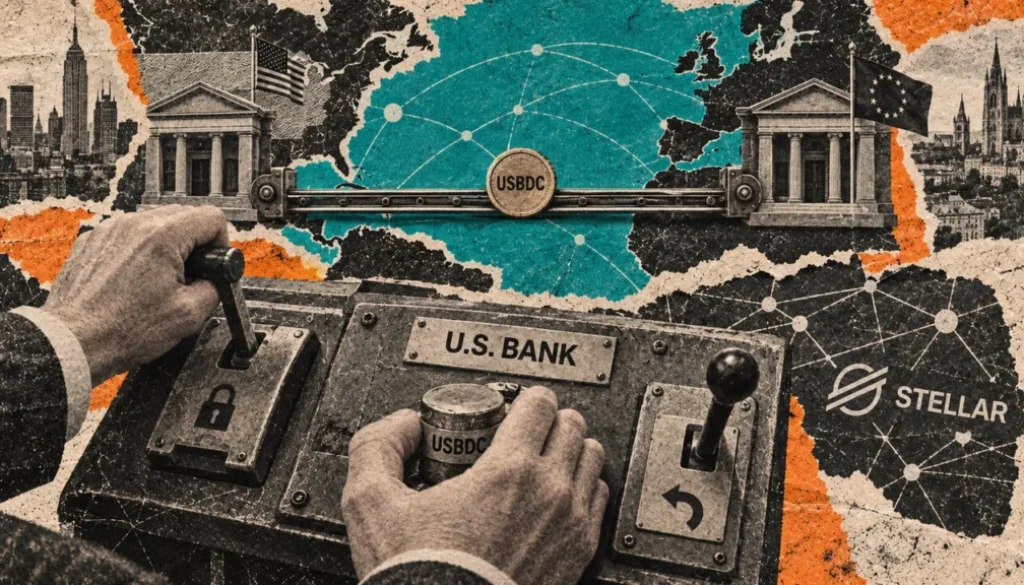
U.S. Bank has demonstrated internal cross-border payments using its proprietary stablecoin on a public blockchain, validating its technical and control infrastructure for institutional use. The pilot, while limited to transfers between the bank’s own regional entities, signals potential for broader institutional applications in treasury and liquidity management.
- U.S. Bank completed a live cross-border payment pilot using USBDC between its North America and Europe entities on Stellar blockchain on September 9.
- The pilot tested four critical functions: minting, redemption, freezing, and clawback capabilities within a single live transaction, not as future features.
- The transaction remained internal to U.S. Bank’s corporate structure and did not involve external banks, merchants, or retail customers.
- 4 Core token control functions tested in single live transaction: minting, redemption, freezing, clawback
- 2 Regions spanned by cross-border payment: North America and Europe entities
U.S. Bank announced the completion of a live cross-border payment pilot using USBDC, its U.S. dollar-backed stablecoin, demonstrating the movement of value between its own regional entities across Stellar, a public blockchain network designed for payments. The September 9 announcement emphasized that the transaction successfully integrated blockchain infrastructure with the bank’s existing financial controls, risk management, and compliance systems. However, the bank did not disclose the transaction amount, provide a timeline for customer access, or outline a commercial rollout plan.
The pilot represents a milestone in the evolution of bank-issued stablecoins, a category that has grown in prominence as institutions seek to modernize payment infrastructure and reduce settlement times. Unlike consumer-focused stablecoins that prioritize speed and accessibility, bank-issued versions like USBDC prioritize control, regulatory alignment, and integration with traditional banking operations. The use of Stellar, a public blockchain rather than a private or permissioned network, adds an additional layer of validation by showing that institutional-grade controls can operate transparently on shared infrastructure.
Internal test validates token controls and Banking integration
The pilot evaluated four critical functions across a single live transaction: minting, redemption, freezing, and clawback. Minting and redemption govern how U.S. Bank creates and removes token units from circulation, while freezing and clawback provide the issuer with tools to halt or reverse token movement when necessary. By testing these controls within an active cross-border payment rather than presenting them only as theoretical features, U.S. Bank demonstrated that its token lifecycle can operate under issuer control while using public blockchain infrastructure.
The freezing and clawback functions are particularly important for regulated financial institutions. Freezing allows the bank to temporarily halt a token holder’s ability to transact, a function useful for compliance, sanctions enforcement, or dispute resolution. Clawback enables the reversal of a transaction after settlement, providing recourse options that traditional banking systems have long offered. These capabilities address regulatory and institutional expectations that blockchain-based payments cannot simply eliminate intermediary oversight in favor of immutability.
The bank’s internally developed Digital Asset Platform served as the foundation for issuing, managing, and transferring USBDC and remained integrated with its core finance, risk, compliance, and operations infrastructure throughout the pilot. This integration covered both token movement on Stellar and the banking processes that accompany it, validating that the platform can bridge traditional banking systems and blockchain networks without sacrificing institutional governance standards.
Limited scope: Intercompany transfer, not customer-facing settlement
Both ends of the cross-border transaction remained within U.S. Bank’s corporate structure, meaning the pilot did not test settlement with external banks, merchants, or retail customers.
This constraint shapes what the pilot establishes about USBDC’s readiness for market deployment. The successful movement of value across regions on Stellar demonstrates technical feasibility and control architecture for internal institutional use, but stops short of proving the token can operate in a competitive, multi-party payments ecosystem. The test covers an important but narrow slice of the payment landscape. Intercompany transactions represent a logical starting point for any new payment technology, as they eliminate counterparty risk and regulatory complexity associated with third-party involvement.
The banking industry has historically validated new payment infrastructure through internal pilots before expanding to correspondent relationships and eventually customer-facing services. USBDC appears to follow this established progression. Testing at the intercompany level allowed U.S. Bank to verify that its token controls, blockchain integration, and compliance automation function reliably without exposing external parties to operational or regulatory unknowns.
Stellar foundation eyes broader Institutional applications
The Stellar Development Foundation noted that the network’s issuer-control features supported the test and stated that U.S. Bank and the organization are now exploring other institutional applications, including liquidity management, collateral mobility, and cross-border treasury operations. Each represents an extension of the same control-and-integration approach to different corners of institutional money movement, though neither organization presented these possibilities as committed products or timelines.
Liquidity management and collateral mobility represent particularly significant use cases for stablecoins in wholesale banking. Financial institutions routinely move collateral between entities and counterparties to optimize capital efficiency and manage risk. A tokenized dollar stablecoin with issuer controls could potentially accelerate these processes by eliminating intermediaries and reducing settlement times from days to minutes or seconds. Treasury operations, where corporations manage their distributed cash positions across multiple jurisdictions, faces similar pain points that blockchain-based settlement might address.
USBDC remains an institutional pilot rather than a publicly available stablecoin. The next material signal will come when U.S. Bank either expands the token beyond intercompany transfers, discloses additional operating details, or announces a timetable for client access.
BlockWest is a news publication. Nothing here is investment advice. Read our disclaimer and editorial policy.