The Tokenized Stock Market on Wall Street Is Becoming Increasingly Chaotic

Major Wall Street exchanges are racing to move equities onto blockchain infrastructure, but rapidly emerging technical and regulatory challenges threaten to derail the market before it matures. The infrastructure debate now centers on whether tokenized stocks can actually deliver the liquidity, privacy, and investor protections that institutions demand.
- Nasdaq committed $100 million to Payward for tokenized equity infrastructure; LSEG partnered with Payward on tokenized UK shares and planned 24-hour trading.
- Tokenized stocks reached $2.91 billion in total value and $13.31 billion in monthly transfer volume as of September 10, held by over 3.17 million addresses.
- Infrastructure gaps remain unresolved across liquidity, privacy, regulatory compliance, and the distinction between true ownership and derivative exposure products.
- $100M Nasdaq’s investment in Payward for tokenized equity infrastructure development
- $2.91B Total value of distributed tokenized stocks tracked as of September 10
- 174% Growth in holder addresses over 30 days, compared to 53% drop in monthly transfer volume
- 3.17M Addresses holding tokenized stock assets, signaling broad but shallow participation
Wall Street’s push to tokenize equities accelerated sharply this week with two landmark commitments to blockchain infrastructure. Nasdaq agreed to invest $100 million in Payward, the parent company of Kraken, to build systems for bringing tokenized equities to market. Days earlier, London Stock Exchange Group announced a partnership with Payward focused on tokenized UK shares and a planned 24-hour trading venue. Yet beneath these headline deals, experts gathering at the Onchain Leaders Gathering in Geneva on September 8 signaled that moving stocks onchain creates far deeper problems than mere technical infrastructure.
The tokenization movement reflects a broader shift in financial markets toward distributed ledger technology. Traditional stock exchanges have operated on centralized systems for centuries, with clearing houses and custodians serving as intermediaries between buyers and sellers. Blockchain-based systems promise to eliminate these intermediaries, reduce settlement times from days to minutes, and create 24-hour trading venues that never close. However, this vision collides with decades of regulatory frameworks designed around centralized market structures and the need to protect retail investors from fraud and manipulation.
Infrastructure gaps widen as market volume stalls
The tokenized stock market has grown to measurable scale but shows warning signs of instability. As of September 10, distributed tokenized stocks held a total value of $2.91 billion across more than 3.17 million addresses, with monthly transfer volume reaching $13.31 billion. Yet growth metrics diverge sharply: the number of holder addresses jumped 174% over 30 days while monthly transfer volume dropped almost 53% during the same period.
That imbalance points to a critical vulnerability. More addresses entering the market does not translate to deeper liquidity or sustained trading activity. For institutions evaluating onchain equity markets as genuine alternatives to traditional exchanges, shallow trading volume undermines the case for tokenization. The panel discussion at Geneva featured experts from Zama, the G-20 Group, Blobb.io, and Rex Change who identified liquidity, privacy, compliance, and market access as the four main barriers institutions still face.
Liquidity remains the most visible problem. Traditional stock exchanges benefit from centralized order books where all buyers and sellers converate simultaneously, creating tight bid-ask spreads and reliable execution prices. Decentralized blockchain systems fragment liquidity across multiple platforms and venues, making it harder to execute large orders without substantial price slippage. This fragmentation particularly concerns institutional investors who move millions of dollars in single transactions and need confidence that they can enter and exit positions at predictable prices.
True enterprise adoption happens when we move beyond isolated proofs-of-concept
Antoine Hello, Director of Financial Institutions at Zama
Hello’s firm develops confidential blockchain infrastructure for financial institutions and argued that public blockchain systems must handle real institutional volume while protecting sensitive financial data.
Privacy concerns run equally deep. Public blockchains record all transactions permanently and transparently, creating an immutable record that competitors and regulators can analyze. Major financial institutions fiercely protect information about their trading activity, client positions, and investment strategies. Some blockchain projects have proposed privacy-enhancing technologies like zero-knowledge proofs or confidential transactions, but these remain experimental at scale and introduce additional technical complexity and regulatory uncertainty.
AMC token dispute exposes ownership problem
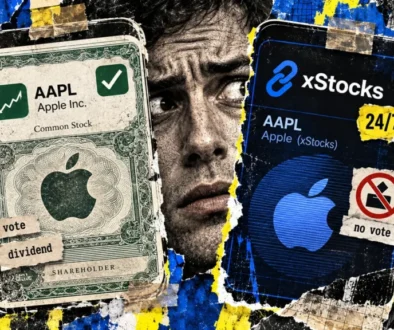
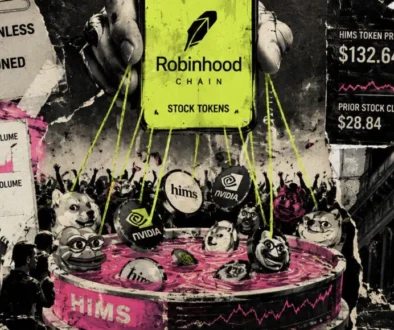
The structural gaps between tokenization and real equity ownership became impossible to ignore this week when AMC CEO Adam Aron publicly attacked Robinhood over its tokenized AMC offering. Robinhood offered tokenized exposure to AMC without the company’s approval. Holders of these products gain price exposure to the stock but do not own actual AMC shares and receive no shareholder rights, voting power, or dividends.
Robinhood CEO Vlad Tenev defended the structure by arguing that companies cannot control every third-party financial product that references their shares. The World Federation of Exchanges took a harder line, labeling some third-party tokenized equities as “mimics” and warning that they could weaken investor protections and market integrity. This distinction matters directly to institutional adoption: if a tokenized stock does not convey actual ownership, it functions as a derivative rather than a true capital market instrument.
This ownership question exposes a fundamental choice facing the industry. True tokenization requires creating a direct link between the token on the blockchain and the actual share registered in the company’s shareholder ledger. This requires deep coordination between blockchain platforms, exchanges, transfer agents, and the companies themselves. The alternative, which some platforms have chosen, is to offer synthetic or derivative products that track the stock price without conveying ownership. Derivatives are faster and simpler to issue but provide none of the regulatory or legal clarity that institutions demand.
What institutions need before tokenization goes live
Diana-Cezara Toader, Head of Digital Assets at UBS Asset Management, acknowledged during a separate Geneva panel that her firm is already “very much in production now” with tokenization pilots. She identified liquidity, common infrastructure, and regulation as the three remaining barriers to moving from limited pilots into genuinely live markets at institutional scale.
Common infrastructure is perhaps the thorniest problem. Currently, multiple competing blockchain platforms claim to be the future home for tokenized equities, including Ethereum, Polygon, XRP Ledger, and private permissioned networks. Each platform has different technical standards, regulatory relationships, and ecosystem partners. For tokenized stocks to function as a genuine market, they need interoperability across these platforms, standardized settlement procedures, and shared custody infrastructure that does not yet exist at production scale.
Francesco Ranieri Fabracci, Head of Tokenization Expansion at Tether, distilled the core problem: “To tokenize something, you need to make the token useful.”
Regulatory uncertainty compounds all these technical challenges. The SEC, FCA, and other securities regulators have not yet issued comprehensive guidance on what it means for a token to represent genuine equity ownership or how tokenized equity trading venues will be regulated. This ambiguity makes it difficult for large institutions to commit capital to tokenization infrastructure without risking regulatory surprises later. Some regulators remain deeply skeptical that decentralized blockchain systems can meet existing requirements for market surveillance, transaction reporting, and investor protection.
Nasdaq and LSEG are betting they can do exactly that by building the infrastructure to support deep, reliable onchain equity markets. The test now shifts from whether Wall Street will tokenize stocks to whether the blockchain systems underneath can deliver the institutional-grade liquidity, privacy, and ownership rights that make the traditional stock useful in the first place. If tokenized equities remain illiquid, opaque to regulators, or disconnected from actual shareholder claims, the infrastructure race will have achieved tokenization without solving the market.
Watch for developments from Nasdaq and LSEG’s infrastructure rollouts over the next 12 months, regulatory guidance from the World Federation of Exchanges and securities regulators on what constitutes genuine tokenized equity ownership, and whether monthly transfer volumes on tokenized stock platforms stabilize or continue to decline despite rising holder numbers.
BlockWest is a news publication. Nothing here is investment advice. Read our disclaimer and editorial policy.