Ethereum staking yields and ETH value are now at odds as the debate over token supply intensifies
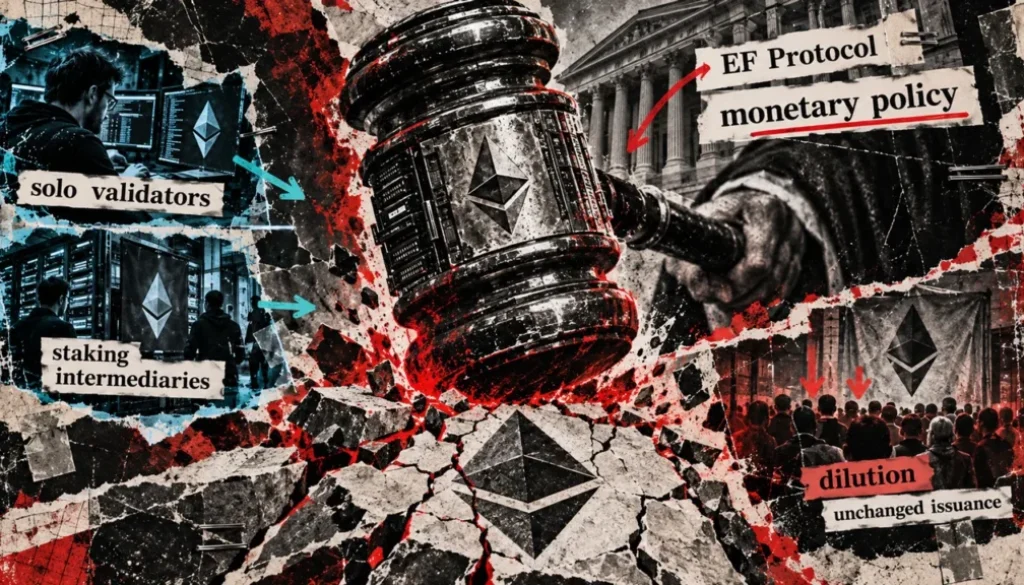
Ethereum faces a fundamental tension between maintaining high staking yields and reducing supply dilution for holders, with the decision now requiring broader ecosystem consensus beyond the core protocol team. The choice will reshape the incentives for both validators and unstaked participants, determining how much security the network pays for and who bears that cost.
- EIP-8363 proposes burning part of validator rewards to reduce issuance, but the Ethereum Foundation’s Protocol cluster declined to prioritize it and called for wider community input.
- At current 35% staking levels, annual issuance dilutes unstaked holdings by approximately 0.88% while validators earn about 0.81 ETH annually on a 32 ETH stake.
- The proposal hinges on unresolved questions about whether lower rewards would protect independent operators or accelerate centralization among large intermediaries.
- 35.13% Share of total Ethereum supply currently staked by validators
- 0.88% Annual dilution to unstaked holdings under existing policy at current staking share
- 2.54% Current consensus APR at 35% staking, falling to 1.03% after proposed transition
- 60.25M ETH saturation threshold at which proposed reward burn fully offsets issuance
Ethereum’s core protocol team has declined to make supply issuance policy a priority for the upcoming Hegotá upgrade, instead insisting the decision belongs to a broader process involving stakers, holders, application developers and node operators. The Ethereum Foundation’s Protocol cluster graded EIP-8363, which would burn a portion of validator rewards to reduce net issuance, as declined for inclusion in its own priorities on September 7, with all four reviewers in agreement. The cluster stopped short of rejecting the proposal on its merits and explicitly reserved judgment, instead calling for ecosystem-wide deliberation on a question that affects both the security budget and the wealth of multiple stakeholder groups.
The dilution-yield tradeoff at current Staking levels
Current network conditions create a stark economic division. Approximately 42.9 million ETH, or 35.13% of total supply, is staked with validators, while an additional 1.975 million ETH sits in the entry queue awaiting activation. Under the existing issuance curve, this staking participation generates roughly 1.086 million ETH in annual consensus rewards at current rates, compensating validators for their participation in consensus and capital lock-up.
Unstaked holders, who retain the same absolute number of coins, see their proportional ownership decline as new issuance expands the supply.
In the 35% staking scenario with no fee burn offset, an unchanged unstaked holding shrinks by approximately 0.88% of its share of total supply over a year. A performing 32 ETH validator stake, by contrast, earns roughly 0.81 ETH annually in consensus rewards before expenses and penalties. The current system thus preserves a two-tier allocation: validators receive issuance in exchange for operational duties and lockup risk, while unstaked holders bear dilution without any compensating rewards. Base-fee burn can offset some or all of that dilution, but the distinction between gross issuance and net supply growth remains economically consequential for holders who do not participate in staking.
EIP-8363’s reward cut and the transition schedule
EIP-8363 would deduct and burn a portion of idealized validator rewards, with the burn fraction rising as total active balance increases. The proposal sets a saturation threshold of 60.25 million ETH, intended to represent roughly half the supply at fork time, where issuance would be fully offset by the burn. That fixed threshold will drift as a percentage of supply over time, making long-term estimates of the cut’s magnitude dependent on future participation levels.
The implementation includes a temporary cushion. At activation, the base reward factor would double from 64 to 128, then return to 64 over approximately 18 months, easing the transition for validators. In the illustrative 35% staking scenario, consensus APR would begin near 2.05% and decline to approximately 1.03% after the full transition, compared with 2.54% under the existing formula. The corresponding annual consensus reward on a 32 ETH stake would fall from 0.81 ETH to about 0.33 ETH. MEV and execution priority fees would remain outside the burn mechanism, and validators could still earn additional income from execution layer priority fees.
The activation epoch remains unset, leaving both the timing and the final technical specification open. Writing a complete specification, securing broad agreement to include it, testing the implementation, and activating the tested software are separate steps in Ethereum’s offchain governance process.
Concentration risk and the contested case for reduced Rewards
Proponents of EIP-8363 argue that rising staking participation increases reliance on custodians and other intermediaries, creating vulnerability to capture and centralizing control of Ethereum’s consensus set. The argument centers on who controls the stake and whether that control threatens the network’s independence from concentrated actors.
The opposing case challenges whether lower rewards would improve validator composition. Participants including goodroot and vshvsh have warned that cutting rewards could render independent solo operators uneconomic before large providers able to spread operational costs across hundreds or thousands of validators. Resolving this dispute requires concrete evidence about operator costs and how different validator types’ economics change under the proposed cut. The same reduction in rewards could have opposite effects on an independent operator and a multinational custodian managing many customers’ stakes.
Participant goodroot questioned whether higher-cost solo operators would become uneconomic before large providers able to spread costs across more validators.
Participant in public discussion on EIP-8363
The interests of holders and stakers overlap but are not identical. Stakers own ETH and benefit from reduced dilution, but they also depend on validators remaining economically viable. Unstaked holders depend on the security that validator rewards help fund. A credible decision must account for both risks without assuming either group has captured the outcome.
Governance path from endorsement to activation
Ethereum’s documented governance process is offchain and inclusive, involving holders, application users, developers, node operators, validators and protocol developers. Community consensus requires broad participation rather than any single mechanism such as a coin vote. Representation matters because a process dominated by reward recipients could systematically underweight dilution borne by others, while one focused only on supply scarcity could underweight the costs of secure network operation.
The Ethereum Foundation’s approach draws a distinction between protocol priority-setting and broader ecosystem decision-making. EF Protocol has announced a September 16 Reddit AMA at 14:00 UTC to discuss its framework and invite challenges to its tier list, offering a public forum for continued deliberation. However, that forum does not resolve the question of how broad agreement converts to tested implementation and eventual activation.
Solana’s approach to its own inflation-cut proposal offers a useful model: its governance proposal is marked Accepted as a statement of endorsement, while the underlying technical specification remains in Review and the activation schedule is explicitly decoupled from the endorsement decision.
Ethereum likewise needs a visible route from broad ecosystem agreement through specification, testing and activation before participants can treat changed rewards as settled policy. Until that path is defined and traveled, the existing allocation stands: validators receive issuance for their consensus participation, while unstaked holders retain their coins without receiving any portion of those protocol-issued rewards. The pending decision is whether a lower reward budget can be reconciled with a validator set that remains both economically viable and sufficiently decentralized to meet Ethereum’s security model.
The Ethereum Foundation’s September 16 Reddit AMA at 14:00 UTC will serve as an immediate checkpoint for community feedback, but the critical next step remains undefined: the ecosystem must agree on the evidence required to justify a change, establish who can authoritatively commit to activation, and set a timeline for moving from consensus to tested implementation.
BlockWest is a news publication. Nothing here is investment advice. Read our disclaimer and editorial policy.