Former White House official converts confidential speech manuscript into $107,000 through prediction market trades until regulatory agency intervenes
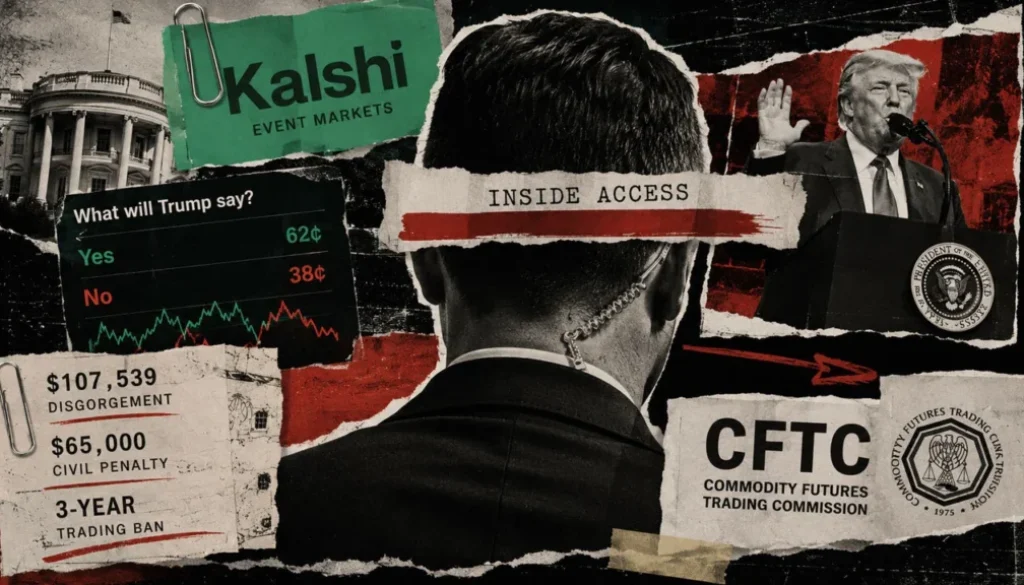
A White House teleprompter operator traded on advance knowledge of presidential speeches in prediction markets, generating over $107,000 in profits before regulators intervened. The case underscores the tension between prediction markets’ growing mainstream adoption and their vulnerability to insider information abuse.
- Gabriel Perez, a White House teleprompter operator, traded presidential mention contracts between December 2025 and February 2026 using advance text access.
- The CFTC ordered Perez to disgorge $107,539.02 in profits, pay a $65,000 civil penalty, and accept a three-year trading ban.
- Kalshi’s surveillance team flagged and referred the trades to the CFTC, but the exchange’s detection came after profits were already realized.
- $107,539.02 in prediction-market profits that Perez generated through insider trading activity
- $65,000 civil monetary penalty imposed, substantially reduced due to Perez’s cooperation
- 3 years trading ban duration imposed as part of the administrative settlement
Gabriel Perez, employed as a White House teleprompter operator, exploited access to presidential speech texts to trade contracts on prediction market Kalshi that settled based on whether the President would use specific words or phrases during speeches. Between December 2025 and February 2026, Perez converted this material nonpublic information into more than $107,500 in profit, according to a Commodity Futures Trading Commission settlement order released this month. The case marks a high-profile enforcement action against insider trading in prediction markets at a moment when these platforms are expanding into mainstream finance.
Prediction markets have gained increasing legitimacy and visibility in recent years, with platforms like Kalshi operating as regulated derivatives exchanges under CFTC oversight. These markets allow participants to buy and bet on the outcomes of future events, from election results to corporate earnings announcements, with contract prices theoretically reflecting collective probability assessments. The Perez case represents the first major enforcement action against insider trading within this rapidly growing segment of financial markets.
How advance speech access created an unfair Trading edge
Perez’s position as teleprompter operator gave him knowledge of prepared presidential remarks before delivery, fundamentally distorting the risk calculation for traders betting on word or phrase usage. Other market participants were pricing the probability that a phrase would be spoken based on publicly available information and market sentiment. Perez, by contrast, already possessed the text that would determine whether the contract settled in his favor, eliminating the uncertainty that legitimate traders face.
The mechanics of such insider trading in prediction markets differs from traditional securities insider trading, but the underlying principle remains identical. While insider traders in stock markets exploit advance knowledge of corporate events, Perez exploited advance knowledge of a specific public event that had already been authored but not yet delivered. His informational advantage was complete and cost-free.
The CFTC determined that Perez misappropriated this material nonpublic information in breach of a duty of trust and confidence owed to his employer, the White House, establishing a legal foundation for enforcement action.
Kalshi’s surveillance flagged trades, but after profits mounted
Kalshi’s compliance and surveillance team flagged and investigated the suspicious trading activity, then referred it to the CFTC. The exchange was credited for its assistance in the regulatory settlement, though the CFTC’s official release does not disclose the detailed timing of Kalshi’s review, investigation, or referral to regulators. This sequence reflects the divided enforcement landscape: exchanges maintain independent surveillance duties, while the CFTC retains authority to investigate and prosecute violations.
The settlement outcome shows both coordination and latency in the enforcement chain. Kalshi detected anomalous activity and escalated it appropriately, yet the detection occurred only after Perez had completed his profitable trading period and realized the full $107,539.02 gain. The CFTC subsequently ordered Perez to disgorge all profits and imposed a $65,000 civil penalty, with the penalty amount reduced substantially in recognition of Perez’s exemplary cooperation with investigators.
Regulatory policy on insider trading penalties typically aims to eliminate the economic benefit of violations while imposing additional sanctions to deter future conduct. The combination of profit disgorgement plus a substantial civil fine is standard CFTC enforcement practice for significant violations. Perez’s decision to cooperate likely spared him from more severe consequences, including potential criminal referral or significantly larger penalties.
Kalshi’s new controls target future Insider Trading but came too late
In June, Kalshi announced new risk-scoring systems for markets flagged as having heightened insider or manipulation risk, employment verification for certain participants, and expanded whistleblower tools. These measures were designed to move surveillance and policing ahead of trades rather than after profits are realized. However, all of these controls were implemented after Perez’s December-to-February trading window, and available sources do not establish whether they would have prevented his activity had they been in place earlier.
The employment verification requirement appears particularly relevant to the Perez case. Had Kalshi required users to disclose employment in sensitive positions with access to material nonpublic information, the exchange might have identified Perez and implemented heightened monitoring on his accounts. Such disclosure requirements are common in traditional securities brokerages but have been slower to develop in prediction markets, which have historically prioritized accessibility and low friction for users.
The broader challenge facing prediction market platforms involves balancing regulatory compliance and fraud prevention against market accessibility. Excessive friction and disclosure requirements could reduce participation and market liquidity, particularly among retail traders. Insufficient safeguards expose the platform to enforcement action and reputational damage, as the Perez case demonstrates.
The Perez settlement confirms that prediction markets attract enforcement attention for insider trading, but leaves unresolved whether current safeguards are sufficiently timely or robust to prevent similar violations. Regulators and exchanges will face continued pressure to demonstrate that surveillance and preventive controls can stop prohibited trades before execution rather than after settlement. As prediction markets continue to mature and expand their market coverage, the accuracy and timeliness of compliance systems will become increasingly critical to maintaining regulatory approval and public trust.
BlockWest is a news publication. Nothing here is investment advice. Read our disclaimer and editorial policy.