Circle becomes Chelsea FC’s principal shirt sponsor to build USDC brand recognition
Circle’s partnership with Chelsea FC to feature USDC branding on matchday shirts reveals how stablecoin issuers must build brand recognition through channels outside blockchain technology. The deal underscores a core business reality: Circle’s revenue depends on growing the USDC money supply, since it captures nearly all its income from interest earned on reserve assets that users never see.
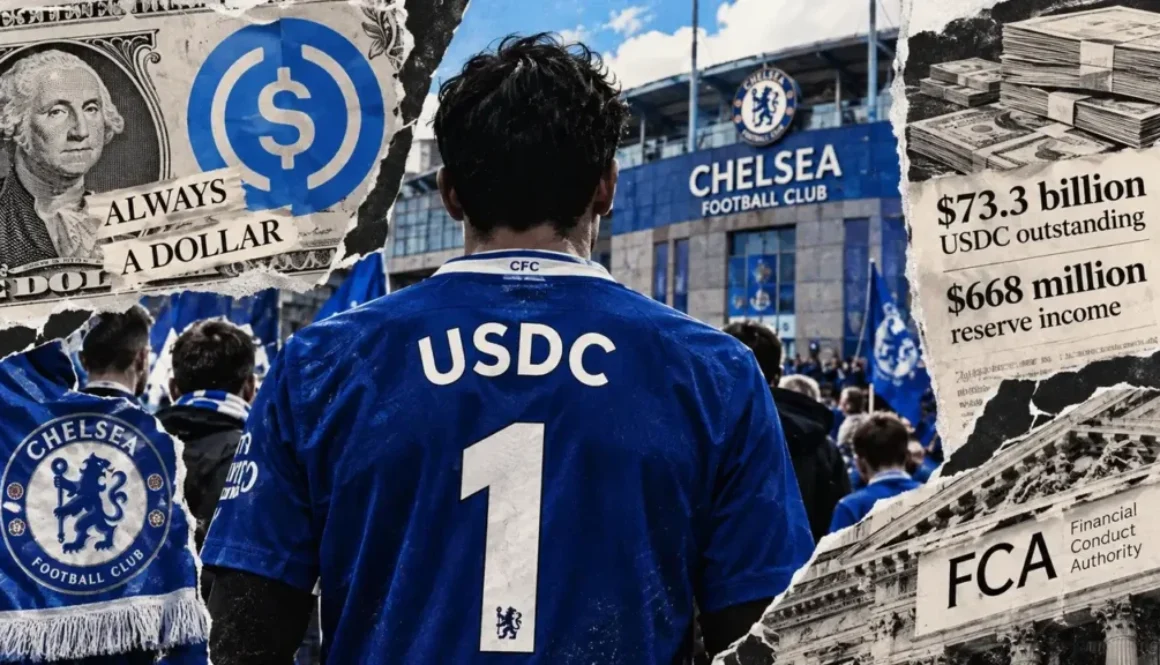
- Circle announced an agreement with Chelsea FC on August 28 for USDC branding as the club’s principal front-of-shirt sponsor for the 2026/27 season across men’s, women’s, and academy teams.
- At the end of June, $73.3 billion of USDC was outstanding; Circle reported $668 million in reserve income for the second quarter out of $701 million in total revenue and reserve income.
- The sponsorship serves to build consumer familiarity with the USDC name rather than drive immediate adoption, leveraging football’s emotional engagement where product features cannot.
- $73.3B USDC outstanding as of June 30, 2026, representing the reserve base Circle earns yield on.
- 95% of Circle’s Q2 revenue derived from reserve income rather than transaction fees or other services.
- Aug 28 Date Circle announced the Chelsea FC sponsorship deal for the 2026/27 season.
- 2026/27 Season when gambling companies are removed from Premier League front-of-shirt positions under a voluntary agreement.
Circle announced a partnership with Chelsea FC on August 28 for USDC branding to appear as the club’s primary front-of-shirt sponsor across men’s, women’s, and academy teams for the 2026/27 season, according to CryptoSlate. The deal places a stablecoin designed to maintain a fixed dollar value at the center of one of football’s most recognizable brands, an unusual pairing that reflects how Circle’s business fundamentally depends on growing the circulation of USDC rather than selling a product with inherent excitement or utility.
Reserve Income Accounts For Nearly All Of Circle’s Reported Revenue
USDC is engineered to track the US dollar by backing each token with cash and cash-equivalent assets held largely in US Treasury securities and Treasury-backed lending instruments. According to Circle’s second-quarter 2026 results, the company reported $668 million in reserve income for the period, compared with $701 million in total revenue and reserve income combined, meaning reserve earnings accounted for roughly 95 percent of reported revenue.
Circle’s terms explicitly state that USDC token holders receive no interest and maintain no claim on returns generated from the reserves.
At the end of June, $73.3 billion of USDC was outstanding. A larger money supply translates directly to a larger pool of interest-bearing assets that Circle can deploy, making growth in USDC circulation essential to the company’s financial model. Football sponsorship addresses a challenge stablecoins face that other financial products do not: the product itself generates no emotional or narrative appeal, making traditional advertising difficult.
Building Brand Recognition Where Product Features Cannot
USDC offers stability but not excitement. It promises to remain worth approximately what it is worth today, generating no victory parade or moment of triumph. Bitcoin captured markets through the promise of scarcity; cryptocurrency exchanges compete on trading features and market access. Stablecoins by design offer none of these narratives, leaving marketing primarily dependent on familiarity and trust.
Football shirts create recognition without requiring understanding. A Chelsea supporter watching matches every weekend will encounter the USDC name repeatedly across broadcast coverage, stadium imagery, and social media without needing to understand how Treasury reserves function or how digital currency redemption works. When that same person later encounters USDC in a financial application alongside competing stablecoin options, name recognition alone influences choice. Circle does not require these supporters to open cryptocurrency wallets immediately or become customers on matchday; the goal is simply that the four letters stop looking unfamiliar.
This approach mirrors how traditional sponsors use football to attach themselves to emotionally invested audiences rather than convince those audiences to care about their core product.
Regulatory Oversight And Competitive Positioning In Football Finance
Chelsea is not Circle’s only crypto partner. The club renewed its partnership with BingX, a cryptocurrency exchange serving as training-kit sponsor for the 2026/27 season. The two partnerships place different financial products on different pieces of apparel: one entity promotes trading capability while the other promotes a stablecoin designed to sit at one dollar. Both rely on the same mechanism: the Chelsea badge makes the financial company feel familiar, something neither could easily accomplish through blockchain messaging alone.
The timing aligns with a shift in Premier League advertising standards. Premier League clubs agreed under a voluntary arrangement to remove gambling companies from front-of-matchday shirts beginning with the 2026/27 season, freeing premium advertising real estate at exactly the moment financial and crypto companies compete for global visibility. The UK Financial Conduct Authority flagged the broader question in a July freedom-of-information response, identifying 18 arrangements involving 13 clubs and financial providers without FCA authorization, though the FCA noted this did not automatically indicate illegality and found no evidence of breaches in most cases reviewed. Circle’s sponsorship announcement explicitly states the partnership is not an invitation to buy, hold, or trade crypto, but rather an invitation to recognize the name.
Someone who encounters USDC through football sponsorship still needs to independently research where to purchase it, who holds it, what fees apply, and what protections exist in their jurisdiction.
Making A Stablecoin Forgettable By Making It Everywhere
Circle’s objective for this partnership is not to generate passion for USDC among football supporters. The goal is to make USDC boring enough that it becomes ubiquitous. If someone encounters USDC in a financial application two years from now and reacts the same way they react to Visa, Mastercard, or PayPal—with simple recognition rather than analysis—Circle has succeeded. They will not think about the yields on short-term Treasuries or how reserve assets are redeemed. They will recognize four letters.
What Chelsea offers that a blockchain cannot offer is cultural familiarity. USDC already possesses the technical capability to maintain its dollar peg across networks and applications. Circle’s transparency page shows how the company manages the reserve base that generates the revenue sponsorships like this one are designed to grow. The sponsorship accelerates adoption by shifting the association from a technical feature set to a brand presence, embedding USDC into the fabric of how people encounter financial products.
The BlockWest read. Circle’s business model depends on reserve growth, not on transaction volume or trading fees. The Chelsea deal reveals that for stablecoin issuers, building distribution and consumer trust matters more than technological differentiation. As USDC competes against other dollar-pegged tokens, this sponsorship is a bet that casual recognition converts to preference when users later choose between dollar stablecoins, a dynamic that plays out far from the pitch.
The true test of the partnership’s effectiveness emerges over the next two years as USDC market share is tracked against competing stablecoins and as the FCA’s regulatory position on financial sponsorships in football becomes clearer. Circle has signaled no additional major sports partnerships, leaving open whether the Chelsea deal represents a one-off marketing experiment or the first of a wider strategy to embed USDC branding into global consumer consciousness.