Central Bank Investigation Shows Stablecoins Could Be Counted Twice in U.S. Money Supply Measures M1 and M2
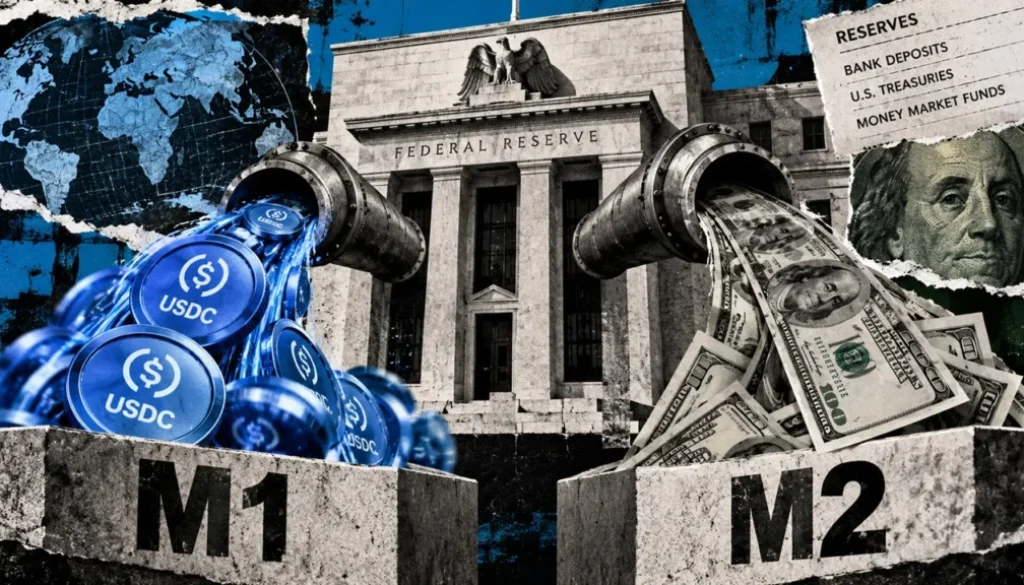
The Federal Reserve has identified a fundamental accounting challenge that could distort official US money supply measures if stablecoins are incorporated without proper adjustments. The risk of double-counting the same dollars across multiple monetary aggregates threatens the integrity of data that policymakers and economists rely on for critical decisions.
- Federal Reserve staff note from September 4 presents a framework for incorporating regulated payment stablecoins into M1 or M2 monetary aggregates.
- Double-counting risk arises when stablecoin reserves held in bank deposits or money market funds are already counted in existing monetary aggregates.
- The Fed identified three separate accounting tasks that must be completed before stablecoins can be classified in official money supply measures.
- $292.1B Global stablecoin market capitalization across 73 assets as of early September
- $74.5B USDC market capitalization, roughly one quarter of total stablecoin market
- $23.218T US M2 money supply on seasonally adjusted basis for July 2026
- 71.826B USDC in circulation according to Circle’s July 31 assurance report
A Federal Reserve staff note released on September 4 outlines how regulated payment stablecoins might eventually be incorporated into M1 or M2, the official measures of the US money supply. Currently, stablecoins are excluded from these measures entirely. The analysis reveals that without careful accounting adjustments, the same dollars could be counted twice: once as stablecoin reserves already captured in the money supply, and again as newly added stablecoin tokens.
The staff note represents independent research by Federal Reserve economists and does not constitute official Federal Reserve policy or recommendations for immediate action.
M1 represents the narrowest measure of US money supply, containing currency and highly liquid balances available for immediate transactions. M2 encompasses M1 plus less liquid savings instruments, including small-denomination time deposits and retail money market funds. The Fed’s framework proposes classifying stablecoins based on their actual economic function rather than treating all stablecoins identically, allowing different tokens to fall into different categories depending on usage patterns and reserve composition.
The stablecoin market has grown substantially, with global market capitalization reaching $292.1 billion across 73 different assets by early September, according to industry tracking data. This growth reflects increasing adoption of stablecoins for payments, remittances, and financial transactions, particularly on blockchain networks. As stablecoin usage expands and regulatory frameworks like the GENIUS Act establish clearer requirements for issuer compliance, policymakers face the question of whether and how to incorporate these digital assets into traditional money supply measures.
Incorporating stablecoins into official monetary aggregates could provide more comprehensive and accurate pictures of the money actually circulating in the US economy. However, the Federal Reserve recognizes that hasty integration without proper accounting adjustments risks undermining the reliability of monetary data that guides interest rate decisions, inflation assessments, and broader macroeconomic policy. The framework demonstrates the Fed’s methodical approach to integrating emerging financial technologies into established statistical systems.
How Reserve backing creates double-counting risk
The core accounting problem emerges from how stablecoin issuers back their tokens. Under the GENIUS Act, permitted issuers must maintain at least 1:1 identifiable reserves and publish monthly reserve information. Permitted reserves can include bank deposits, Treasury instruments, and government money market funds. When an issuer receives dollars, deposits them in a bank account or money fund, and issues stablecoins backed by those reserves, the Fed identifies the double-counting trap.
Since bank deposits and money-fund net assets are already captured in M1 or M2, adding the stablecoin tokens at face value as a separate line item would count the same dollars twice. The reserve asset would already be measured in the monetary aggregate, while the stablecoin itself would appear as additional money supply. This overlap only occurs with reserve assets already represented in M1 or M2, and the extent of the problem depends on each issuer’s specific reserve composition.
Treasury securities held outside money market funds would not create this overlap problem since they are not already counted in M1 or M2.
Resolving this accounting challenge requires more than theoretical analysis. Regulators would need detailed reporting from stablecoin issuers about reserve composition, updated monthly or more frequently to capture changes in backing assets. This transparency requirement would allow Federal Reserve statisticians to identify which reserve assets are already captured in existing monetary aggregates and calculate net increments accurately.
USDC Reserve structure illustrates accounting complexity
Circle’s USDC demonstrates the practical challenges involved. According to Circle’s July 31 assurance report, most USDC reserves are held in the Circle Reserve Fund, an SEC-registered government money market fund that holds cash, short-dated US Treasuries, and overnight US Treasury repurchase agreements. The report also lists Treasury securities held outside the fund and cash at regulated financial institutions. The assurance documented 71.826 billion USDC in circulation backed by reserve assets totaling $71.904 billion in fair value.
Calculating the net addition to M1 or M2 requires more than these aggregate figures. A defensible estimate would need to match reported reserve categories against the exact money-stock components already counted, remove only genuine overlaps, and preserve backing assets existing outside the aggregates. The current available sources leave that net increment unquantified, illustrating why the Fed considers this calculation essential before any classification decision.
Other major stablecoins maintain different reserve structures, adding complexity to any framework that would apply universally across issuers. Some reserve significant percentages in commercial paper or corporate securities rather than government money funds, which would create different accounting outcomes. The Fed’s framework must accommodate these structural variations while ensuring consistent treatment across the stablecoin ecosystem.
Geographic reach and usage patterns complicate classification
A second major accounting challenge involves geographic boundaries. Dollar stablecoins issued by US-regulated companies can move globally on public blockchains, yet transaction records typically lack sufficient information to identify what portion circulates within the United States. The GENIUS Act applies to US-regulated issuers without distinguishing domestic from international circulation, so additional reporting mechanisms may be required to isolate US circulation from global activity.
The Fed’s functional classification framework also requires evidence beyond raw transaction counts. A Bank for International Settlements working paper analyzing more than 593 million event logs from 141 million Ethereum transactions in 2025 involving USDT, USDC, and PayPal USD found that roughly one-third of transactions generated multiple transfer events, while nearly 60% of transfer events occurred inside complex transactions combining trading, lending, arbitrage, liquidity provision, and settlement. Treating every emitted event as a standalone payment would exaggerate activity counts and overstate the payment role of stablecoins relative to their actual use in consumer and business transactions.
Distinguishing payment activity from financial engineering and speculation requires sophisticated data analysis that goes beyond public blockchain records. Issuers would likely need to provide additional transaction context and customer categorization data to help regulators understand actual stablecoin usage patterns in the US economy.
Three accounting tasks must precede any integration
The Fed staff framework identifies three distinct accounting challenges that must be resolved before stablecoins can be classified in official monetary aggregates. First, analysts must determine how the tokens function economically through transaction-level analysis and usage patterns. Second, they must consolidate reserve assets already represented in existing aggregates to identify and remove overlaps. Third, they must isolate the circulation relevant to the United States, separating domestic holdings from global activity.
Stablecoins could eventually make M1 or M2 more complete measures of the money supply, but improper adjustments would distort the accuracy of official monetary data that policymakers and economists rely on for critical decisions.
Each task involves methodological decisions that will significantly affect the final count of stablecoin-based money added to official aggregates. The Fed’s deliberative approach reflects the high stakes involved, given the importance of accurate money supply data for Federal Reserve policy decisions and public economic assessment.
The Fed has not announced a timeline for completing this accounting work or a date when stablecoins might be incorporated into official monetary aggregates, leaving open the question of when these three tasks will be formally addressed and what reporting requirements regulators may impose on stablecoin issuers to support the classification effort.
BlockWest is a news publication. Nothing here is investment advice. Read our disclaimer and editorial policy.