Banking groups oppose revised Digital Asset Market Clarity Act before Senate vote
The revised Digital Asset Market Clarity Act faces opposition from banking regulators, state attorneys general, and Senate Democrats on ethics grounds hours before a critical procedural vote. Whether Republicans can secure 60 votes to advance the bill will determine whether the crypto framework reaches a final Senate vote this week.
- Eight banking trade groups, including the American Bankers Association, urged amendments to tighten stablecoin yield restrictions in the revised bill text.
- New York Attorney General Letitia James led 18 state attorneys general opposing the bill, citing $11.4 billion in crypto fraud losses during 2025, up 22 percent from 2024.
- Senator Elizabeth Warren rejected the ethics provision as inadequate, claiming it fails to prevent President Trump from profiting from his crypto businesses including World Liberty Financial.
- $11.4B Crypto fraud losses reported by FBI during 2025 versus prior year total
- 22% Year-over-year increase in cryptocurrency fraud losses from 2024 to 2025
- 60 Senate votes required for cloture motion to pass the Clarity Act forward
- 330+ Anti-fraud enforcement actions brought by state attorneys general since 2017
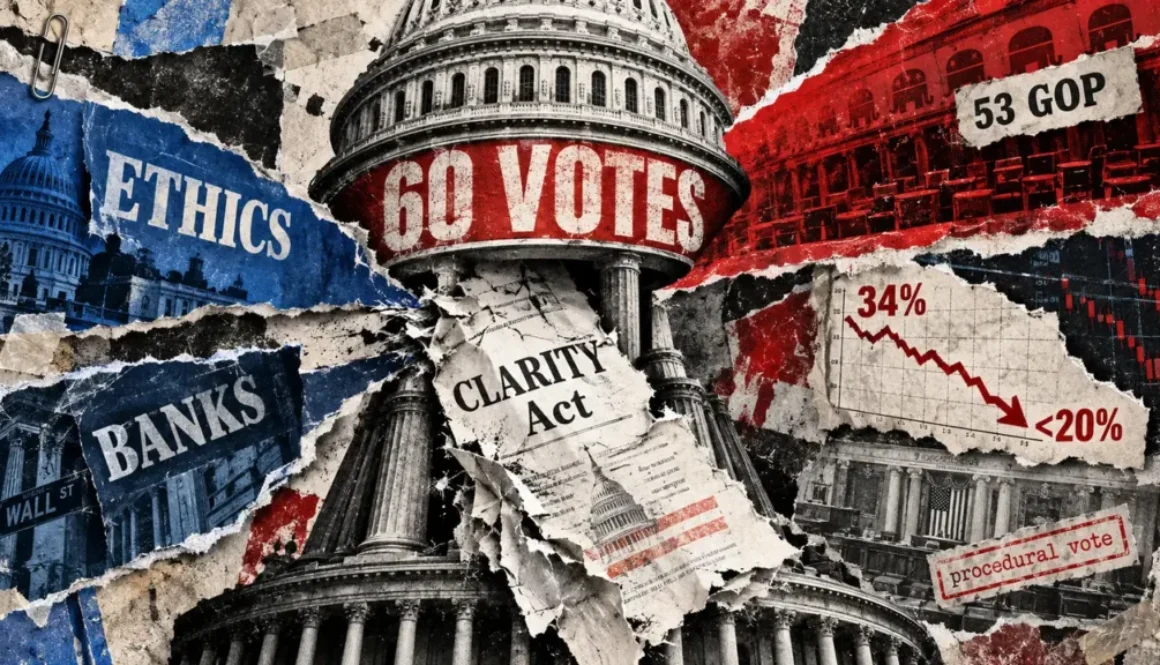
BeInCrypto reported that the revised Digital Asset Market Clarity Act encountered coordinated resistance from three separate constituencies just hours before the Senate prepares for a procedural vote. Republicans released updated bill text on September 14 and characterized it as their final offer to Democrats. A cloture motion scheduled for Tuesday afternoon (September 16) will determine whether the bill advances, requiring 60 votes to succeed. With Republicans controlling 53 seats, they must flip at least seven Democratic votes to move the measure forward.
Banking Regulators Call for Tighter Stablecoin Restrictions
Eight major banking trade groups, including the American Bankers Association and the Independent Community Bankers of America, submitted a joint letter to Majority Leader John Thune and Democratic Leader Chuck Schumer opposing the current stablecoin language. The groups contend that the yield ban as drafted contains loopholes permitting interest-like payments on customer balances, undermining the restriction’s intent.
The coalitions recommended specific amendments to the crypto market structure bill. In their letter, the groups stated: “With the targeted changes described above, we believe that this innovation can be pursued while also protecting the ability of banks to continue providing credit for America’s consumers, small businesses, and communities.” This position echoes arguments banks advanced during the Senate’s July deliberations on the same measure.
State Attorneys General Warn of Federal Preemption and Fraud Risk
New York Attorney General Letitia James convened a coalition of 18 state attorneys general to oppose the bill outright, warning that federal preemption would eliminate state registration requirements and grant the Securities and Exchange Commission unilateral authority over regulatory scope. The attorneys general cited law enforcement data documenting the scale of the problem: the FBI recorded $11.4 billion in crypto fraud losses during 2025, a 22 percent jump from 2024. States have independently pursued more than 330 anti-fraud actions since 2017.
James stated: “As written, the Clarity Act would embolden scammers and potentially strip attorneys general of our authority to protect our states’ investors and their wallets. Together with my attorney general colleagues, I urge Congress not to pass the Clarity Act.”
The state coalition’s objections parallel those raised in July, indicating that substantive revisions have not addressed their core concerns about federal preemption displacing state enforcement mechanisms.
Warren Rejects New Ethics Language as Democrats Prepare Counteroffer
Senator Elizabeth Warren rejected the ethics provision Republicans added to the revised text, arguing that it provides insufficient safeguards against presidential self-dealing. Warren characterized the provision as a “weak fig leaf,” asserting that it transfers enforcement discretion to the President’s political appointees, who could disable enforcement, and leaves loopholes that permit Trump’s crypto holdings and World Liberty Financial ventures to operate untouched.
Warren stated: “We got the details of President Trump and Republicans’ quote ‘final offer’ on ethics, and it reads exactly like what you expect the most corrupt President in our history to bless: a weak fig leaf that will do nothing to stop him from making his next $1.4 billion in crypto profits.”
Not all Democrats have abandoned negotiations. Democratic negotiators convened in Senate Minority Leader Chuck Schumer’s office on Monday (September 15) to craft a counteroffer, according to reporting by Politico. Senator Raphael Warnock indicated that Republicans would receive the text that evening. Senator Cynthia Lummis posted on X that Republicans have incorporated over 100 Democrat-requested changes and questioned whether any Democratic holdouts would support the measure regardless of revisions.
The BlockWest read. The three-front opposition reveals that crypto market structure legislation faces structural opposition beyond partisan positioning. Banks worry about competitive disadvantage in stablecoin issuance; states fear lost enforcement authority; and ethics concerns reflect genuine institutional tension over presidential financial interests. Tuesday’s cloture vote will show whether Republican attempts to address these grievances sufficed or whether the bill has run into a durability ceiling.
The Senate cloture motion on Tuesday afternoon (September 16) requires 60 votes to advance the bill to a final vote. Republicans control 53 seats and must secure at least seven Democratic crossovers. Senator Lummis’s public statement insisting that Democrats demanded the ethics changes now in the bill will inform whether that pitch succeeds in the chamber Tuesday.