CLARITY Act’s Senate passage odds fall below 20% ahead of Tuesday vote.
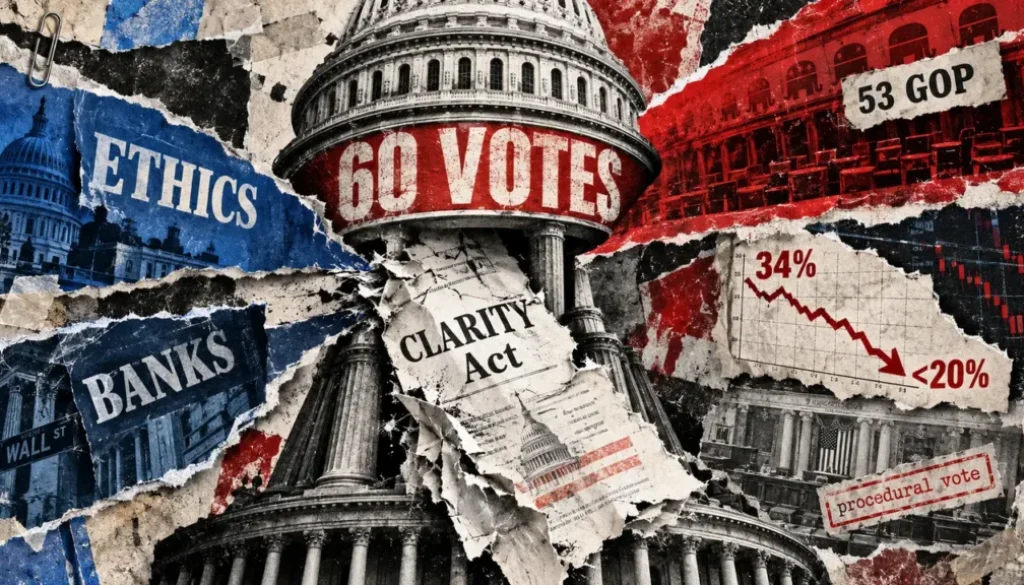
The CLARITY Act, a landmark bill to restructure crypto market oversight, faces a Senate procedural vote on Tuesday (September 16) that requires 60 votes to advance; betting markets price its odds of passage at below 20%, down sharply from 34% the previous day. Republican and Democratic negotiators remain at odds over ethics provisions and banking safeguards, with key GOP senators uncommitted and the industry deployed to lobby wavering lawmakers.
- Polymarket odds of CLARITY Act enactment fell below 20% after reaching about 34% in the prior 24 hours.
- The bill requires 60 Senate votes to proceed; Republicans hold 53 seats and cannot advance it alone without Democratic support.
- Senate Democrats delivered a counterproposal to GOP negotiators Monday night, rejecting the Republicans’ latest offer on ethics rules.
- 53 Republican senators, insufficient to reach 60-vote threshold for Senate passage alone
- 60 Votes needed to advance the bill past Tuesday procedural hurdle in Senate
- 126 Additional substantive changes Democrats requested and negotiators incorporated into bill text
- 600+ Pages in final CLARITY Act text after successive rounds of bipartisan negotiation
The CLARITY Act is headed toward a critical procedural test on Tuesday afternoon, according to CryptoSlate reporting, as Senate Republicans struggle to assemble the 60-vote coalition required to advance the crypto market-structure legislation. The bill, designed to replace the current regulatory patchwork by dividing oversight responsibilities across agencies, has deteriorated sharply in its odds of passage. With Republicans holding 53 seats, they cannot clear a procedural vote without support from at least seven Democratic senators, a target that has grown harder to reach as the two parties clash over ethics provisions and banking safeguards.
GOP defections and banking concerns erode Republican support
The Senate path to 60 votes has narrowed considerably as Republican senators express reservations about the measure. Sen. Susan Collins has raised concerns that the bill could accelerate deposit flight from community banks, a key objection from the financial industry that opposes crypto firms competing more aggressively for customer balances. Sen. John Cornyn has also declined to commit to the legislation, and Sen. John Curtis has distinguished between supporting debate and voting for final passage, signaling he will not back the current text.
These GOP fractures prompted the White House to intensify outreach to Republican senators, attempting to prevent banking-industry opposition from eroding further support.
Democrats reject final Republican package on ethics rules
Senate Democrats delivered their own counterproposal to Republican negotiators on Monday night (September 15), rejecting what GOP aides had described as their final legislative offer. Republicans had spent the weekend attempting to close a gap on ethics provisions by tightening rules governing financial conflicts involving senior government officials, changes meant in part to address Democratic concerns about President Trump’s crypto interests.
It’s becoming clear that some Democrats simply won’t get to yes, no matter what we put in the text. President Trump has now agreed to two historic ethics provisions — provisions these very members demanded. We’ve given you everything you’ve asked for, yet you keep holding the bill hostage, demanding more and more and more. It’s beyond frustrating. There’s nothing left to give.
Sen. Cynthia Lummis, via social media post
Sen. Mark Warner said Democrats who participated in negotiations concluded that the latest Republican package still fell short of their demands. The Democratic counterproposal has been delivered to GOP negotiators, though its provisions remain undisclosed.
Industry makes final pitch as coalition strain shows
With the procedural vote hours away, crypto executives are attempting to convince wavering senators that Democrats have already secured substantial concessions. Coinbase Chief Policy Officer Faryar Shirzad stated that the CLARITY Act addresses all seven principles Democratic senators outlined a year ago for acceptable crypto market-structure legislation, including regulatory jurisdiction, issuer oversight, illicit finance, conflicts of interest and consumer protection. Negotiators incorporated 126 additional substantive changes requested by Democrats, he argued, portraying the bill as the product of more than a year of bipartisan work rather than a Republican proposal Democrats are being asked to accept unchanged.
Ripple Chief Executive Brad Garlinghouse urged lawmakers to vote yes, warning that “perfect can’t be the enemy of good.”
The strain on the coalition extends beyond the Senate floor. Some House Democrats who backed crypto legislation earlier in Congress have grown concerned that major industry-backed super PACs may not support them in upcoming elections despite their votes, according to Semafor. That unease adds pressure to the standoff as crypto political groups decide where to deploy substantial campaign resources. A successful procedural vote would advance the bill to floor debate, where amendments on ethics, banking and stablecoin competition would likely consume much of late September. A procedural defeat could prove more damaging; Lummis warned such an outcome would “drive the digital asset industry overseas, leave consumers vulnerable, and sideline American leadership.”
The BlockWest read. The betting markets are pricing in Republican failure to hold their own conference, not Democratic intransigence. Lummis and industry executives are arguing Democrats have exhausted negotiating leverage, yet Democrats are delivering counter-proposals rather than signaling final positions, suggesting their public posture and private negotiating stance remain misaligned as the vote approaches.
The Senate is scheduled to vote on the procedural motion on Tuesday afternoon (September 16). If the motion fails to reach 60 votes, the CLARITY Act is unlikely to advance further this congressional session, ending the most serious legislative push to overhaul crypto regulation since the sector’s emergence.
BlockWest is a news publication. Nothing here is investment advice. Read our disclaimer and editorial policy.