
Strategy allocates $603 million from share sale toward Bitcoin acquisitions and STRC backing
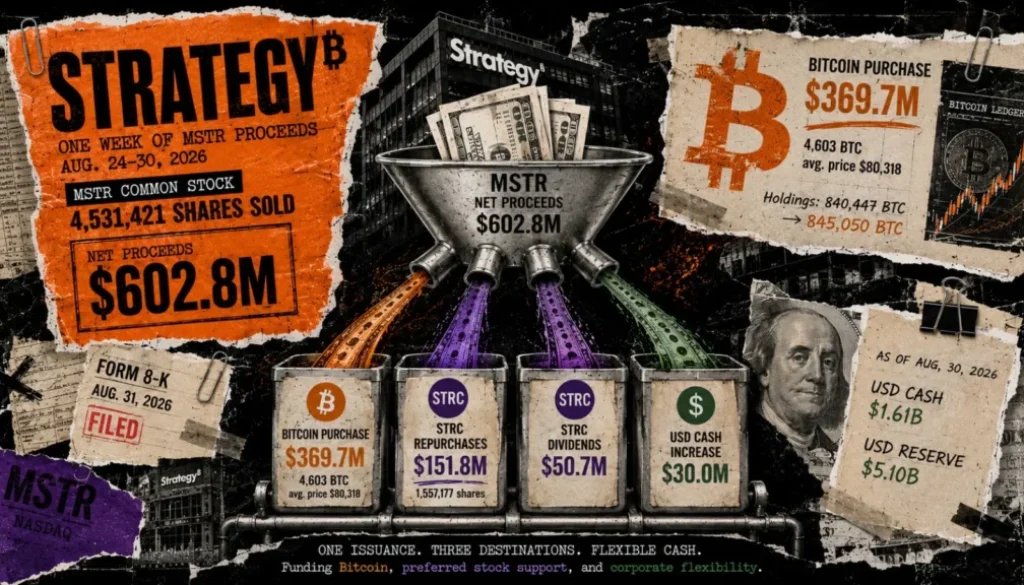
Strategy completed a $602.8 million equity raise this week, allocating roughly 61 percent to Bitcoin purchases while directing the remainder toward preferred stock support and cash reserves. The allocation reflects the company’s dual mandate to accumulate digital assets while managing its capital structure and preferred equity obligations.
- Strategy bought 4,603 BTC between Aug. 24-30 at average price of $80,318, raising total holdings to 845,050 BTC.
- Company allocated $202.5 million of proceeds to STRC preferred stock repurchases and dividends combined.
- The $602.8 million raise came from selling 4,531,421 common shares, marking continued equity issuance to fund asset purchases.
- $369.7M Of $602.8M proceeds directed to Bitcoin purchases this week
- $80,318 Average price per BTC including fees, compared to $75,412 historical average cost
- 4,603 BTC Purchased in one week, versus zero in the prior weekly period
- $1.61B Total USD Cash balance as of Aug. 30, separate from reserves
Strategy deployed $369.7 million of its latest capital raise toward Bitcoin accumulation, purchasing 4,603 coins during the week of Aug. 24-30 at an average cost of $80,318 per token inclusive of fees and expenses. The acquisition increased the company’s total Bitcoin holdings from 840,447 BTC to 845,050 BTC, according to filings and its official Bitcoin ledger. This marked a sharp reversal from the prior week, when the company completed no Bitcoin purchases or sales.
The week’s purchase activity reflects renewed momentum in Strategy’s core business model of raising equity capital and converting proceeds into Bitcoin holdings. This approach has become increasingly common among corporate treasury strategies seeking to diversify reserve assets beyond traditional cash and fixed-income instruments. Strategy’s model differs from traditional corporate treasury management by treating Bitcoin as a primary asset class worthy of dedicated capital allocation.
Bitcoin purchases drive $369.7 million of the weekly Capital Raise
The four-thousand-plus coin purchase reflects Strategy’s continued commitment to accumulating Bitcoin as its primary use of newly raised capital. At the $80,318 purchase price, the weekly buy cost approximately $369.7 million, or just under 61 percent of the total $602.8 million raised through the share sale.
Strategy reported an aggregate purchase cost of $63.73 billion across its entire 845,050 BTC position and an average cost basis of $75,412 per coin. The current week’s purchases at $80,318 came in $4,906 above the historical blended average, reflecting Bitcoin’s price movement over the company’s accumulation period. This price premium suggests the company continues purchasing regardless of near-term Bitcoin valuations, maintaining discipline around its capital deployment schedule rather than attempting to time market movements.
The at-the-money offering program that funded this week’s purchase allows Strategy to raise capital continuously without waiting for discrete fundraising events or shareholder votes. This structure provides operational flexibility while creating potential stock dilution for existing shareholders, a tradeoff the company has deemed acceptable given its strategic objectives.
STRC preferred stock absorbs $202.5 million in combined repurchases and dividends
Beyond Bitcoin, Strategy deployed $151.8 million to repurchase 1,557,177 shares of STRC, its variable-rate cumulative perpetual preferred stock, and allocated $50.7 million to STRC dividends. The combined $202.5 million represents the second-largest use of the weekly capital raise and reflects ongoing management of the company’s preferred equity structure.
Following the buyback activity, Strategy reported $364.8 million remained available under its broader preferred-stock repurchase authorization. The company has been using common-stock proceeds to support its preferred equity obligations, a shift from earlier periods when it directed virtually all capital toward Bitcoin. This rebalancing addresses concerns about preferred stock accumulation and associated dividend burden as the company’s capital base has grown.
The preferred buyback strategy serves multiple purposes, reducing future dividend obligations while potentially supporting stock price stability. Preferred shares typically carry fixed or variable dividend rates that compound over time, making buybacks an efficient use of capital compared to allowing preferred obligations to accumulate indefinitely.
Cash reserves and future Capital Allocation flexibility
The final $30 million of proceeds went into USD Cash, a flexible account designated for Bitcoin purchases, balance sheet expansion, and other corporate purposes.
Strategy maintains two distinct cash accounts with separate intended uses. As of Aug. 30, the company reported $1.61 billion in USD Cash alongside a $5.1 billion USD Reserve, the latter intended primarily to support preferred dividend payments and debt service. Both balances include expected proceeds from at-the-market share sales not yet settled.
The dual-reserve approach provides layered financial flexibility during volatile market periods. The designated reserve for dividend and debt obligations ensures obligations continue being met even if Bitcoin holdings decline significantly in value or capital markets access temporarily constrain new fundraising.
The filing shows Strategy now channeling common-stock issuance toward three concurrent objectives: Bitcoin accumulation, preferred-stock buybacks and dividends, and flexible cash positioning. This capital allocation framework reflects maturation in the company’s financial strategy as it balances growth objectives with balance-sheet stability and investor obligations. Investors will monitor whether future capital raises maintain this proportional split or shift allocation emphasis depending on Bitcoin price movements, preferred equity market conditions, or changes to the company’s leverage and cash management strategy.
BlockWest is a news publication. Nothing here is investment advice. Read our disclaimer and editorial policy.