S&P 500 enters correction territory without signs of bear market or recession
The S&P 500 has entered correction territory for the first time in nearly two years, but history suggests such declines need not trigger bear markets or recessions. Understanding the structural differences between this selloff and past market crises matters for investors assessing tail risk and central bank policy ahead.
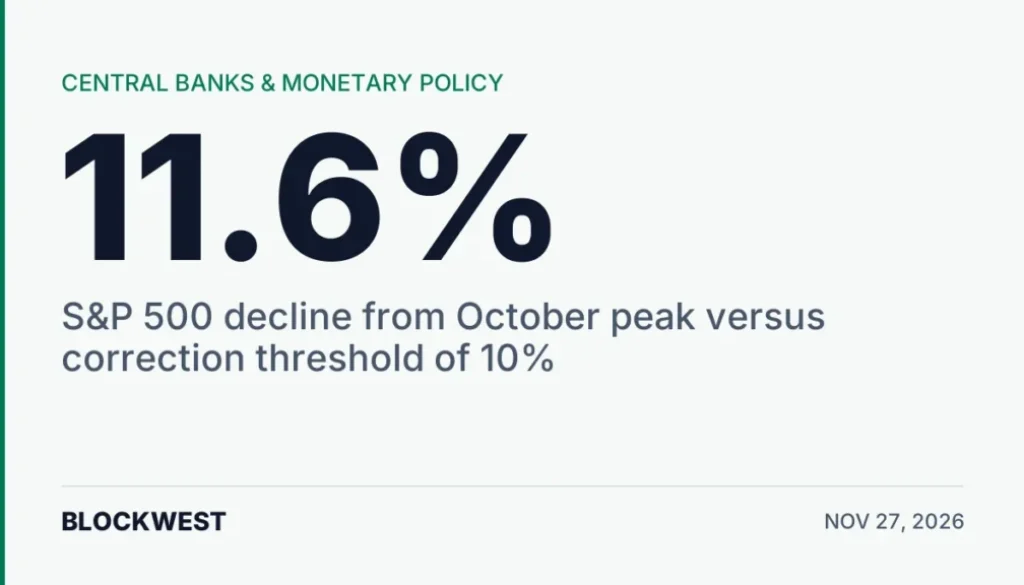
- The S&P 500 fell 11.6% below its October 6 record high, entering correction territory on November 20 for the first time since April 2025.
- Of 13 S&P 500 bear markets since records began, only eight overlapped with recessions as defined by the National Bureau of Economic Research.
- Deutsche Bank strategist Henry Allen notes that every bear market since 1962 has coincided with recession, deteriorating economic data, or Federal Reserve rate hikes, none of which are present today.
- 11.6% S&P 500 decline from October peak versus correction threshold of 10%
- 8 of 13 S&P 500 bear markets that overlapped with recessions since records began
- 54.6 November U.S. flash composite PMI, above 50 indicating continued business expansion
- 33.9% S&P 500 plunge during 33-day Covid-19 shock in 2020
The S&P 500 entered correction status on Friday, November 20 as equity markets extended a sharp reversal from October’s record highs, with CNBC reporting that the index closed 11.6% below the October 6 peak of 7,818.93. The decline to 6,910.39 on November 20 alone represented a 3.7% single-day drop and marked the seventh consecutive daily loss. Investor anxiety over potential slowdowns in artificial intelligence spending, stretched valuations in mega-cap technology stocks, and uncertainty over the Federal Reserve’s interest rate trajectory fueled the selloff.
Corrections and bear markets follow different paths to recession
Market declines are defined by severity: a correction represents a 10% drop from a recent peak, while a bear market begins at 20%. The critical question for allocators is whether either automatically signals economic contraction. Historical data compiled in a CNBC analysis shows the relationship is more complex than many assume. Among 13 S&P 500 bear markets on record, only eight coincided with recessions as defined by the National Bureau of Economic Research, which describes recession as “a significant decline in economic activity that is spread across the economy and lasts more than a few months.”
Five major bear markets occurred without recession, most notably in 1987 and 2022, when equity prices fell sharply but economic output remained resilient. The 1973-74 oil shock, the dot-com bubble burst in 2000, the 2007-09 financial crisis, and the 2020 pandemic downturn each overlapped with both bear markets and recessions. These examples demonstrate that equity drawdowns and economic contractions, while often correlated, follow separate dynamics.
Economic data and Fed policy show no recession warning signs
Henry Allen, macro strategist at Deutsche Bank, argues that every S&P 500 bear market since the 1962 “Kennedy Slide” has coincided with at least one of three structural conditions: an actual recession, worsening economic data that raises recession fears, or a cycle of Federal Reserve rate hikes. Allen wrote on Tuesday that none of those conditions are present in the current environment.
Much as last week’s selloff was severe, it’s worth remembering that it has several differences with many of the other big risk-off moves in recent times.
Henry Allen, Deutsche Bank
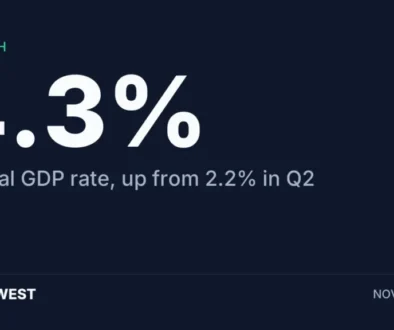
The November U.S. flash composite Purchasing Managers’ Index stood at 54.6, above the 50 threshold that signals business activity expansion rather than contraction.
Allen noted that the current selloff lacks the sudden downward reassessment of growth that accompanied past crises. During the 2020 pandemic shock, the S&P 500 plunged 33.9% in 33 days as the economy entered recession. The 2025 tariff shock similarly prompted a significant repricing of growth expectations. Neither dynamic is present now. Additionally, markets are pricing in fewer Federal Reserve rate hikes through September 2027 than they were on October 6, when the S&P 500 hit its record. Allen stated that “pricing has shifted slightly dovishly with the equity declines,” contradicting the hawkish central bank repositioning that accompanied the 1966 and 2022 bear markets.
The December Fed meeting will test whether conditions remain unchanged
Allen maintains that given the absence of these three historical warning factors, another bear market today would be “unusual.”
The Federal Reserve is widely expected to raise interest rates at its final meeting of 2026 on December 9, a potential shift that could alter the dovish pricing Allen cited. That decision will test whether the structural conditions he outlined have shifted or remain stable. If the Fed holds course and economic data continues to signal expansion, the correction could resolve without deepening into a bear market or recession. If new deterioration emerges in the weeks ahead, the absence of these historical recession markers may prove incomplete.
The BlockWest read. Strategists and allocators should focus on what has not happened rather than what has. No hawkish shock from the central bank, no sudden downgrade to growth forecasts, and no visible deterioration in business activity. The selloff reflects repricing of AI spending and tech valuations, not systemic economic strain. That does not guarantee equities find a floor at current levels, but it means this correction operates under different physics than past crisis episodes.
The Federal Reserve’s December 9 policy meeting will be the first major test of whether the structural backdrop remains benign or shifts. Markets currently expect a rate increase at that meeting, though fresh economic data or equity volatility could alter that view between now and then. How the Fed frames its outlook for 2027 rate policy may be more consequential to the correction’s trajectory than the December decision itself.
BlockWest is a news publication. Nothing here is investment advice. Read our disclaimer and editorial policy.