Most DeFi yield would not survive a basic audit
Opinion. This is a contributed piece by Pavel Klachko, CFO of Seasons Labs. The views are the author’s own and do not necessarily reflect those of BlockWest.
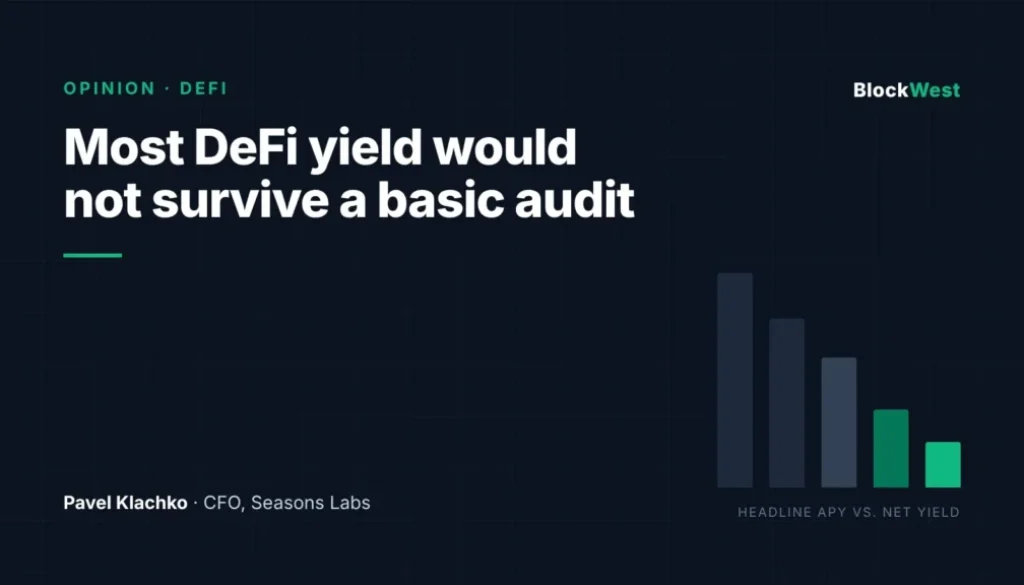
For those who come from the world of traditional finance (where profit and loss statements are the norm), DeFi dashboards can look a little jarring at first. For instance, the headline number is almost always a massive APY figure, printed in a large font. However, just underneath this surface is where people start asking the real question: Where is the money actually coming from?
For a surprising share of the market, the honest answer is simply “the protocol’s own printer,” since rewards are typically paid out in a token the protocol issues itself, often to people whose main exit is selling it to whoever turns up next. In traditional finance, a return that depends on new buyers turning up rather than on underlying earnings would not make it past a first review.
Revenue is not the same thing as yield
Research from Q3 this year showed that crypto protocols generated roughly $7.42 billion in revenue, with six of the biggest names in the space (Aave, Aerodrome, Hyperliquid, Pump.fun, Sky and Uniswap) bringing in $726 million of that in the first half alone.
The problem, however, shows up once new issuance, unlocks and incentive spending are netted out. In fact, Aerodrome, Sky and Uniswap all came out negative for holders, which in other words means that more value was printed into supply than flowed back to the people already holding the token.
That hasn’t gone unnoticed by the industry, as crypto projects were found to have spent a record $638 million buying back their own tokens as of late August, up seventeen percent from just a year earlier.
That doesn’t make buybacks a bad idea, since a buyback funded by real, recurring fees is about as clean a signal as a protocol can send. However, one funded by a treasury that was itself built on token sales is mostly the same money taking a lap around the block.
Where the yield actually comes from
Broadly speaking, on-chain yield has only a handful of real sources, namely: trading fees paid by people swapping or trading perpetuals, interest paid by borrowers, staking rewards for securing a network (though part of that is itself fresh issuance), and returns from real-world assets such as tokenized Treasuries, which is also what sits behind most yield-bearing stablecoins. Delta-neutral strategies that harvest funding rates sit somewhere in between, paying handsomely in a bull market and turning negative when sentiment flips.
Each of these behaves differently across a cycle, so much so that no fund manager would rely on just one of them. However, that is exactly what most protocols do: they collect fees from trading activity on their own platforms and route them into buybacks, meaning the entire yield rests on a single source that rises and falls with volume.
Consequently, when the market goes quiet, fees dry up, buybacks shrink and holders are left with a token that is falling at the same time as its payout. A sturdier design, in this regard, is one that stacks several of these sources together, the same way a fund diversifies its income, so that a slow month in one leg does not wipe out the whole return.
What a payout should actually be made of
From the outside looking in, one of the key issues the buyback debate skips over is that even a perfectly timed buyback pays the holder in exposure to the same token. As a result, if the protocol has a bad quarter, the reward and the risk move together, and the yield tends to disappear at precisely the moment it is needed most.
Liquidity providers face a version of the same problem. A pool can advertise a healthy fee APR, but if the two assets in it drift apart in price, the provider ends up holding more of the one that fell (i.e. impermanent loss), and that loss can quietly exceed every fee earned. A payout figure that leaves this out is, much like an emissions-funded APY, only telling half the story.
This is why the denomination of a payout is paramount, since yields paid in something the protocol does not control (be it yield-bearing stablecoins, bitcoin or even gold for that matter) give the recipient a real choice about what to hold. It also imposes discipline on the protocol, since outside assets can’t be produced on demand to paper over a shortfall.
All of this, however, still does not make hard assets risk-free, given that even gold (widely considered one of the best stores of value ever) saw one of its steepest monthly falls since 2008 earlier this year in March.
Therefore, any payout basket worth the name has to be diversified, and its weights should be published up front rather than quietly adjusted when one leg has a rough month.
The hurdle rate to clear
The Federal Reserve lifted its benchmark to 3.75%-4% in September, meaning that cash parked in a money market fund could earn a decent sum of money for doing absolutely nothing. Any on-chain yield that can’t comfortably beat that figure (after emissions and dilution) is asking users to take more risk for less reward.
Thus, it is imperative that yields are traceable to fees that someone actually paid, and also distributed in assets the protocol cannot print. Not only that, they should be on a schedule that is set in advance and can be checked on-chain afterwards.
The good part is that the tooling needed to achieve this already exists; what is missing is the willingness to show the whole ledger rather than the flattering half of it. Until yield gets reported the way an auditor would read it, i.e. net of everything it costs to produce, the sector will keep attracting the kind of capital that leaves the moment the printer slows down.
Pavel Klachko is the CFO of Seasons Labs Inc., which builds the Seasons yield protocol on Solana, and a founding partner at SYSDK Inc., a Web3 advisory and consulting firm. Since 2016, he has supported more than 50 companies and startups as a legal and finance expert, specializing in corporate structuring, cross-border operations, tax optimization, regulatory compliance, and AML/KYC frameworks.
Disclosure: This op-ed was submitted through Energent Media on behalf of the author. BlockWest did not receive payment for it. Nothing in this article is financial advice.
BlockWest is a news publication. Nothing here is investment advice. Read our disclaimer and editorial policy.