How Bitmine Might Surpass Its 5% Ethereum Goal Without Buying More ETH
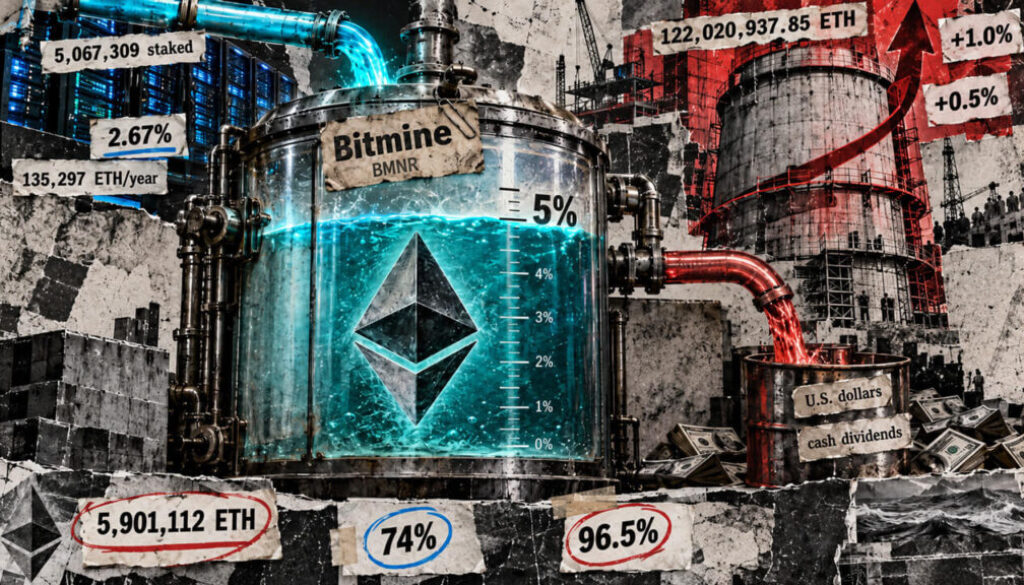
Bitmine’s path to a 5% Ethereum ownership stake depends increasingly on how much staking income it retains rather than how much it purchases outright. With over 5 million ETH staked at 2.67% annual yield, the Nasdaq-listed company could theoretically reach its goal through rewards alone, but dividend obligations and operational costs complicate that calculus.
- Bitmine purchased 53,501 ETH in the week ending Aug. 30, bringing total holdings to 5.9 million tokens.
- More than 5.06 million ETH were staked at an annualized seven-day yield of 2.67% as of Aug. 30.
- At current staking rates, Bitmine would generate roughly 135,000 ETH annually, nearly matching the shortfall to reach 5% ownership.
- 5.9M ETH Bitmine’s total holdings as of Aug. 30 compared to 5% ownership requirement
- 2.67% Annualized seven-day staking yield on Bitmine’s deployed Ethereum tokens
- 135,000 ETH Projected annual staking rewards versus 134,000 ETH shortfall to 5%
- 122.02M ETH Ethereum supply as of Sept. 5, versus 120.7M assumed in ownership calculations
Bitmine, a Nasdaq-listed treasury company, has accumulated 5.9 million Ethereum tokens as of Aug. 30 and continues to pursue a 5% ownership stake in the network. The company disclosed that it purchased 53,501 ETH during the week ending Aug. 30, extending a pattern of methodical accumulation. Blockchain analysis platform Lookonchain reported on Sept. 1 that wallets associated with Bitmine acquired approximately 51,000 ETH worth around $126 million from cryptocurrency service providers FalconX and BitGo, though Bitmine has not formally confirmed this transaction in its latest corporate filings.
The company’s strategy reflects a wider shift within the cryptocurrency industry, where institutions increasingly treat Ethereum staking as a pathway to strategic ownership rather than purely as a yield-generating activity. This shift has accelerated as Ethereum’s proof-of-stake consensus mechanism, implemented in 2022, created new opportunities for large holders to generate returns while simultaneously building long-term positions in the network. For treasury-focused companies like Bitmine, staking offers a dual benefit: the ability to earn passive income on holdings while maintaining or increasing exposure to the asset.
Staking Rewards could close the remaining gap without further purchases
At Bitmine’s disclosed staking balance of 5.06 million ETH and a 2.67% annual yield, the company would generate approximately 135,000 ETH per year in staking rewards. Against its official 5.9 million ETH balance as of Aug. 30, Bitmine stood approximately 134,000 ETH short of the 5% ownership threshold when measured against the company’s benchmark of 120.7 million ETH in circulation. This alignment suggests the company could reach its target through retained staking income alone, without purchasing additional tokens.
Retaining nearly 99% of staking rewards over a single year would be sufficient to reach 5% under the assumption of flat Ethereum supply. If the reported Sept. 1 acquisition of approximately 51,000 ETH proves accurate, that requirement would fall to roughly 61% of annual staking rewards, providing more flexibility in how the company allocates its rewards.
These calculations assume Bitmine maintains its current staking infrastructure and operational efficiency. The company operates validator nodes on the Ethereum network, a capital-intensive undertaking that requires ongoing investment in hardware, software, and personnel. These infrastructure costs are typically deducted from staking rewards or funded through other revenue sources before retained earnings increase the company’s balance sheet holdings. The efficiency of Bitmine’s validator operations therefore directly impacts how much gross staking income translates into net token accumulation.
Growing Ethereum supply creates an expanding target
The expanding Ethereum supply complicates Bitmine’s path to 5% ownership by raising the absolute number of tokens required to maintain any fixed percentage. On Sept. 5, Etherscan showed approximately 122.02 million ETH outstanding, up from the 120.7 million ETH benchmark Bitmine used in its calculations. Holding Bitmine’s Aug. 30 balance constant against that larger supply would reduce its ownership share to around 4.84%, widening the shortfall to nearly 200,000 ETH.
Ethereum’s supply dynamics result from the interplay between token issuance through staking rewards and token destruction through network transaction fees. While the network’s staking mechanism creates new ETH continuously, the burning mechanism removes tokens from circulation, creating uncertainty about long-term supply levels. For a company pursuing a fixed percentage ownership stake, this uncertainty introduces a moving target that can either accelerate or delay achievement of the goal.
Over a two-year horizon, different supply growth scenarios dramatically alter the mathematics. With flat supply, Bitmine would need to retain approximately 73.9% of modeled staking rewards to reach 5%. At 0.5% annual growth, that requirement rises to 96.5%. At 1% annual growth, retaining every staking reward would prove insufficient without additional purchases, requiring roughly 119.2% retention, an impossible target without external capital.
Lower staking yields would tighten these constraints further. At a 2% yield rather than 2.67%, modeled annual rewards would fall to roughly 101,000 ETH, pushing the flat-supply two-year threshold to nearly 99% retention. Staking yields themselves fluctuate based on network participation rates and the total amount of capital engaged in validation, introducing additional volatility into long-term planning.
Dividend obligations and capital allocation pressures threaten accumulation strategy
Bitmine faces competing capital demands that could substantially reduce the staking rewards it retains on its balance sheet. The company has declared 17 cash dividends on its BMNP preferred stock, with scheduled payments extending through late December. Additionally, Bitmine’s management agreement with Ethereum Tower includes reward-linked compensation, infrastructure costs, and custody fees. Because staking rewards arrive in ETH form, meeting cash obligations often requires selling tokens that would otherwise accelerate progress toward the 5% ownership goal.
Bitmine has disclosed that it periodically converts ETH-denominated staking rewards into US dollars but has not committed to a fixed percentage of rewards to retain. Changes in ETH prices and staking yields directly affect the company’s ability to fund operations and preferred dividends, which typically take priority in the capital stack regardless of strategic ownership progress. This hierarchy of obligations means that even with substantial staking rewards, cash requirements could force token sales that limit accumulation.
The preferred stock structure adds another layer of complexity. As a Nasdaq-listed company with preferred shareholders, Bitmine must balance its 5% ownership ambition against fiduciary duties to equity holders and contractual obligations to preferred stockholders. During periods of ETH price appreciation or yield decline, management may face pressure to convert more staking rewards to cash to maintain stable dividend payments, potentially slowing the company’s progress toward its strategic goal.
The critical metric for investors tracking Bitmine’s progress toward 5% ownership is no longer the headline dollar value of ETH purchases. Instead, the company’s annual disclosure of how much staking income it actually retains on its balance sheet, versus how much it converts to cash for dividends and operations, will reveal the true trajectory. Until Bitmine clarifies its intended retention rate for staking rewards, the gap between annual rewards generated and rewards kept will remain the definitive indicator of whether the company can reach its ownership target, and on what timeline.
BlockWest is a news publication. Nothing here is investment advice. Read our disclaimer and editorial policy.