Does becoming a federal bank protect crypto from Washington or give Washington greater control?
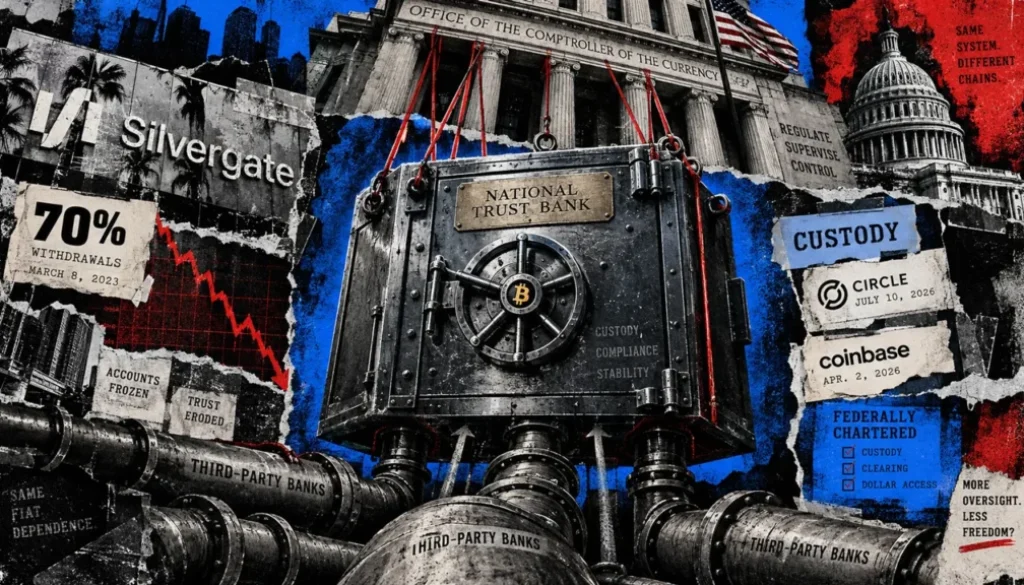
The wave of crypto firms obtaining federal trust-bank charters offers legal protection for custody operations but creates direct supervisory exposure to Washington policymakers. How much these charters actually shield firms from regulatory pressure depends on whether new reputation-risk limits genuinely constrain examiner discretion—a question Silvergate’s forced liquidation left unresolved.
- Silvergate’s former CEO says the bank survived 70% demand-deposit withdrawals but chose liquidation due to political pressure, not insolvency.
- The OCC has conditionally approved or granted preliminary approval to Coinbase, Circle, Ripple, BitGo, Fidelity Digital Assets and Paxos for federal trust-bank charters since December 2025.
- New OCC rules effective November 2026 bar supervisors from taking adverse action based on reputation risk alone, but examiners retain broad authority over safety, soundness and compliance.
- 70% Share of Silvergate’s demand deposits withdrawn before March 2023 liquidation announcement
- $43M FDIC fine imposed on Silvergate for anti-money-laundering noncompliance violations
- June 9 Effective date of OCC and FDIC reputation-risk rule barring adverse supervisory action
- Nov. 2 Implementation date for new OCC unsafe-practice standards limiting reputation-risk supervisory findings
The question of whether federal bank charters protect crypto companies from political pressure has taken on new urgency as a growing number of custody firms win approval to operate as trust banks under direct Office of the Comptroller of the Currency supervision. Silvergate Bank’s March 2023 liquidation set the cautionary backdrop: the bank held a federal charter from the OCC but collapsed after regulatory and political hostility, according to its former chief executive Alan Lane. In a September 2024 account, Lane stated that Silvergate remained solvent and liquid even after losing roughly 70% of its demand deposits in late 2022, suggesting that political pressure rather than insolvency prompted the decision to wind down. That narrative contrasts sharply with the Federal Reserve’s September 2023 inspector general review, which cited governance weaknesses, rapid growth, funding risks and concentrated deposits in crypto-industry clients as the drivers of failure. The Fed later confirmed Silvergate’s liquidation in July 2024 and imposed a $43 million fine for anti-money-laundering noncompliance. The divergent accounts underscore the core tension: a federal bank charter establishes legal standing and supervisory clarity, but it also creates a direct relationship with Washington regulators whose views on crypto can shift with political winds.
Silvergate’s model versus the trust-bank structure
Silvergate operated as a traditional deposit-funded bank serving a concentrated customer base of crypto-industry clients, a model that left it vulnerable to sudden deposit flight and funding concentration risk. The newer trust-bank charters approved by the OCC follow a fundamentally different architecture: they are custody-focused entities that do not accept insured deposits and hold customer fiat in accounts at third-party banks, removing the classic bank-run exposure from the chartered entity itself.
This structural difference matters because it shifts the vulnerability from deposit concentration to third-party banking dependencies and operational resilience.
A trust bank holding custody also operates under clearer asset-safeguarding mandates than a full-service bank, which may provide a narrower and more defensible business perimeter in regulatory exams. However, the shift does not eliminate supervisory pressure; it relocates potential friction points to compliance, operational controls and the willingness of partner banks to maintain correspondent accounts or cash-management services. The reduced balance-sheet risk profile of trust banks makes them structurally more resilient to sudden withdrawals, but it also means their regulatory standing depends heavily on operational performance and the stability of third-party banking relationships.
The OCC’s expanding roster of approved and pending trust-bank applicants
The OCC has approved or conditionally approved federal trust-bank charters for a broad cross-section of crypto custody firms. Circle announced final approval on July 10, 2026 for Circle National Trust, which will offer custody for Circle and its affiliates with reserve-management capabilities deferred to a later stage. Coinbase received preliminary conditional approval on April 2, 2026 for its National Trust Company, focused on fiduciary digital-asset custody and related services. Ripple, BitGo, Fidelity Digital Assets and Paxos all received conditional approval in December 2025 for either new trust charters or conversions from existing state-regulated custody businesses. The pending pipeline includes applications from Zerohash filed August 19, 2026, and earlier submissions from Payward National Trust Company, Agora National Trust Bank and EDX Trust.
Each of these charters comes with explicit conditions. The OCC retains authority to modify, suspend or rescind preliminary approvals before a firm begins operations, and significant business-plan changes during organization and the first three years require advance written non-objection from supervisors. Capital, liquidity and compliance benchmarks all remain subject to examiner review, and the charters define permissible activities within boundaries set by the OCC. The conditional nature of these approvals underscores that federal oversight is ongoing and subject to reassessment if business models or risk profiles shift materially.
Reputation-Risk rules and the limits of legal protection
The legal framework surrounding these charters shifted materially in 2025. In November 2021, the OCC imposed a written non-objection requirement for crypto activities at national banks, creating a gating mechanism for any bank seeking to enter crypto-related business lines. That process was rescinded on March 7, 2025, opening the door for trust-bank charters without crypto-specific approval hurdles. However, the removal of that general gate did not remove all supervisory discretion.
Two new rules tighten the terms under which regulators can exercise that discretion. An OCC and FDIC reputation-risk rule, effective June 9, 2026, bars the agencies from taking adverse supervisory action based on reputation risk alone and prohibits pressure on institutions to cut off customers solely because they engage in lawful but politically disfavored activity. A second set of standards for unsafe or unsound practices, published September 1 and taking effect November 2, 2026, narrows the scope of supervisory findings to those tied to material financial harm, deposit-insurance risk or banking law violations, explicitly excluding reputational concerns unrelated to financial condition.
Bank status did not save Silvergate. Trust-bank status may narrow the risk perimeter. The real test is whether crypto firms can operate predictably through future policy swings.
Source analysis based on regulatory and historical record
These rules represent a structural constraint on examiner discretion, but they do not eliminate it.
Supervisors retain full authority to scrutinize financial risks, anti-money-laundering compliance, operational resilience and third-party banking relationships. A future regulatory leadership could interpret those remaining authorities aggressively, tightening conditions on permissible activities or demanding higher capital and operational standards without violating the reputation-risk rule. The OCC’s December 2025 findings that nine large national banks had maintained inappropriate restrictions on digital-asset activities between 2020 and 2023 show how supervisory practice can vary within the same legal framework. The question is whether the November 2026 standards, combined with judicial-review protections under the Administrative Procedure Act, will prove sufficiently durable to insulate crypto trust banks from future tightening. Trust banks also face the practical reality that federal chartering brings transparency and direct Washington oversight, which can amplify political attention during periods of heightened congressional skepticism toward the industry.
The November 2026 implementation of the unsafe-practice standards will provide the first real test of whether reputation-risk limits can restrain examiner discretion and whether crypto trust banks can conduct their authorized businesses predictably across changing administrations. If supervisors find ways to pressure these firms through financial-risk or compliance channels without violating the letter of the new rules, the legal protection a federal charter provides will prove narrower than its text suggests. The durability of these firms’ banking relationships with third-party correspondent banks remains equally unresolved and may become the more binding constraint if banking partners themselves face political or reputational pressure to limit crypto exposure. Success for these new trust banks will depend not only on regulatory rules but on maintaining stable funding and banking infrastructure through cycles of shifting policymaker sentiment.
BlockWest is a news publication. Nothing here is investment advice. Read our disclaimer and editorial policy.