
A Japanese firm profited from Ethereum, Solana, and XRP sales yet chose to liquidate those gains to maintain its $121 million Bitcoin position
A Japanese public company has liquidated its entire altcoin portfolio to concentrate exclusively on Bitcoin, signaling a shift in how corporations are reassessing their cryptocurrency exposure. The move underscores growing skepticism about diversification strategies among firms adopting digital-asset treasuries.
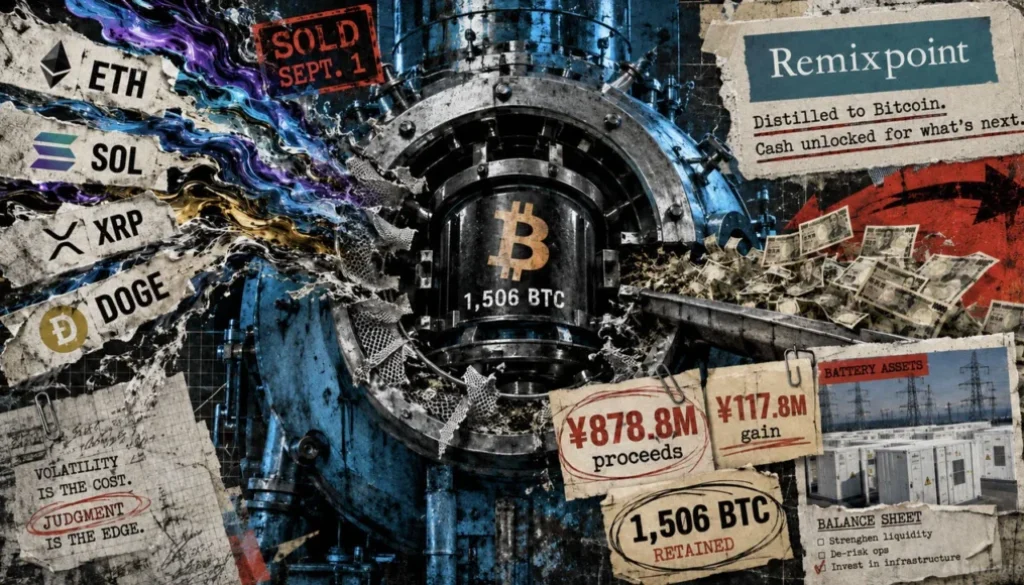
- Remixpoint sold 901.45 ETH, 13,920 SOL, 1.19 million XRP, and 2.8 million DOGE on September 1
- The sales generated ¥878.8 million (approximately $5.5 million) with net realized gains of ¥117.8 million (roughly $737,000)
- The company now holds approximately 1,506.23 BTC worth roughly $121 million, representing its sole cryptocurrency asset
- ¥60.2M Ethereum realized gain, largest among all altcoin disposals by Remixpoint
- ¥49.3M Solana realized gain, second largest from September altcoin liquidation
- ~1,506 BTC Bitcoin holdings following altcoin exit, representing only crypto asset
- ~90 BTC Bitcoin accumulated by Remixpoint during 2024 calendar year
Remixpoint, a publicly listed Japanese company, has completed a strategic pivot away from cryptocurrency diversification by selling its entire holdings in Ethereum, Solana, XRP, and Dogecoin while maintaining its Bitcoin-only digital-asset treasury. The September 1 liquidation generated ¥878.8 million in gross proceeds, yielding net realized gains of ¥117.8 million across the four assets, according to a regulatory filing. The move leaves Bitcoin as Remixpoint’s sole digital-asset exposure, with holdings valued at approximately $121 million based on its September 3 inventory of roughly 1,506.23 BTC.
The decision reflects a fundamental shift in corporate thinking about cryptocurrency portfolios. Rather than viewing altcoins as complementary assets to Bitcoin with unique risk-return characteristics, Remixpoint’s leadership appears to have concluded that Bitcoin’s established network effects, greater regulatory clarity, and institutional acceptance justify a concentrated approach over a diversified one.
Ethereum and Solana Drove Most of the Realized Gains
Ethereum proved the most profitable exit, generating ¥60.2 million in realized gains from the sale of 901.45 ETH. Solana followed with ¥49.3 million in gains from 13,920 SOL, while XRP contributed ¥11.5 million from the disposal of 1.19 million tokens. Only Dogecoin produced a loss, with 2.8 million DOGE resulting in a ¥3.3 million negative impact on the transaction.
The successful exits in Ethereum and Solana suggest Remixpoint purchased these assets at favorable prices and benefited from their appreciation over the holding period. The profitability of these disposals indicates that the company achieved meaningful returns before deciding to consolidate its cryptocurrency strategy, making the timing of the liquidation particularly significant from a fiduciary perspective.
The company did not commit the ¥878.8 million in sale proceeds to additional Bitcoin purchases.
Instead, Remixpoint indicated the capital would support multiple corporate priorities including grid-scale battery storage expansion, balance sheet strengthening, and other shareholder value initiatives. The company stated it evaluated market conditions, risk-return profiles, and its overall financial strategy when deciding to eliminate altcoin exposure and concentrate exclusively on Bitcoin.
This capital allocation decision reveals pragmatic corporate governance. Rather than pursuing a “hodl and accumulate” strategy with every available dollar, Remixpoint appears to be balancing cryptocurrency treasury operations with broader business needs and shareholder expectations. The emphasis on battery storage investment suggests the company operates within the energy or technology sectors where such infrastructure investments align with core business operations.
Bitcoin holdings extended through lending and staking income
Beyond the altcoin disposals, Remixpoint’s Bitcoin position has expanded substantially through income generated across its cryptocurrency holdings. Between February 24 and August 31, the company’s Bitcoin holdings earned 14.92 BTC through lending arrangements, valued at approximately ¥164.2 million using month-end pricing. This accumulation pattern reflects an intentional strategy to grow Bitcoin exposure independent of the altcoin liquidation proceeds.
Bitcoin lending has emerged as an increasingly popular strategy among corporate treasuries seeking to generate yield on static holdings. These arrangements typically involve collateralized loans to institutional borrowers, with repayment backed by Bitcoin or cash equivalents. Remixpoint’s participation suggests confidence in institutional-grade lending protocols and counterparty risk management practices that have become more sophisticated across the industry.
The company also reported ¥29.9 million in yen-denominated staking rewards derived from Ethereum and Solana between July 2025 and August 31, 2026, demonstrating that yield generation continued even as it prepared to exit those positions. Remixpoint’s year-to-date Bitcoin accumulation totaled approximately 90 BTC, according to Bitcoin Treasuries data, indicating consistent monthly purchasing or reward-based additions.
The staking income from Ethereum and Solana represents a growing trend among institutional cryptocurrency holders seeking to generate passive income from blockchain validation activities. These rewards demonstrate that companies can maintain profitable exposure to altcoins through yield mechanisms even while reducing outright ownership, though Remixpoint ultimately chose to eliminate this exposure entirely.
Remixpoint follows metaplanet’s Bitcoin Treasury model in Japan
Remixpoint ranks among the early Japanese publicly traded companies to adopt an aggressive Bitcoin treasury strategy, a model domestically championed by Metaplanet, which has aggressively accumulated Bitcoin holdings. Metaplanet itself deployed 83 percent of a $500 million credit line to acquire 43,000 BTC and has signaled plans to pursue additional funding for further accumulation, setting a precedent for Japanese corporate Bitcoin adoption.
The Japanese market has emerged as a notable center for corporate Bitcoin adoption, partly due to regulatory clarity established through the Payment Services Act and growing institutional appetite for alternative reserve assets. Both Remixpoint and Metaplanet’s strategies reflect confidence in Bitcoin’s long-term value proposition and its suitability as a corporate treasury asset class.
Corporate treasury strategies vary significantly across markets and industries. While some companies view Bitcoin as a hedge against currency devaluation or inflation, others emphasize its role as an uncorrelated asset or appreciate its technical superiority and network security. Remixpoint’s Bitcoin-only approach suggests the company has concluded these characteristics outweigh the diversification benefits traditionally associated with holding multiple digital assets.
The liquidation reflects a broader reassessment among corporate crypto treasuries as they navigate weaker market conditions and mounting pressure to justify how digital assets align with business fundamentals and shareholder returns, raising questions about whether other corporations holding diversified cryptocurrency portfolios will follow Remixpoint and Metaplanet toward Bitcoin concentration strategies.
BlockWest is a news publication. Nothing here is investment advice. Read our disclaimer and editorial policy.