Your Bitcoin wallet’s greatest security risk could be found on the delivery package label

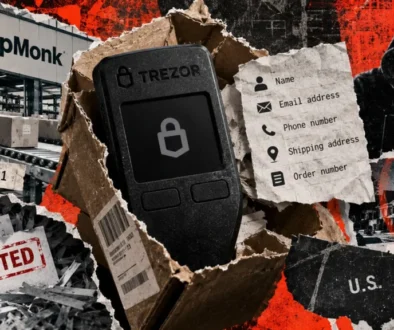
A shipping data breach affecting over 80,000 Trezor customers exposes how hardware wallet purchases create lasting privacy vulnerabilities that persist long after the device is unpacked and deployed. The leaked contact information, though containing no private keys or funds, can enable targeted social engineering attacks designed to trick owners into surrendering their wallet recovery phrases.
- Trezor disclosed that approximately 67,000 additional US customers were affected by ShipMonk shipping records from 2019 to 2021, raising the total to 80,689 affected customers overall.
- The leaked data included only contact and delivery details; no private keys, wallet contents, or funds were exposed or stolen.
- Attackers can use home addresses from old shipping records to craft convincing phishing campaigns via physical mail or email, targeting wallet owners to extract recovery phrases that bypass all device security.
- 80,689 Total Trezor customers affected by shipping provider data breach
- 2019-2021 Years covered by records exposed in the ShipMonk breach
Hardware wallet manufacturers have long emphasized that their devices protect private keys by keeping them isolated from internet-connected computers. Yet the process of purchasing and receiving a physical device creates a separate security problem that outlives the transaction itself. On September 4, Trezor updated its public disclosure regarding a breach of its shipping provider, ShipMonk, confirming that contact and delivery information for 80,689 customers had been compromised, including orders placed between 2019 and 2021. The company stated that Trezor’s own systems and device contents were unaffected, but the leaked shipping records create a persistent risk of targeted social engineering.
The incident highlights a fundamental tension in the hardware wallet industry. While devices themselves represent significant security improvements over software wallets, the supply chain surrounding them introduces vulnerabilities that technical cryptography cannot solve. Manufacturers must rely on third-party logistics providers to store and handle customer addresses, creating data exposure risks that extend far beyond the device’s design lifecycle. This supply chain risk affects not only Trezor but the entire hardware wallet sector, where similar outsourcing practices are industry standard.
How a shipping address becomes a Social Engineering tool
The separation between a hardware wallet’s secrets and the customer’s personal information is critical. A hardware wallet’s private keys authorize all transactions on the blockchain and remain secure inside the device, protected from a compromised computer. Recovery phrases, typically sequences of 12 or 24 words, can restore wallet access if the device is lost or damaged, but they also grant complete access to anyone who obtains them. Trezor’s own guidance warns users never to share recovery phrases or store them digitally, yet an attacker armed with a customer’s name and address can make fraudulent requests appear legitimate.
Physical mail has proven particularly effective for these schemes. Ledger has documented phishing campaigns that delivered physical letters to customers’ homes, directing them to scan codes or visit websites where they were prompted to enter their recovery words. An email addressed to someone by name and referencing an order they recognize carries far more credibility than mass-produced spam. A letter delivered to the address on an old shipping record can impersonate official correspondence, with instructions designed to trick the recipient into surrendering wallet access.
The leaked information itself contains no funds or blockchain secrets, yet it creates ongoing vulnerability by connecting a real-world identity to a known Bitcoin purchase. This linkage between personal identity and cryptocurrency ownership remains valuable to attackers even years after the initial transaction, since wallet owners typically do not expect threats from information so far removed from their device security.
Why deletion assurances are not the same as evidence
When companies outsource delivery operations, they create contractual obligations to handle customer data responsibly. Trezor stated that ShipMonk provided written assurances that records were deleted, but obtaining a vendor’s promise to dispose of data is distinct from verifying that deletion actually occurred across all systems where the information may have been stored. Shipping records can persist in database replicas, backup systems, support-system exports, and other infrastructure long after formal removal from front-end applications.
The Federal Trade Commission’s business guidance establishes a straightforward principle: companies should collect and retain sensitive information only for legitimate business needs, understand where that data flows, and dispose of it securely. Yet that principle requires manufacturers to demand concrete evidence from contractors and define specific retention periods, not simply accept written assurances. A company cannot inspect its fulfillment partner’s databases years after a purchase to confirm that old records have actually been removed. The responsibility to verify compliance falls on the manufacturer that chose the vendor and negotiated the contract terms.
Legitimate operational reasons exist for temporarily retaining shipping records, but those reasons typically expire within months after delivery and payment reconciliation. Industry best practices in data minimization suggest that records older than one or two years should be destroyed unless specific legal obligations require longer retention. Yet most companies retain such information far longer than necessary, increasing both the volume and age of records at risk if a breach occurs.
Defending against leaks that predate modern Security practices
Some privacy protections can reduce exposure at the point of purchase. Parcel lockers, neutral packaging, and separate contact details for online orders can make targeted scams harder to execute. However, these measures have limits. Locker operators often require identification, payment providers retain billing information for chargebacks and disputes, and unmarked packaging does not delete retailer records. Buying secondhand or through unfamiliar sellers introduces different risks if device authenticity becomes difficult to verify.
The most effective defense requires manufacturers to implement data minimization practices before any breach occurs. This means collecting only information necessary for delivery, separating details that do not need to travel together, and establishing verifiable evidence that contractors remove records when their job ends. A home address remains valid and useful for social engineering long after the original purchase is forgotten, and once copied records are distributed, they cannot be recalled. Moving to a new address does not erase the association between a person and their past Bitcoin purchase, and old addresses can still help attackers match other records or impersonate legitimate businesses.
Beyond address handling, hardware wallet manufacturers should consider requiring customers to verify their purchases through secure channels before responding to any future support requests or recovery assistance. This adds friction to the process but makes it significantly harder for attackers to exploit leaked shipping records alone. Some manufacturers have begun implementing two-factor authentication for account recovery, creating a secondary barrier that prevents attackers from gaining access based solely on compromised shipping data.
Trezor has not announced specific changes to its vendor management or data retention policies in response to the ShipMonk disclosure. Hardware wallet buyers remain exposed to the same risk with their current devices, and watchdog scrutiny will likely turn toward whether manufacturers implement evidence-based verification protocols with fulfillment partners to confirm deletion of old shipping records, rather than relying on vendor assurances alone. Industry observers expect this incident may prompt other wallet makers to examine their own supply chain vulnerabilities and establish stricter data governance standards with their logistics partners.
BlockWest is a news publication. Nothing here is investment advice. Read our disclaimer and editorial policy.