Bitcoin maintains its advance while traders assess September rate increase probability at 85%
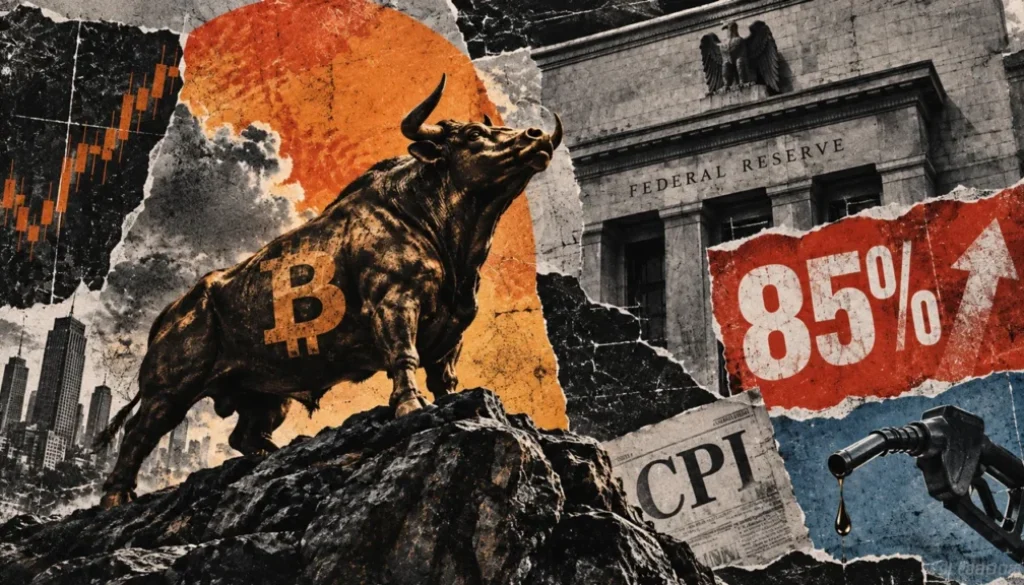
The Federal Reserve faces conflicting inflation signals that have raised September rate hike odds to 85%, even as Bitcoin initially held modest gains following the August CPI report. For digital asset traders, the outcome hinges on whether energy price pressures spread into core inflation and shift Fed expectations away from the rate cuts priced into recent rallies.
- August core CPI rose 0.3% monthly after 0.2% in July, even as annual core inflation eased to 2.4% from 2.5%.
- Fed futures moved to 85% probability of a quarter-point rate increase at the September 15-16 meeting, up from 70% before the report.
- Bitcoin held near $78,683, up 2.08% over 24 hours as of US market close, but the report’s energy component and September oil price moves remain unpriced.
- 85% Probability of a 25-basis-point Fed rate hike in September, versus 70% before the inflation release
- 0.3% August monthly core CPI increase, accelerating from 0.2% in July despite annual easing
- 3.9% August gasoline index rise, accounting for over one-third of the monthly headline increase
- 2.4% Annual core inflation rate, down from 2.5% but still above the Fed’s 2% target
The August consumer price index delivered a split verdict that kept financial markets on edge. Headline CPI rose 0.4% on a seasonally adjusted basis after a 0.1% increase in July, with the unadjusted 12-month rate holding steady at 3.4%. Gasoline drove much of the monthly move, its index climbing 3.9% and representing more than one-third of the all-items increase, while the broader energy index gained 2.1%. That composition initially offered some relief to Bitcoin traders and rate-cut advocates: a spike concentrated in volatile energy need not signal the same policy urgency as broad-based inflation. Yet the report contained pressures extending well beyond fuel prices.
The inflation data arrives at a critical juncture for monetary policy. The Federal Reserve has held its benchmark interest rate in the 5.25-5.50% range since July 2023, and market participants have increasingly priced in the possibility of rate cuts beginning in late 2024. However, the stickiness of core inflation has prompted debate among policymakers about whether the Fed has truly tamed price pressures or merely paused at an insufficient level. Digital asset markets have traded heavily on rate expectations, as lower interest rates typically reduce the opportunity cost of holding non-yielding assets like Bitcoin and other cryptocurrencies.
Monthly core Inflation accelerates despite annual easing
Core CPI, which excludes food and energy, rose 0.3% in August following a 0.2% increase in July. Simultaneously, the annual core inflation rate eased to 2.4% from 2.5%, creating a fundamental tension. The longer-run trajectory improved toward the Federal Reserve’s 2% goal, but the latest monthly pace moved in the opposite direction, signaling renewed underlying inflation pressure that extends beyond energy volatility.
This divergence between monthly and annual metrics illustrates a key challenge facing the Fed. When monthly core inflation accelerates after appearing to stabilize, it raises questions about whether the disinflation process has stabilized or merely paused. Fed policymakers typically examine both time horizons, as monthly figures can be volatile while annual rates capture broader trends, but consistent acceleration in the monthly data warrants serious attention.
Other price components reinforced that mixed signal. Shelter rose 0.3% in August, while services excluding energy services gained 3.0% over the 12-month period. Services inflation remains particularly stubborn and difficult to forecast because it reflects labor market dynamics, wage pressures, and structural demand patterns that cannot easily reverse through commodity price declines. Federal Reserve Governor Christopher Waller had previously framed his September decision around August inflation data, stating in a September 3 speech that continued progress toward the 2% target would incline him to support holding rates steady, but that a hot report or evidence of reversed progress could lead him to consider a hike at the September 15-16 meeting.
Continued progress toward the Fed’s 2% goal would incline him to support holding the policy rate steady. He also said a hot report, or evidence that progress had reversed, could lead him to consider a hike at the September 15-16 meeting.
Christopher Waller, Federal Reserve Governor
Traders weight monthly risk over annual improvement
Market reaction showed that futures traders gave substantial weight to the monthly core acceleration risk rather than the annual core improvement.
CME FedWatch probabilities, derived from 30-Day Fed Funds futures, moved to an 85% probability of a quarter-point increase in September, up from approximately 70% before the inflation report. Waller described his policy view as a reaction function rather than a commitment, and his comments do not predetermine committee votes. However, they illustrate why the monthly core acceleration cannot be dismissed simply because annual core inflation edged closer to target. Waller noted that core inflation remains useful for seeing through energy volatility and that broader spillovers from earlier energy increases have not appeared so far, yet he identified renewed energy pressure and a possible rise in longer-term inflation expectations as risks warranting Fed attention.
The market’s repricing toward higher rate hike odds reflects rational uncertainty about whether the Fed should remain patient or take defensive action. A quarter-point increase at this stage would represent a hold rather than a true tightening, but it would signal that the Fed retains options if inflation proves more persistent than recent trends suggest. For Bitcoin and other risk assets, such a signal could dampen near-term momentum that has built on expectations of imminent rate cuts.
September energy shocks still unpriced in Inflation data
Bitcoin initially held its daily gain near $78,683, up 2.08% over 24 hours as of US market close, yet the August CPI release carries a critical timing constraint. The August report cannot capture the sharper oil price movements that developed in September, creating a gap between the data released and current market conditions. The new energy shock remains outside the August CPI figures and cannot yet be assessed as evidence of broader inflation spread.
Whether September’s energy pressure persists or bleeds into broader price categories remains a separate risk for subsequent inflation data and inflation expectations channels that Waller identified as policy concerns. Oil prices can fluctuate sharply based on supply disruptions, geopolitical events, and demand shocks that may prove temporary. However, if energy costs remain elevated for several consecutive months, they can eventually feed into broader price pressures through transportation costs, manufacturing expenses, and consumer demand patterns.
The August report gave policymakers reason to look through part of the gasoline-led jump, but faster monthly core inflation complicated the case for holding rates. Bitcoin traders must now monitor whether the September oil price shock appears in upcoming inflation expectations measures or broader price data that could shift Fed decision-making away from the rate-cut scenario currently embedded in digital asset valuations.
The tension between monthly and annual inflation metrics, combined with persistent services inflation and energy volatility, creates genuine uncertainty about the Fed’s September decision. For digital asset markets, clarity may not arrive until later inflation reports and forward guidance provide stronger signals about the Fed’s confidence in the disinflationary trend. The next few weeks of economic data and Fed communications will prove critical for determining whether September marks a pause in rate cuts or a signal of persistent policy tightness ahead.
BlockWest is a news publication. Nothing here is investment advice. Read our disclaimer and editorial policy.