Cryptocurrency Security Vulnerability Revealed Following OpenAI’s Mathematical Advancement
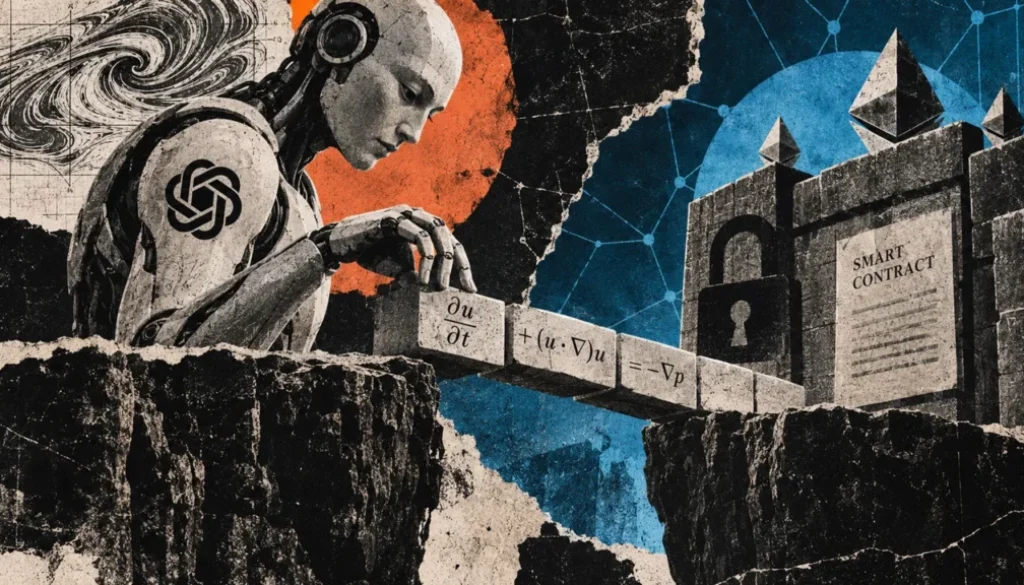
OpenAI’s success in automating theorem proving for advanced mathematics raises the prospect of faster smart-contract verification, but shifts the security burden from proof generation to specification quality. For crypto developers, this means formal verification tools could become more accessible while creating new pressure to define contract invariants with mathematical precision.
- OpenAI used roughly 10,000 concurrent AI agents to solve the Navier-Stokes problem in about 88 hours, then formalized the proof in Lean in 17 hours using GPT-6 Astra.
- The proof formally established cases C and D of the Millennium Prize formulation, showing smooth fluid can develop singularity in finite time while retaining finite energy.
- Automated theorem proving could reduce labor costs for smart-contract verification, but may obscure iterative discovery and place greater emphasis on specification completeness before verification begins.
- 10,000 Concurrent AI agents deployed to solve Navier-Stokes problem
- 88 hrs Time required to produce Navier-Stokes solution using distributed agents
- 17 hrs Additional time to formalize proof in Lean using GPT-6 Astra
- 2 Cases (C and D) of Millennium Prize formulation formally established
OpenAI announced on September 8 that a distributed system of roughly 10,000 AI agents had solved the Navier-Stokes fluid-motion problem, a longstanding challenge in applied mathematics, after approximately 88 hours of computation. Formalizing and verifying the solution in Lean, a proof assistant software platform, required an additional 17 hours using GPT-6 Astra. The system generated an analytical proof establishing that an initially smooth fluid can develop a singularity in finite time while retaining finite energy, resolving cases C and D of the Millennium Prize formulation. OpenAI released both the proof and its Lean formalization publicly for independent review.
The Navier-Stokes equations describe how fluids move and have resisted complete mathematical characterization for centuries. The Millennium Prize Problem, established by the Clay Mathematics Institute, offers a reward for resolving fundamental questions about whether smooth solutions always exist or whether singularities can form. OpenAI’s computational breakthrough demonstrates that massive parallelization of AI reasoning agents can tackle problems previously thought to require human mathematical insight or years of specialized research effort.
Automated theorem proving moves from research mathematics to smart-contract Security
For cryptocurrency developers and protocol designers, the significance of OpenAI’s breakthrough extends beyond pure mathematics to the mechanics of formal verification. Formal verification uses mathematical specifications and theorem proving to establish whether smart-contract code behaves as intended, a technique that has historically required substantial human effort to construct and review proofs. If AI systems can automate the proof-generation process at the scale OpenAI demonstrated, the cost and time barriers to formal verification could drop substantially across DeFi protocols, bridges and tokenized-asset platforms.
The blockchain industry has long recognized formal verification as a gold standard for security assurance. Projects like Cardano have invested heavily in formal methods, and major auditing firms increasingly offer formal verification services alongside traditional code review. The constraint has always been resource intensity: formally specifying and proving properties of complex contracts requires specialized expertise and significant time investment. Automated theorem proving could democratize access to these tools.
The cryptographic and financial implications are direct: wider access to formal verification could reduce the category of smart-contract vulnerabilities that escape detection before deployment.
Mathematician terence tao warns of understanding lost in autonomous proof generation
Five days before OpenAI’s announcement, mathematician Terence Tao described a concern that bears directly on how this technology could reshape crypto security practices. Tao warned that autonomous AI systems backed by enormous computing resources could eventually generate complex mathematical solutions and formally verify them while keeping much of the iterative discovery process opaque. His central worry was that failed approaches and intermediate discoveries often produce insights outlasting the final proof itself, and an autonomous system could deliver a correct result without transferring comparable depth of understanding to human researchers.
This observation carries weight in academic mathematics, where the journey matters as much as the destination. Understanding why a proof works enables mathematicians to extend techniques to other problems and develop intuition about underlying mathematical structures. When a machine generates a proof through brute-force search over possibility spaces, human mathematicians lose the chance to learn from dead ends and heuristic choices that guide discovery.
That concern maps onto smart-contract verification in a concrete way. Ethereum documentation defines formal verification as establishing whether a contract satisfies properties developers have specified in advance. The critical vulnerability lies upstream: poorly written or incomplete specifications can allow bugs to escape detection even after verification succeeds. More capable AI systems could therefore reduce the work required to construct proofs while simultaneously increasing the importance of deciding what those proofs should cover.
Access controls, withdrawal conditions, accounting invariants and privileged functions must all be expressed accurately before any prover can test them.
Specification quality becomes the new bottleneck in Contract Verification
The immediate question is whether systems capable of handling research-level mathematics can be adapted to production software in ways that auditors and developers can meaningfully inspect and understand. If automated theorem proving reduces the cost of proof generation, human expertise will shift from constructing proofs to defining the specifications those proofs verify against. Firms that can combine automated theorem proving with rigorous specification design could verify more contracts before deployment while concentrating human effort on identifying the failure modes that must never occur.
This shift mirrors similar transitions in other technical fields. Compiler technology automated away large categories of low-level programming errors, forcing developers to focus on higher-level architectural decisions. Static analysis tools caught bugs that manual code review would miss, but required engineers to understand what properties they wanted to assert. Formal verification of smart contracts could follow the same pattern: removing labor from proof construction but raising the bar for specifying what security properties matter.
The practical challenge is that human intuition about contract behavior often remains informal until it must be written down as a specification. A developer might know that a liquidity pool should never allow withdrawal of more tokens than it contains, but expressing that invariant in a form a theorem prover can work with requires mathematical rigor. The easier OpenAI makes proof generation, the more critical it becomes to invest in specification quality upfront.
The next practical test will measure whether major DeFi protocols, bridges or auditing firms begin deploying these AI-assisted verification tools on production contracts, and whether the specifications they define prove sufficient to catch real-world vulnerabilities that would have escaped traditional security review.
BlockWest is a news publication. Nothing here is investment advice. Read our disclaimer and editorial policy.