Why Bitcoin Advocates Shouldn’t Confuse Declining Dollar Reserve Dominance With Increased Central Bank Purchases
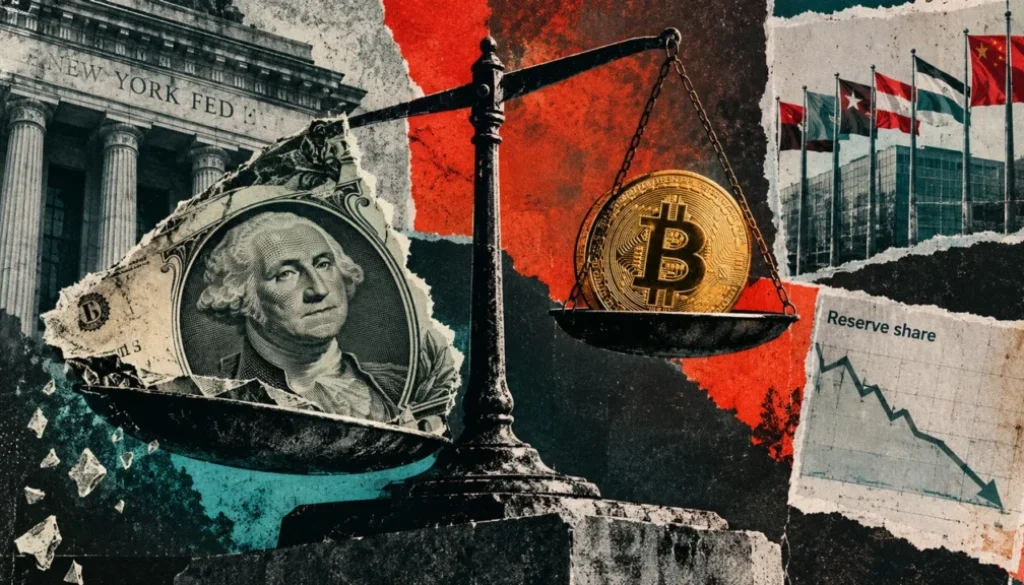
A New York Fed analysis reveals that declining dollar reserves may reflect portfolio shifts among a small number of large reserve holders rather than broad central bank retreat from the currency. For Bitcoin investors betting on sovereign demand, the distinction matters: a falling dollar share does not automatically signal central bank Bitcoin purchases.
- Dollar share of global official reserves fell from 64% in 2015 to 56% by end-2025, per IMF COFER data.
- Switzerland’s reserve growth between 2015 and 2019 lowered the global dollar share despite raising its own dollar allocation.
- Neither the New York Fed research nor declining reserve statistics measure or establish actual sovereign Bitcoin purchases.
- 64% Dollar share of global official reserves at year-end 2015 versus 2025
- 56% Dollar share of global official reserves at year-end 2025 versus 2015
- 76 Countries with complete reserve data analyzed for 2015-2019 period
- $1M Czech National Bank’s digital-asset test portfolio announced November 2025
Researchers at the New York Federal Reserve examined whether the eight-percentage-point contraction in the dollar’s share of global official foreign-exchange reserves between 2015 and 2025 reflects a genuine shift in central bank preferences or simply the mechanical effect of how reserves are distributed across nations. Linda S. Goldberg, Oliver Hannaoui, and Sneha Parthasarathy identified a critical distinction: countries can alter the currency composition of their portfolios, or they can change the total size of their reserves, with the latter effect capable of shifting the global average without any individual nation changing course.
This research carries particular relevance as discussions intensify about central bank reserve diversification. The International Monetary Fund’s Composition of Official Foreign Exchange Reserves (COFER) data has become a focal point for analyzing shifts in monetary power and currency preferences among nations. Understanding the mechanisms behind these shifts helps policymakers, investors, and economists distinguish between genuine preference changes and statistical artifacts.
How Reserve growth can mask stable Dollar preferences
The research demonstrates that a country holding a below-average dollar allocation can expand its total reserves and thereby reduce the worldwide dollar share, even while maintaining or increasing its own dollar proportion. Switzerland exemplified this dynamic between 2015 and 2019: as its total reserves grew, it pulled down the aggregate global dollar share even as its own dollar allocation rose.
The researchers split the eight-percentage-point decline into two components: changes in countries’ currency preferences and changes in reserve sizes.
From 2015 to 2019, across 76 countries with complete data, preferences contributed a decline of 1.2 percentage points while reserve-size changes accounted for 1.5 percentage points. In the subsequent 2019-2023 period, the pattern reversed: 62 countries with complete data showed a modest positive 0.3-percentage-point preference shift toward dollars, offset by a negative 0.5-percentage-point contribution from shifting reserve sizes. China, Russia, Mexico, and Morocco lacked comparable 2023 data, complicating the full picture.
The implications extend beyond academic interest. Central banks manage reserves to support monetary policy operations, maintain exchange rate stability, and provide confidence in a nation’s ability to meet external obligations. The composition of those reserves signals strategic priorities and geopolitical alignments. When reserve data suggests a shift away from dollars, questions about currency stability and reserve asset diversification naturally arise.
The limited case for inferring Bitcoin demand from Dollar Reserve decline
The underlying Federal Reserve Staff Report, originally issued in March 2024 and revised in February 2026, separates reserves held for operational liquidity needs from those available for discretionary investment. Trade payments, foreign-currency debt management, and currency stabilization typically drive liquidity requirements, while diversification beyond those needs occurs when reserves exceed operational thresholds.
The rise of cryptocurrencies and digital assets has prompted speculation about whether central banks might reallocate reserves toward Bitcoin or other digital currencies. This possibility emerged from discussions about de-dollarization, alternative store-of-value assets, and emerging technologies. However, actual sovereign adoption has remained limited, with most official digital-asset exploration focused on central bank digital currencies rather than Bitcoin.
A shrinking dollar share of reserves establishes neither a preference shift nor an investment decision in any particular asset class, including Bitcoin.
The researchers note that even when a central bank announces an actual Bitcoin purchase, the inference from aggregate reserve data remains limited. The Czech National Bank disclosed on November 13, 2025, that it had allocated $1 million to a digital-asset test portfolio including Bitcoin, a dollar stablecoin, and tokenized deposits, but explicitly positioned the purchase outside its official international reserves. The case for sovereign Bitcoin demand requires direct evidence: a disclosed allocation, an identified funding source, evidence of executed purchases, and a clear distinction between official reserves and holdings held separately.
Central banks operate under regulatory constraints, transparency requirements, and governance structures that differ significantly from private investors. Any large-scale Bitcoin acquisition would likely require board approval, public disclosure, and explanation to legislatures or finance ministries. The absence of such announcements from major reserve-holding nations suggests that Bitcoin remains a marginal consideration in official reserve strategy, despite broader interest in digital assets.
Bitcoin investors relying on declining dollar reserve statistics as evidence of emerging central bank demand should seek separate confirmation. The New York Fed research provides no measure of sovereign Bitcoin purchases and does not estimate any price effects from reserve diversification. Market participants await either official announcements of reserve allocations to Bitcoin or purchase disclosures from major central banks to establish concrete demand, not inferences drawn from aggregate currency-composition shifts.
BlockWest is a news publication. Nothing here is investment advice. Read our disclaimer and editorial policy.