Tech companies drain construction workers with triple-wage data center offers
The race to build AI data centers is creating fierce competition for skilled construction workers across rural America, with tech companies offering triple typical wages to poach electricians and plumbers from local projects. Political pushback and proposed restrictions threaten to accelerate timelines and reshape where the next wave of construction happens.
- Associated Builders and Contractors estimates the construction industry needs 349,000 net new workers in 2026 to meet current demand.
- One Abilene electrical company lost 42 workers in a single day to data center jobs paying at least triple local wages.
- Texas Gov.-elect Gina Hinojosa has called for a statewide data center moratorium, potentially constraining new projects and intensifying competition for existing sites.
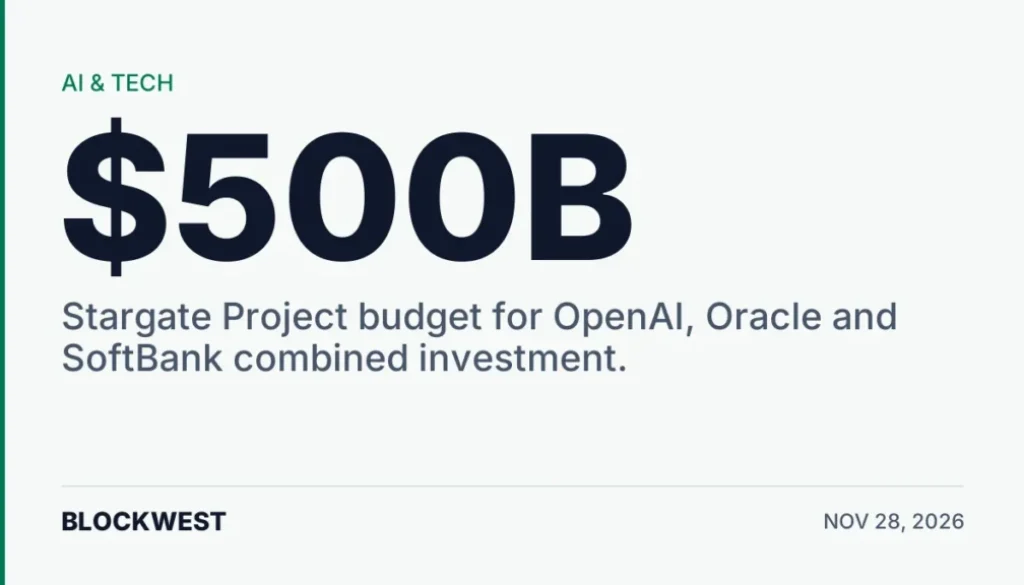
- $500B Stargate Project budget for OpenAI, Oracle and SoftBank combined investment.
- $50B Meta’s Hyperion data center investment in Richland Parish, Louisiana.
- $115M Meta’s American Workforce Academy funding for construction worker training nationwide.
- 349,000 Net new construction workers needed industry-wide in 2026 versus current supply.
CNBC reported that the AI data center construction boom is creating acute labor shortages across the United States, with rural regions like Abilene, Texas serving as a flashpoint for the competition between tech giants and local contractors. President Donald Trump said last week that American companies will face a “tremendous tax” for building data centers outside the U.S., but the immediate constraint is not regulatory or financial—it is the dwindling availability of skilled construction workers. Associated Builders and Contractors estimates the construction industry needs to attract 349,000 net new workers in 2026 just to keep pace with demand, far exceeding the current supply of electricians, plumbers and other trades.
Abilene becomes ground zero for wage competition between tech and local builders
Abilene has emerged as a proving ground for the tension between data center expansion and regional economic stability. Thousands of construction workers have descended on the city since 2025 to build massive facilities including the $500 billion Stargate Project for OpenAI, Oracle and Japan’s SoftBank. RV parks and temporary housing have expanded to accommodate the influx, reshaping the local landscape alongside mile-wide construction sites that now dot the prairie.
Gene Lantrip, an Abilene homebuilder, describes the phenomenon as “a two-edged sword.” Data centers are bringing new business and residents to the city, but they are simultaneously draining the local workforce. Scotty Wristen, an Abilene master electrician who works with Lantrip, said that some of his electricians have abandoned local work for AI data center positions because of vastly higher compensation.
I know of one company that lost 42 guys in one day. If I was young and didn’t have a wife and kids, I would probably do it too, because they pay at least triple what I can pay.
Scotty Wristen, master electrician
Even commercial electrical companies in the area have lost significant portions of their workforce to data center jobs offering substantially higher pay combined with on-the-job training sponsored by tech companies.
Tech giants deploy training programs to expand the construction labor pool
To address the shortage, major tech companies including Meta, Google and Amazon are investing millions in construction worker training initiatives. Meta is partnering with the Associated Builders and Contractors on a $115 million program called the American Workforce Academy, which the company describes as a nationwide fast-track to careers in skilled trades. Joel Thames, an ABC vice president of health, safety, environment and workforce development, said the program has “attracted thousands of folks who want to get into construction and learn a trade and to eventually work in data centers.”
These initiatives provide hands-on, paid experience at data center sites, attempting to convert aspiring builders into a permanent workforce rather than relying solely on poaching existing workers.
Political restrictions could accelerate construction timelines and shift projects to other states
The outlook for new data center construction in Texas has shifted following midterm elections in which voters overwhelmingly supported restrictions on data center projects. Texas Democratic Gov.-elect Gina Hinojosa has called for a statewide data center moratorium until additional rules give residents more agency to determine whether new facilities should be built. Hinojosa has prioritized data center policy as a campaign focus.
Anita Verma-Lallian, CEO of Arizona Land Consulting and a data center real estate developer with projects in Texas and Arizona, said the proposed restrictions will likely have the opposite of their intended effect. “What’s happened in my view, it’s just going to make the demand even higher because the supply is going to be so much more constrained,” she said. “We’re going to see a rush to get those projects built and online as soon as possible.” Verma-Lallian views Arizona as a more favorable environment for data center development, noting that Governor Katie Hobbs is “fairly moderate on data centers.”
If construction eventually slows in Texas, Verma-Lallian said the labor diaspora could “go to other states or other projects,” potentially redistributing the worker shortage across the country.
The BlockWest read. The labor constraint facing data center builders is not temporary friction but a structural bottleneck that will persist whether projects accelerate in Texas or migrate to Arizona and beyond. Tech companies’ training programs are essential but insufficient; they cannot quickly replace experienced electricians and plumbers. The real question is whether political restrictions will force projects online faster or whether capital will simply flow to jurisdictions offering faster permitting, leaving rural economies to absorb workforce churn either way.
The timing of Hinojosa’s data center moratorium and any enabling legislation will determine whether existing Texas projects face compressed construction schedules that further strain the labor market, or whether developers shift investment to states like Arizona where permitting remains less restrictive. Industry watchers should monitor whether Meta, Google and Amazon expand their training programs in response to the Texas uncertainty and whether wage competition continues to escalate.
BlockWest is a news publication. Nothing here is investment advice. Read our disclaimer and editorial policy.