OKX’s tokenized stock venue draws minimal retail demand on first day.
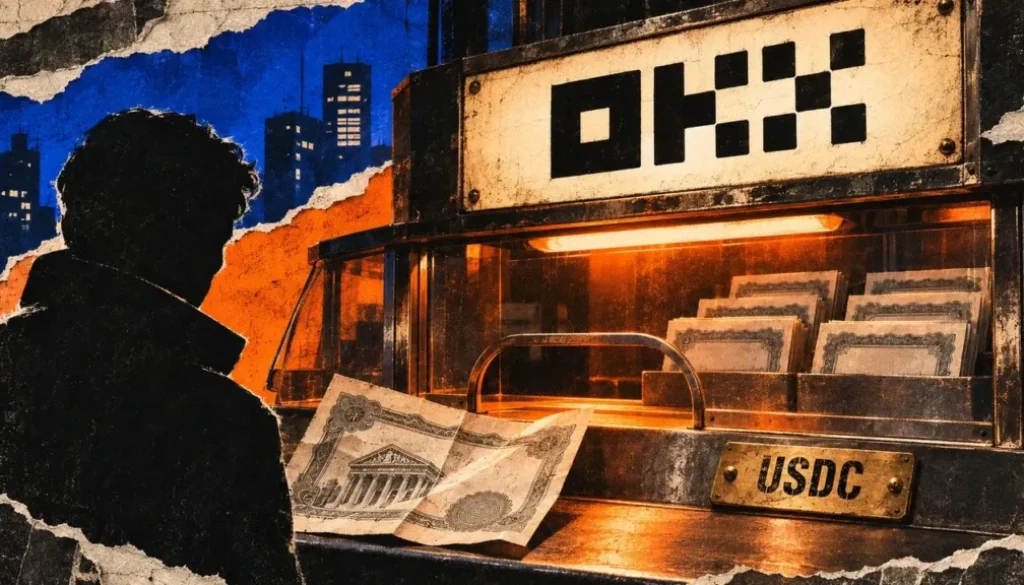
OKX’s new 24/7 stock trading venue opened with minimal retail participation on its first day, raising questions about whether tokenized equities can attract individual investors at scale. The vast majority of opening volume came from liquidity providers rather than customers, a pattern that may shape how platforms approach future launches.
- OKX launched round-the-clock trading in six tokenized stocks on November 23 at noon ET using USDC stablecoin
- Customer wallets accounted for only $121,000 of $1.64 million in first-day trades through 4 p.m. ET, or roughly 7 percent
- Liquidity providers contributed 93 percent of volume, with one provider known as “Akiba” driving the majority of activity
- $1.64M Total first-day trading volume tracked through 4 p.m. ET on November 23
- $121K Customer wallet volume on first day, or 7 percent of total
- $1.22M Total liquidity held across six pools at midnight ET on November 24
- 6 Tokenized stocks available for 24/7 trading at launch
OKX opened 24/7 trading in tokenized equities through a permissioned venue operated by its joint venture with Intercontinental Exchange, the parent company of the New York Stock Exchange, according to reporting by CryptoSlate. The initial lineup includes Coinbase (COIN), Securitize (SECZ), MicroStrategy (MSTR), BitGo (BTGO), Robinhood (HOOD) and Circle (CRCL), all paired with USDC. Eligible US customers can now buy and sell these tokens in the OKX app after traditional stock markets close, subject to identity verification and wallet screening requirements.
Customer participation lagged far behind liquidity provider activity on day one
Data analyzed by blockchain research firm Allium showed a stark imbalance between retail and professional trading in OKXICE’s first 24 hours. Customer wallets generated only $121,000 of the $1.64 million in trades tracked through 4 p.m. ET on November 23, meaning retail accounted for approximately 7 percent of opening volume. A single liquidity provider, identified as “Akiba,” was credited with 93 percent of total activity, underscore how dependent the new venue was on professional market makers to establish initial trading conditions.
Robinhood’s pool held the most liquidity of any pair at $353,000 as of midnight ET on November 24, while Securitize’s held the least at $31,000.
The SEC’s temporary exemption allows AMM-based trading outside traditional exchange rules
OKXICE operates under temporary conditional SEC relief from the statutory definition of an exchange, granted to facilitate permissioned trading of tokenized NMS stocks using automated market maker liquidity pools. The order, issued under Section 36(a)(1) of the Securities Exchange Act of 1934, exempts tokenized securities venues from full exchange regulation while requiring them to set standards for participant access and conduct wallet screening. The exemption also shields certain liquidity providers from the definition of “dealer” under the Exchange Act.
Trades execute against permissioned Uniswap v4 liquidity pools on OKX’s X Layer network, where pool prices move based on the ratio of assets deposited. When a customer buys stock tokens, they add USDC to the pool and withdraw tokens, pushing the pool price upward; sales move the price downward. Liquidity providers can restrict their funds to specific price ranges, meaning order size and available liquidity near the current quote determine execution prices and slippage. OKXICE says tokenized stocks can trade at prices materially different from underlying shares, particularly outside regular market hours.
Securitize Markets tokenized the six launch stocks with Securitize serving as tokenizer, and underlying shares back the tokens on a one-for-one basis through Securitize’s brokerage arrangements.
OKX plans a rolling rollout of 113 confirmed assets but retail demand remains uncertain
OKX has confirmed 113 assets for future listing on the venue, encompassing stocks, ETFs and exchange-traded products, though the company has not disclosed a timeline for rollout. When checked on November 24, the six launch pairs remained the only assets on the venue’s public asset list. The venue stops trading a token if the primary exchange halts or suspends the underlying stock, and can resume only after the primary listing exchange resumes trading. Volume limits and risk controls also trigger trading stoppages.
The opening day’s liquidity provider dominance raises questions about whether individual investors will adopt tokenized stock trading once the initial enthusiasm fades and more assets go live. OKX has not disclosed customer signup numbers, adoption rates among eligible US participants, or expectations for retail engagement in coming weeks. The question of how the market will function as liquidity spreads across a larger asset base, and whether retail demand will grow beyond the 7 percent threshold seen on day one, remains unanswered.
The BlockWest read. OKXICE’s reliance on a single liquidity provider for 93 percent of opening volume suggests the platform’s business model hinges on retaining professional market makers willing to seed pools with capital and bear the spread risk. Sustainable growth will require customer volume to rise materially, but first-day data offers no evidence that tokenized stocks appeal to retail users at the scale needed to justify infrastructure investment.
The next indicator of success will emerge once OKX launches the 107 additional confirmed assets beyond the initial six. If retail participation remains near 7 percent and liquidity fragments across more pools, the SEC’s exemptive relief framework may face renewed scrutiny over whether permissioned AMM venues can operate safely at scale without traditional exchange surveillance and market integrity protections.
BlockWest is a news publication. Nothing here is investment advice. Read our disclaimer and editorial policy.