US bans DeepSeek from federal systems as Chinese AI firm open-sources technology
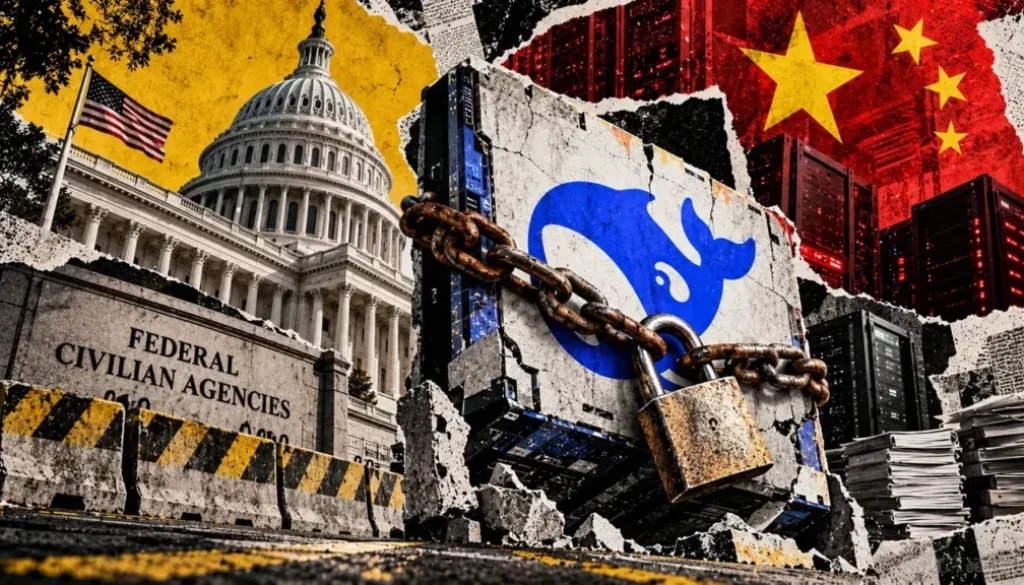
The US government has barred DeepSeek technology from federal civilian systems and extended the ban to third-party products built on its models, a compliance problem for any AI vendor selling to Washington. On the same day, DeepSeek open-sourced the inference stack behind its services, widening the gap between US procurement policy and global developer access.
- DHS directive orders civilian agencies to remove DeepSeek products and bars future purchases, with compliance starting immediately.
- DeepSeek open-sourced DeepInfer under Apache 2.0, supporting Nvidia SM100 and Huawei Ascend 950 chips.
- Contractors must check whether products using DeepSeek implementations can still serve government customers, replace components or seek exemptions.
- 60 days Window for agencies to request exceptions, against immediate compliance requirement
- 552B Parameters in DeepSeek-V4.1-Flash, though only a fraction activate per task
- July 24 Date Mullin signed the order, ahead of its October 20 publication
- 2018 Year of the supply chain law used, eight years before the order
The US Department of Homeland Security (DHS) ordered federal civilian agencies to strip DeepSeek technology from their information technology systems and stop buying it, CryptoSlate reported. DHS published the directive on Tuesday (October 20), the same day DeepSeek open-sourced the inference framework behind its large-scale AI services.
DHS extends the DeepSeek ban to third-party products built on its models
Homeland Security Secretary Markwayne Mullin originally signed the order on July 24 under the Federal Acquisition Supply Chain Security Act of 2018. Agencies were required to begin complying immediately, with a 60-day window to request exceptions.
The restrictions also cover software and services that other companies developed using DeepSeek implementations. That could affect American technology contractors that have incorporated its models into their products. DHS cited national security concerns about DeepSeek’s Chinese operations, including the possibility that government employees could enter sensitive information that might be transmitted to servers in China.
The department also warned that the technology could contain security vulnerabilities and that information collected through its services could provide intelligence on American government activities. The order follows earlier actions against DeepSeek by the Commerce Department, the US Navy and several state governments.
China condemned the decision, accusing Washington of politicizing technology and undermining commercial cooperation between the world’s two largest economies. The reporting does not include a response from DeepSeek to the directive.
DeepSeek releases DeepInfer and deepseek-recipe, widening its open-source push
DeepInfer is the inference framework that powers DeepSeek’s large-scale AI services, and the company had previously used it internally to operate its models. The release includes optimized computing kernels, distributed inference, speculative decoding and processing tools meant to raise throughput and cut the computing needed to generate responses.
DeepSeek also released deepseek-recipe, a set of software components that handle token encoding, prompt formatting and API request processing. The tools let independent developers reproduce key elements of the company’s API behavior when running its models. Company engineer Cui Tianyi
BlockWest is a news publication. Nothing here is investment advice. Read our disclaimer and editorial policy.