Zcash climbs above $1,000 as its spot ETF accumulates $400 million in assets
Zcash’s surge past $1,000 and the rapid accumulation of assets in Grayscale’s newly launched spot ETF signal renewed institutional interest in privacy-focused cryptocurrencies. The rally raises fundamental questions about whether the token can sustain gains against Bitcoin’s entrenched dominance or whether the move reflects temporary momentum in alternative assets.
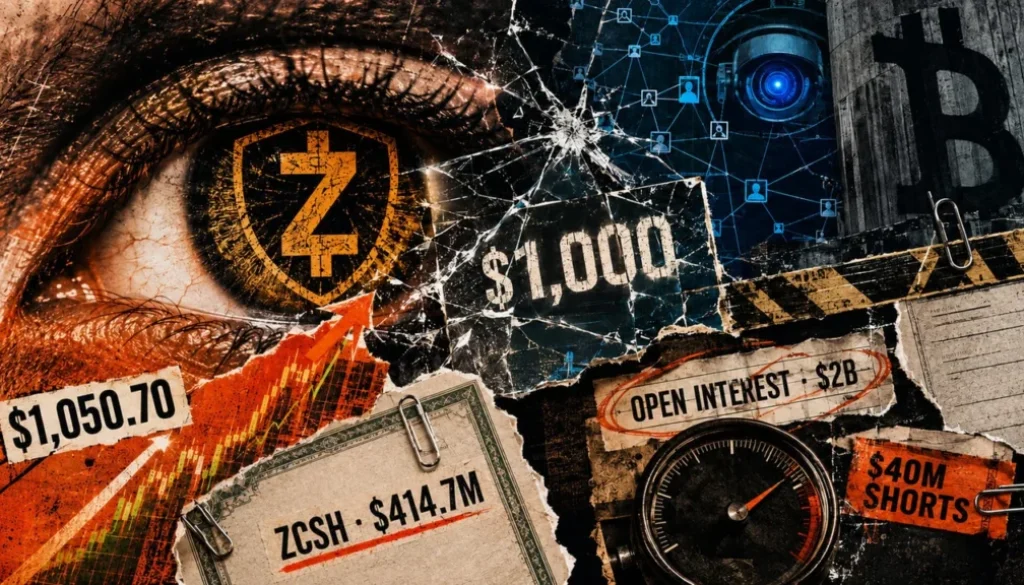
- Zcash reached $1,050.70 intraday on September 4, gaining roughly 20% in 24 hours and nearly 100% over the preceding month.
- Grayscale’s ZCSH spot ETF accumulated $414.7 million in assets by September 3, up from $304.6 million at its August 25 launch.
- ZEC short positions totaling approximately $40 million were liquidated in 24 hours, and futures open interest crossed $2 billion for the first time.
- $1,050.70 Zcash intraday high on September 4, marking entry to top 10 cryptocurrencies by market cap
- $414.7M ZCSH spot ETF assets as of September 3, less than two weeks after NYSE Arca launch
- 428,613 ZEC Token holdings in ZCSH ETF by September 3, up from 387,849 at launch
- $2B Zcash futures open interest, reaching all-time high for the first time ever
Zcash broke through the $1,000 threshold on September 4, a milestone that coincided with Grayscale’s ZCSH spot exchange-traded fund crossing $400 million in assets less than two weeks after its debut on NYSE Arca. The token’s intraday peak of $1,050.70 represented roughly 20% gains over a single day and nearly 100% appreciation over the previous month, substantially outpacing concurrent moves in Bitcoin, which surpassed $82,000, and Ethereum, which reclaimed $2,500. This resurgence pushed Zcash back into the top 10 cryptocurrencies by market capitalization for the first time since 2018, restoring visibility to an asset that had languished at the market’s periphery throughout much of the previous cycle.
Grayscale’s ETF accumulates $414.7 million in record time
The ZCSH spot ETF accumulated capital at a pace that exceeded ZEC’s price appreciation alone, indicating genuine new investor interest flowing through the regulated investment vehicle. The fund’s holdings in Zcash increased from 387,849 tokens at launch on August 25 to 428,613 by September 3, while outstanding shares climbed to 5.35 million during the same period. This combination of metrics suggests that inflows of new capital outpaced the token’s price gains, a pattern distinct from mere appreciation of existing holdings.
The ZCSH fund inherited initial positions from the Grayscale Zcash Trust, which had provided exposure to ZEC before spot ETF approval.
The speed of capital accumulation reflects broader market dynamics reshaping access to alternative cryptocurrencies. Spot ETF structures offer tax efficiency, simplified custody, and regulatory clarity that appeal to institutional investors who previously relied on trusts or direct token holdings. For privacy-focused assets like Zcash, which face heightened regulatory scrutiny in some jurisdictions, the legitimacy conferred by exchange listing on NYSE Arca may have signaled reduced compliance risk to a new class of institutional investors.
Leveraged Trading activity accelerates Zcash momentum
Derivative markets registered extraordinary activity as ZEC climbed toward and beyond $1,000. Approximately $40 million of Zcash short positions were liquidated over 24 hours, according to available data, while futures open interest crossed $2 billion for the first time in the asset’s history. 24-hour futures volume climbed above $6 billion for the first time since mid-August, demonstrating that institutional and sophisticated traders were participating actively in the advance.
A year prior, ZEC traded around $40, underscoring the magnitude of the gain.
The sharp liquidation of short positions amplified upward momentum in a dynamic known as a short squeeze, where leveraged bearish bets force forced buying as positions close at losses. This pattern indicates that derivative traders and market makers were unprepared for Zcash’s velocity, with stop-loss orders and margin calls creating cascading buying pressure. Such dynamics can create self-reinforcing momentum but also raise questions about whether the advance reflects genuine value reassessment or primarily mechanical liquidation flows.
Privacy and monetary properties form competing Investment thesis
Cryptographer Arjun Khemani cautioned against characterizing Zcash’s advance purely as a privacy-coin rally, arguing that the broader investment case centers on whether ZEC can develop into a form of sovereign money that competes with Bitcoin on fundamental monetary properties.
Privacy is just one property of Zcash
Arjun Khemani, Cryptographer
Zcash features a fixed supply of 21 million tokens and a Bitcoin-like emissions schedule, matching Bitcoin’s scarcity model. The network has been distributing coins for a decade and is pursuing quantum recoverability, substantially higher transaction throughput, and formal verification of its shielded pool against undetectable inflation vulnerabilities. These technical developments indicate that Zcash developers view the project as competing on multiple dimensions beyond privacy alone.
This multi-dimensional approach distinguishes Zcash from other privacy coins that emphasize anonymity as their primary differentiator. By emphasizing monetary properties alongside privacy, Zcash’s development roadmap positions the asset as an alternative to Bitcoin rather than simply a privacy-enhanced version of existing cryptocurrencies. The strategy reflects recognition that pure privacy advantages may not be sufficient to challenge Bitcoin’s market dominance absent complementary strengths in scarcity, technical sophistication, and network maturity.
Artificial intelligence reshapes the case for Privacy infrastructure
Grayscale frames Zcash’s privacy advantages within a broader context of evolving technological and regulatory concerns. Bitcoin transactions are permanently recorded on a public ledger, and once an address becomes linked to an offchain identity, its balances and transaction history can potentially be reconstructed with growing ease. Grayscale contends that artificial intelligence could make this process faster, cheaper, and more widely accessible through improved address labeling and blockchain activity analysis.
Zcash addresses privacy differently from Bitcoin, employing zero-knowledge cryptography in shielded transactions to conceal sending and receiving addresses and transaction amounts. This approach allows users to retain Bitcoin-like scarcity without making every transfer permanently visible on a public record. Grayscale argues that this distinction could become increasingly valuable as AI makes surveillance of transparent blockchains more sophisticated, positioning privacy as an enduring concern that intensifies as technology enables new forms of surveillance.
Regulatory hurdles and bitcoin’s structural advantages create headwinds
Zcash’s privacy architecture presents significant regulatory obstacles. Shielded transactions can complicate sanctions screening, anti-money laundering controls, and efforts to trace illicit funds, creating compliance concerns that have historically weighed more heavily on privacy-focused cryptocurrencies than on Bitcoin. These regulatory headwinds have limited institutional adoption and could constrain future growth if they intensify.
Bitcoin maintains structural advantages that extend beyond technology alone, including liquidity, infrastructure, brand recognition, and more than 15 years of network growth that reinforce its central position in the digital-currency market. Bitcoin currently accounts for approximately 93% of market capitalization within Grayscale’s Currencies Crypto Sector, a level of dominance that alternatives such as Litecoin have failed to seriously disrupt. The path dependencies embedded in Bitcoin’s dominance create obstacles that Zcash would need to overcome to capture meaningful market share.
The coming months will determine whether this surge represents a structural reallocation of capital toward privacy-focused cryptocurrencies or another speculative episode that eventually reverses, placing greater weight on whether privacy and technological differentiation can produce durable market-share gains once momentum from the current rally subsides.
BlockWest is a news publication. Nothing here is investment advice. Read our disclaimer and editorial policy.