
Metaplanet Chief Executive Relinquishes $220 Million in Stock Rights in Effort to Restore Investor Confidence
Metaplanet’s decision to forfeit more than $220 million in executive warrant value signals a potential shift in how Bitcoin treasury companies balance management incentives with shareholder dilution. The move reflects growing pressure from investors to align compensation with the quality of capital raises rather than their quantity alone.
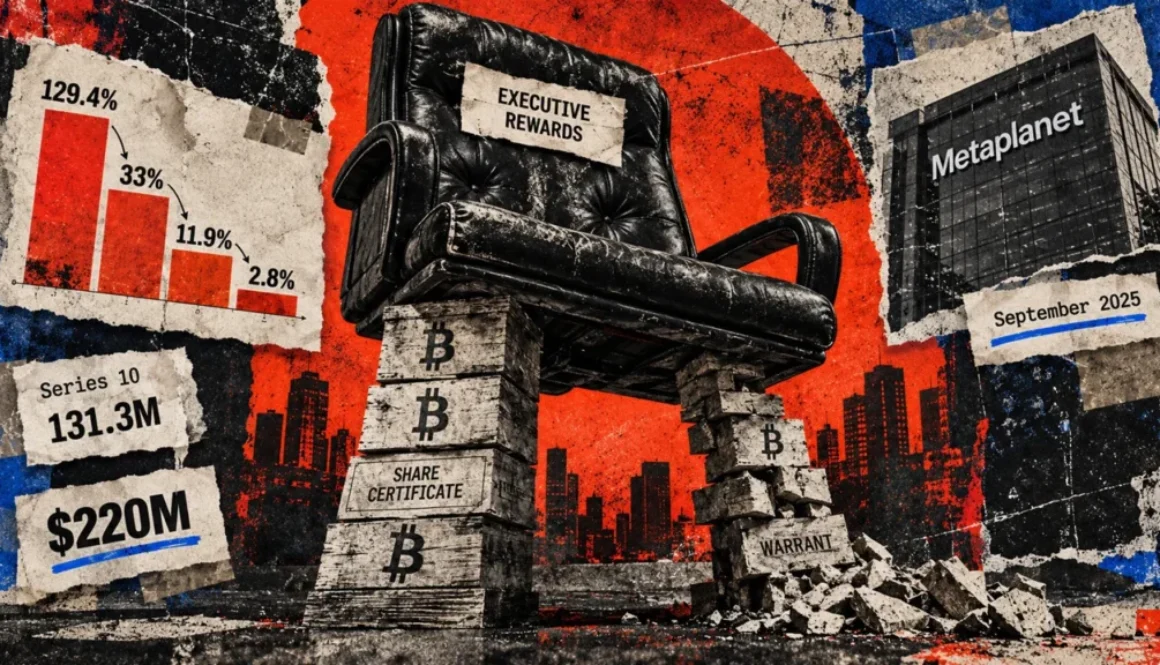
- Metaplanet eliminated 131.3 million potential shares, or 41.1% of Series 10 warrant pool, worth over $220 million.
- CEO Simon Gerovich forfeited approximately $123 million in compensation after the board reset conversion ratios and reference dates.
- The company redrew compensation triggers at its September 2025 financing, when capital raises became less accretive to Bitcoin per share.
- $220M Warrant value eliminated through Series 10 reset and share cancellation
- 8.8% Increase in Bitcoin per diluted share without new Bitcoin purchases
- 2.8% BTC Yield in Q1 2026, down from 129.4% in Q2 2025
- 43,000 BTC Metaplanet’s current Bitcoin holdings after compensation restructure
Metaplanet, the Tokyo-listed Bitcoin treasury company, announced on September 11 that it has reset its Series 10 stock acquisition rights to address a structural misalignment between executive compensation and shareholder value creation. The board’s decision eliminates more than $220 million in warrant value and reduces remaining unexercised shares by 55.5% to approximately 105.4 million. The company concluded that capital raises begun in September 2025 generated significantly weaker Bitcoin accretion per diluted share than earlier financings, making the existing executive compensation pool disproportionately valuable relative to the economic benefit delivered to existing investors.
The Accretion Problem That Triggered the Reset
Metaplanet’s board reviewed its equity financing history and identified a critical inflection point. Financings completed through mid-2025 occurred at substantial multiples to Bitcoin net asset value and produced meaningful increases in Bitcoin per fully diluted share. The company’s September 2025 international offering and subsequent capital raises, by contrast, occurred at more modest premiums to NAV and delivered far slower per-share Bitcoin accretion despite still adding to total holdings.
This deterioration in economics coincided with a dramatic slowdown in the company’s BTC Yield metric. The measure reached 129.4% in the second quarter of 2025 as Bitcoin holdings jumped to 13,350 BTC from 4,046 BTC, but fell to 33% in the following quarter, 11.9% in the fourth quarter of 2025, and 2.8% in the first quarter of 2026. CEO Simon Gerovich stated that September 2025 marked the point when capital raises became “less accretive,” and the Series 10 warrant structure began conferring disproportionate value on management relative to existing shareholders.
The deterioration reflects broader market dynamics affecting Bitcoin treasury companies. As Bitcoin’s price appreciation has moderated from its earlier pace and the company’s asset base has grown larger, each successive capital raise produces smaller incremental additions to per-share Bitcoin holdings. This mathematical reality creates a fundamental tension: warrant pools designed during periods of explosive accretion become outsized during periods of slower growth, even as the company continues to accumulate Bitcoin.
We will develop a new plan in consultation with a leading global compensation consultant to incentivize new hires. We will share details as the design progresses.
Simon Gerovich, CEO, Metaplanet
The Board’s Escalating Response to Investor Pressure
Metaplanet initially attempted to address the issue in August by eliminating the automatic adjustment mechanism that tied the Series 10 pool to the company’s diluted share count and fixing the pool at 319.5 million potential shares using the June 30, 2026 share count as reference.
The first measure proved insufficient. Investor criticism continued, prompting the board to go substantially further. The September announcement replaces the June 2026 reference date with September 1, 2025, resets the conversion ratio to 410 shares per Series 10 right from 696, and cancels 131.3 million potential shares outright. Matthew Sigel, head of digital assets research at VanEck, characterized the revision as a “meaningful concession” that better aligns management with shareholders. Sigel noted that the revision would see Gerovich “forfeit $123 million of controversial Series 10 comp.”
The board also abandoned a proposal to transfer as many as 90,000 Series 10 rights into a new employee incentive pool, choosing instead to cancel those rights as part of the overall 41% reduction. This decision signals that the board prioritized immediate shareholder relief over maintaining optionality for future hiring, suggesting confidence in its ability to attract talent through other means or through the new compensation program under development.
Rebuilding Compensation Without Recreating Dilution
The reset delivers an immediate benefit to existing shareholders: canceling 131.3 million potential shares raises Bitcoin per fully diluted share by approximately 8.8% without requiring Metaplanet to purchase additional Bitcoin. This mechanical accretion illustrates how compensation structures can meaningfully impact per-share metrics independent of operational performance.
The company now faces a more complex challenge: designing a compensation program that rewards management for growing Bitcoin holdings without recreating the dilution dynamics that necessitated this reset. Metaplanet said it will work with a leading global compensation consultant and external advisers to develop a new incentive program for employees and future hires. Remaining unvested Series 10 rights will become exercisable in three equal portions in 2029, 2030, and 2031, with shares remaining subject to the existing five-year lock-up, giving the board time to evaluate which performance metrics should drive future rewards.
The reset also reflects a broader conversation within the Bitcoin treasury company sector about optimal incentive design. Early-stage treasury companies often used aggressive warrant pools to attract experienced leaders willing to join speculative ventures with limited initial resources. As these companies mature and accumulate significant assets, the rationale for outsized equity pools diminishes, yet the earlier grants continue vesting according to their original schedules.
Implications for Future Compensation Frameworks
Metaplanet continues expanding internationally through its pending acquisition of a controlling stake in Nasdaq-listed Super League Enterprise and the establishment of a Hong Kong subsidiary, increasing pressure for a scalable compensation framework. The company’s next incentive plan will clarify whether the September reset represents a permanent shift toward quality-based metrics such as BTC Yield or Bitcoin per diluted share, or simply a reduction of an unusually large legacy award structure.
The episode also raises questions about how compensation committees at Bitcoin treasury companies should approach warrant pool sizing. Some market participants argue that linking warrant pools to metrics tied to shareholder value creation, such as Bitcoin per diluted share or BTC Yield, would better align interests than pools tied to diluted share counts or fixed share quantities that become misaligned as financing economics change.
For Metaplanet, the challenge ahead involves designing a program that incentivizes management to pursue accretive capital raises without introducing new sources of shareholder dilution. The company’s success in doing so may influence compensation practices across the emerging Bitcoin treasury company industry.