
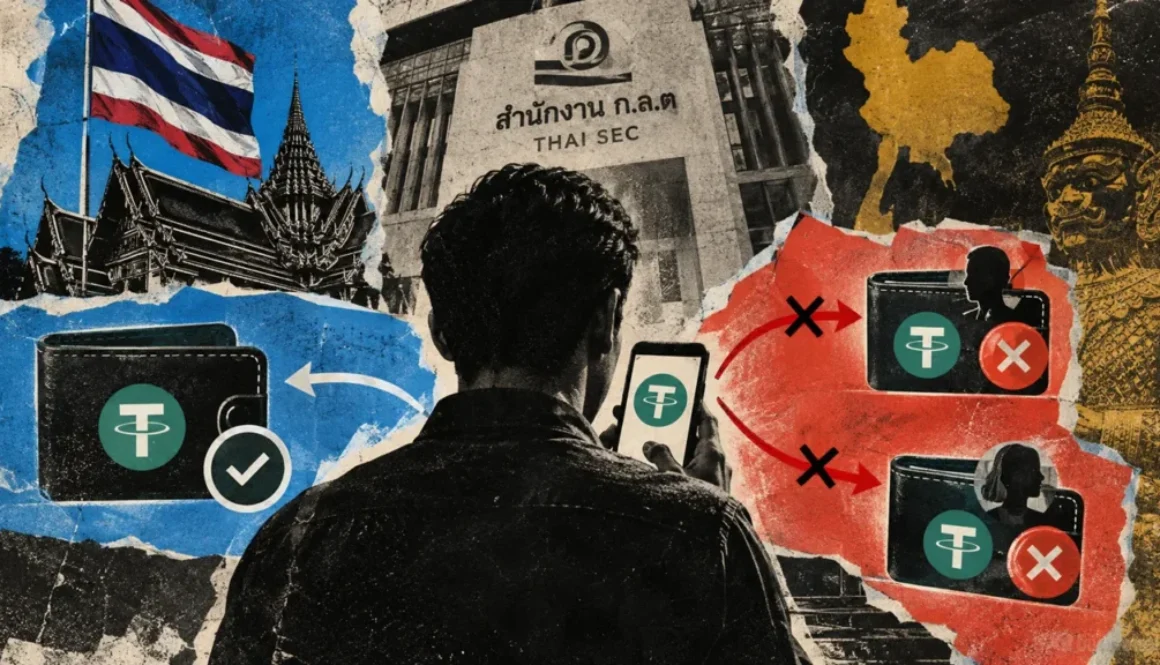
Thailand’s stablecoin proposal would prevent transfers between individual wallets
Thailand’s Securities and Exchange Commission has proposed strict controls on stablecoin transfers through licensed platforms that would effectively block customers from sending or receiving tokens to third parties. The measure, still in consultation phase, represents one of the world’s most restrictive approaches to stablecoin movement and signals regulatory concern over money laundering and illicit finance tied to rapid USDT growth.
- Stablecoin deposits and withdrawals through Thai SEC-supervised operators must originate from and go to accounts verified as belonging to the same customer.
- Daily transfer caps of 5 million baht per person per operator would apply, with limited exemptions for inter-operator transfers complying with the Travel Rule.
- Public consultation runs through September 25, 2026, with no effective date yet announced for the restrictions.
- 5M baht Maximum daily stablecoin transfer cap per person per operator under proposal
- Feb. 27, 2027 Effective date for Thailand’s finalized Travel Rule requiring operator disclosures
Thailand’s Securities and Exchange Commission approved consultation principles on September 3 outlining a same-owner requirement that would fundamentally restrict how customers can move stablecoins such as USDT through regulated digital asset operators. The proposal targets transfers conducted via supervised platforms rather than peer-to-peer transactions occurring entirely outside the regulated system. The SEC developed the measure in response to significant growth in stablecoin transaction volume and value, citing patterns associated with money laundering, cybercrime, and circumvention of international money transfer rules.
Stablecoins, which maintain value by pegging themselves to fiat currencies like the US dollar, have emerged as a critical infrastructure layer in the global cryptocurrency ecosystem. Thailand’s move reflects a broader global pattern in which regulators attempt to subject stablecoins to controls comparable to traditional payment systems. The Bangkok-based SEC’s approach is notably more restrictive than most existing frameworks, including those adopted by the European Union, Singapore, and the United States, where regulators have generally focused on licensing operators rather than blocking peer transactions entirely.
Same-Owner Requirement Blocks Third-Party Transfers
Under the proposal, a customer using a Thai SEC-supervised platform could not receive stablecoins from another person’s wallet or send tokens to another person’s account. Both inbound and outbound transfers would require verification that the originating or receiving account belongs to the customer themselves. The restriction applies solely to transfers processed through licensed operators and does not reach peer-to-peer transactions conducted outside the regulated ecosystem.
The prohibition is explicit: deposits from another person’s account or withdrawals to another person’s wallet would be barred.
This same-owner requirement mirrors anti-money-laundering controls applied to traditional banking, where transferring funds between unrelated parties typically requires enhanced verification and creates a documented trail. However, the application to stablecoins is unusual because it prevents legitimate commercial and personal transactions that occur routinely in conventional finance. A customer could not pay a merchant for goods in USDT or send money to a family member without using off-chain payment rails or unregulated platforms.
Daily Caps and Exemptions Create Implementation Gaps
Stablecoin transfers would be capped at 5 million baht per day, per person, per operator, and must align with a customer’s stated income source and financial position. The September 11 consultation identifies exemptions to this cap for transfers between customer accounts through SEC-supervised operators when both firms comply with the Travel Rule, certain Bank of Thailand-authorized operators, and stablecoin-to-baht market makers engaged in specified business transfers.
The SEC has not clarified whether these cap waivers would interact with the same-owner test, leaving unclear whether exempt transfers could involve third-party accounts. The public consultation period, which runs through September 25, 2026, may add implementation detail, but the SEC did not announce an effective date for the restrictions.
Industry observers have raised concerns that the daily cap of 5 million baht (approximately USD 140,000) may prove insufficient for legitimate business use cases, including corporate treasury operations, merchant settlement services, and larger institutional transfers. The exemptions for inter-operator transfers and market makers hint at recognition of these concerns, but the scope of permitted exempted activity remains vague enough to create compliance uncertainty for operators planning systems to implement the rule.
Travel Rule Implementation Separate From Stablecoin Ownership Test
The stablecoin proposal operates independently from Thailand’s finalized Travel Rule, which requires digital asset operators to collect information about transfer parties, verify counterparty identity, and confirm ownership or control of self-hosted wallets. The Travel Rule takes effect on February 27, 2027, and represents an existing compliance obligation distinct from the new same-owner ownership gate.
Thailand’s Travel Rule framework aligns with international standards developed by the Financial Action Task Force, a Paris-based intergovernmental organization that sets anti-money-laundering policy. The stablecoin same-owner requirement goes substantially further than Travel Rule compliance would require, layering an additional ownership verification layer on top of existing transaction reporting obligations.
The SEC opened public consultation on September 11 with comments due by September 25, 2026, but has not provided a target date for final rules or implementation. Industry participants and international observers will track whether the SEC revises the proposal during consultation or proceeds with restrictions that would make Thailand among the world’s most tightly controlled stablecoin markets. The proposal could reshape stablecoin adoption in Southeast Asia and influence regulatory approaches in neighboring jurisdictions considering similar frameworks.