
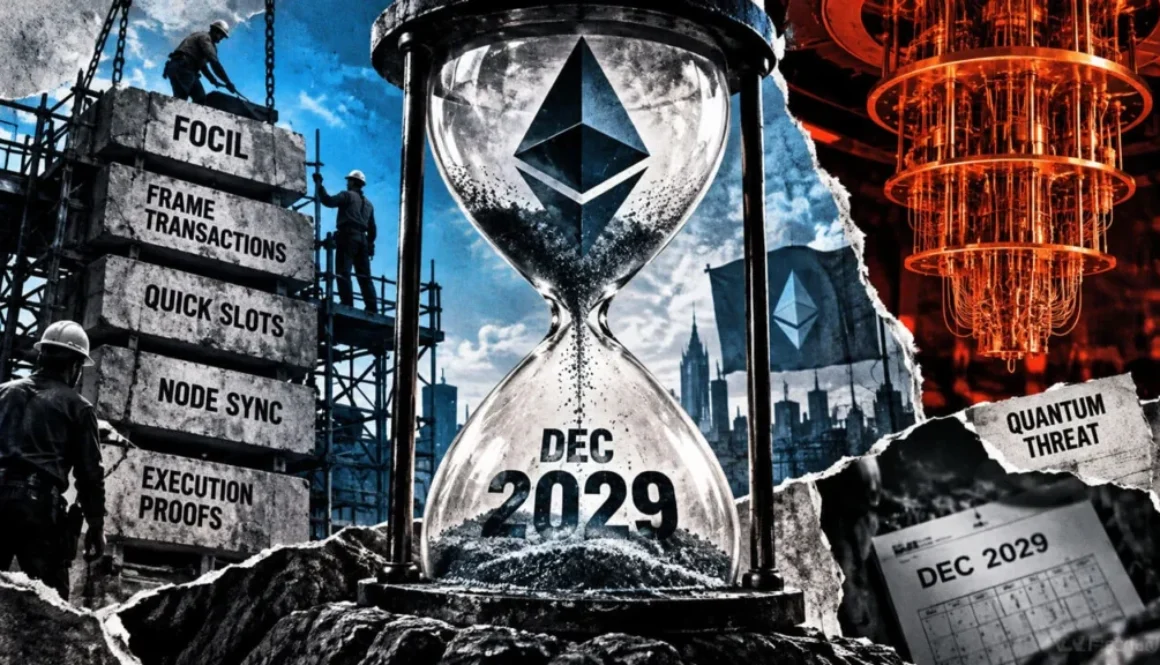
Ethereum’s approaching 2029 quantum threat is beginning to influence upcoming development priorities
Ethereum’s December 2029 quantum-resistance deadline is reshaping which features can be added to upcoming network upgrades, forcing developers to prioritize cryptographic hardening over optional improvements. The constraint is already visible in the Hegotá upgrade, where non-quantum work faces sharply reduced capacity unless it directly supports the post-quantum roadmap.
- Ethereum Foundation set December 2029 as a non-negotiable deadline for quantum-resistant execution, consensus, and data layers on September 7.
- Hegotá upgrade will prioritize FOCIL and Frame Transactions, with Foundation stating appetite for additional consensus work is “close to zero” outside post-quantum priorities.
- Developers are considering accelerating post-quantum attestations from L* to K* while delaying execution proofs, reshaping the entire fork sequence to meet the 2029 target.
- Dec 2029 Target date for full quantum-resistant Ethereum aligned with tech giants’ cryptography migration schedules.
- 7.2 months Required average interval between forks to reach post-quantum readiness from Glamsterdam in December 2026.
- 62 Proposals evaluated for Hegotá and divided into tiers based on quantum-readiness priority and scheduling flexibility.
Ethereum’s network upgrade timeline is tightening under pressure from a single, immovable deadline. On September 7, the Ethereum Foundation’s Protocol cluster announced that December 2029 will remain the target for making Ethereum’s base layer resistant to quantum computing attacks, signaling this date will hold firm at least until an expert review in January. This constraint is already forcing trade-offs in what the network can build next, as optional features compete directly against the engineering effort required to harden Ethereum’s execution, consensus, and data infrastructure before quantum computers could theoretically break current cryptography.
The quantum threat, while still years away, reflects legitimate long-term security concerns shared across the technology industry. Major technology companies and cryptographic standards bodies have begun migrating to post-quantum algorithms, recognizing that adversaries could begin harvesting encrypted data today for decryption once sufficiently powerful quantum computers emerge. Ethereum’s 2029 deadline aligns with these broader industry timelines and reflects the protocol’s commitment to remaining secure across decades of use.
Hegotá Upgrade Narrows Focus to Quantum-Critical Features
The first visible effects appear in Hegotá, the upgrade being designed after Glamsterdam. Two features have received protected status: FOCIL, a system to strengthen transaction-inclusion guarantees, and Frame Transactions, which introduces a new account model and provides a path toward post-quantum cryptography. The Foundation declared its willingness to add other consensus-layer work beyond FOCIL is “close to zero” unless that work directly advances the post-quantum roadmap.
This prioritization reflects the mathematical reality of Ethereum’s fork schedule. If Glamsterdam reaches mainnet in December 2026 as planned, the current roadmap positions full post-quantum readiness at the L* upgrade, five forks away. Reaching that milestone by December 2029 requires upgrades to land every 7.2 months on average, a pace the Foundation characterized as aggressive and vulnerable to delays from any missed fork.
Post-Quantum Attestations May Shift Forward, Execution Proofs Delayed
Developers are now weighing a more dramatic restructuring of the roadmap. The leading proposal would move post-quantum attestations forward from the L* upgrade to K*, while pushing mandatory execution proofs backward from K* to L*. This swap has not been approved, yet its consideration alone demonstrates how a threat still years away is already determining which upgrades can proceed today.
The Foundation has built a fallback into the schedule. A minimum viable post-quantum milestone, or MV-PQ, is planned for J*. That would include a post-quantum consensus heartbeat, leanDA sampling, and leanSPHINCS transactions, with implementation of a public-key registry one fork earlier. An annual fork cadence could still reach J* by December 2029, though with reduced guarantees and temporary protections rather than full quantum resistance.
The middle path of moving attestations to K* would enable full readiness at roughly nine-month intervals while deferring execution proofs, potentially keeping both quantum security and execution infrastructure on track without demanding an unsustainable fork velocity.
Features Like Quick Slots Face Intense Competition for Engineering Capacity
The Protocol cluster evaluated 62 proposals for Hegotá and sorted them into tiers based on quantum priorities and scheduling flexibility. S-tier proposals define the fork itself and remain protected even if the schedule slips. A-tier items are expected to ship but can be cut before headliners. B-tier features must wait until higher-priority work is stable on development networks, then compete individually for whatever engineering capacity remains.
Quick Slots, which would shorten Ethereum’s slot time, ranks in B tier despite research support. Developers are requiring a complete specification, full prototype, analysis of downstream effects, and confirmation that shorter slots will not complicate the decoupled-consensus design planned for later forks. Engineering teams warned that changing slot timing affects assumptions throughout the protocol and ecosystem. Independent consensus and execution-layer syncing faces similar requirements; while it could roughly halve some synchronization bandwidth by avoiding duplicate payload downloads, developers are still evaluating simpler alternatives and seeking a clear delivery owner.
Neither feature has been formally delayed, but their inclusion increasingly hinges on clearing those requirements without consuming capacity needed for post-quantum work.
Ethereum Preserves Flexibility on Post-Quantum Cryptography Choice
Not every proposal carrying a post-quantum label automatically advances to the front of the queue. Hash-Chain RANDAO remains B-tier because developers fear hardening one part of consensus before the broader quantum-resistant architecture is settled could force rework. A proposal to add ML-DSA verification precompiles ranks even lower. The Foundation considers committing to a specific post-quantum signature scheme at this stage premature, particularly while cryptographic standards and Ethereum’s longer-term architecture continue to evolve.
Frame Transactions sidesteps some of that rigidity. The new transaction model would make account validation programmable, giving Ethereum what developers call cryptographic agility. Accounts could adopt new signature schemes without requiring a separate hard fork each time the network needs to support different cryptography. That utility before the final cryptographic toolset is selected explains why Frame Transactions remains a protected headliner.
Consensus machinery cannot be swapped account by account, requiring coordinated protocol changes network-wide, which is why consensus upgrades face tighter scheduling than execution-layer protections.
Related proposals Keyed Nonces and Recent Roots received A-tier grades. Keyed Nonces would allow users to share a sender while maintaining separate transaction sequences, while Recent Roots would let private transactions reference recent onchain state compatible with FOCIL. Optional Execution Proofs also remains A-tier, enabling work on stateless execution and zkVM infrastructure to continue even if the mandatory execution proofs deadline shifts.
Ethereum plans to overlap much of the remaining work. Hegotá implementation would proceed simultaneously while specifications for I* mature and researchers prepare components for later upgrades, creating intense simultaneous demand for cryptographers, client developers, security reviewers, and testing capacity across multiple workstreams. This parallel approach maximizes progress toward quantum readiness while minimizing idle time between upgrades.
The next critical juncture comes when developers decide whether to actually move post-quantum attestations from L* to K* and mandatory execution proofs in the opposite direction. If approved, teams building toward mandatory execution proofs face another fork delay while quantum-resistant consensus accelerates. If rejected, developers must sustain a faster upgrade cadence or approach December 2029 with minimum viable protections in place while full economic finality remains incomplete.